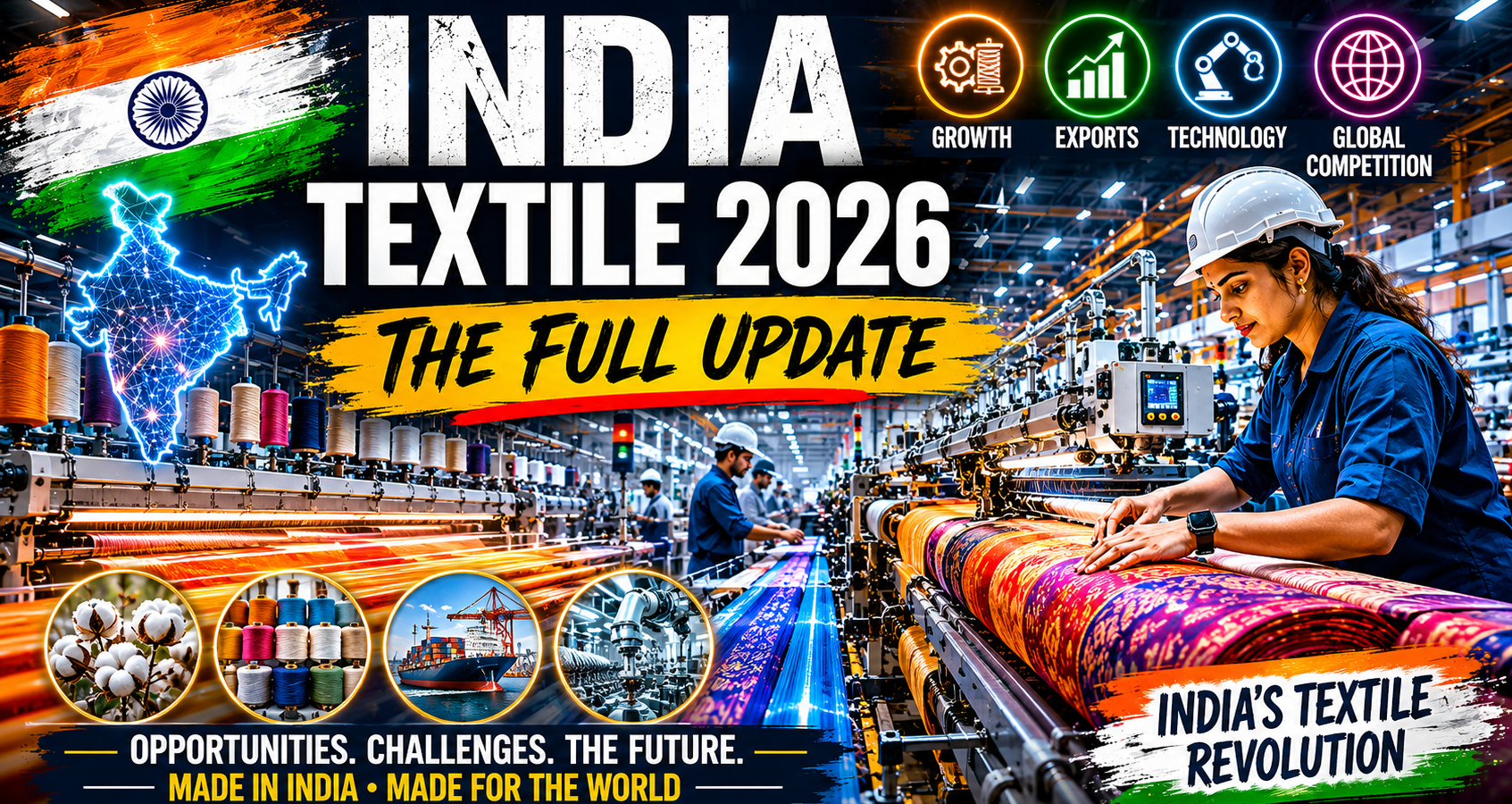
India’s textile industry — the backbone of the country’s manufacturing economy, the second-largest employer after agriculture, and a sector woven into the lives of over 45 million workers — has entered 2026 with remarkable momentum. After a turbulent 2025 defined by US tariff shocks, supply-chain disruptions, and global demand uncertainty, the sector is now navigating a decisive recovery: a landmark US trade deal, an expanded PLI scheme, aggressive export diversification, and a technology-driven sustainability transition are all reshaping the industry simultaneously.
From the looms of Surat and the handloom clusters of Varanasi to the cutting-edge technical textile factories of Coimbatore and the denim mills of Ahmedabad, India’s textile story in 2026 is one of resilience, reinvention, and real opportunity. Here is the complete latest news breakdown — everything you need to know right now.
The US–India Tariff Breakthrough: What It Means for Your Business
The single biggest development for India’s textile exporters in 2026 arrived in February. On February 2, 2026, the United States and India announced a landmark trade agreement that will reduce US tariffs on Indian imports to 18% — a dramatic improvement from the punitive levels that had reached up to 50% in mid-2025.
The context of this deal cannot be overstated. Through the course of 2025, Indian textiles had faced a devastating tariff escalation. US tariffs of up to 50 per cent disrupted India’s textile exports, triggering order cancellations, factory shutdowns, and job losses across key textile hubs. The pressure was especially acute because the US is India’s single largest textile export destination. During 2024, India exported textile and apparel products worth $10.5 billion to the US, accounting for about 28.5 per cent of India’s total textile and apparel exports to the world.
The 18% tariff rate agreed in February 2026 is not perfect — Indian industry had pushed for lower rates — but it represents a significant competitive reset. India’s reciprocal tariff remained comparatively lower than tariffs faced by rivals like China (34%), Bangladesh (37%), and Vietnam (46%) even at the peak of the tariff dispute, and the new deal strengthens India’s relative position further.
Key Development
The India–US trade agreement reducing tariffs on Indian textile imports to 18% (from a peak of 50%) is expected to restore buyer confidence and help reverse the order cancellation trend that hit Indian mills hard through mid-2025. Experts expect the full recovery effect to be visible in H2 FY2026–27 export numbers.
PLI Scheme for Textiles: 91 Companies In, Deadline Extended Again
The Production Linked Incentive (PLI) Scheme for textiles — one of the government’s flagship manufacturing initiatives — has accelerated significantly in the past 12 months. As of September 9, 2025, a total of 91 companies had been selected under the PLI scheme for textiles, with approved projects involving investments amounting to Rs 7,731 crore (US$858 million), reported exports of Rs 733 crore, and a combined turnover of Rs 7,290 crore.
The Ministry of Textiles extended the deadline for submission of fresh applications under the PLI Scheme until 31st March 2026, noting that the extension follows a strong response since the application portal was reopened in August 2025, with textile companies submitting proposals across priority segments such as man-made fibre (MMF) apparel, MMF fabrics, and technical textiles.
The scheme has been meaningfully revised to attract more participants. Key amendments include expanded product coverage with 8 new HSN codes for MMF apparel and 9 new HSN codes for MMF fabrics, greater flexibility in business structure allowing project units within existing companies (eliminating the earlier requirement to create new entities), and a reduced investment threshold.
The scale of committed investment is substantial. 74 companies received approval under the textile PLI Scheme with committed investments of INR 287.11 billion (US$3.23 billion) as of October 2025. These investments are expected to generate an estimated turnover of INR 2.16 trillion (US$24.3 billion), create employment for over 259,000 people, and boost India’s manufacturing capacity in the MMF and technical textiles value chains.
Companies participating in the PLI scheme reported investments of Rs 944.48 crore, turnover of Rs 4,473 crore, and exports worth Rs 363.55 crore during the first three quarters of FY 2025–26.
For MSME Owners & Investors
The PLI scheme application window at pli.texmin.gov.in has been extended with simplified entry rules — reduced investment thresholds and the ability to apply as an existing entity rather than forming a new company. If you’re in MMF apparel, MMF fabrics, or technical textiles, this is the most important scheme to engage with right now.
Export Diversification: India Breaks Into 111 Markets
One of the most strategically significant stories of FY 2025–26 is India’s aggressive market diversification in response to US tariff pressure. The textile and apparel sector demonstrated remarkable resilience in the first half of FY 2025–26 despite global headwinds and tariff-related challenges. Some of the large export markets that clocked impressive growth rates were the UAE (14.5%), UK (1.5%), Japan (19.0%), Germany (2.9%), Spain (9.0%), and France (9.2%).
Markets outside the US contributed $8,489.08 million during April–September 2025, compared to $7,718.55 million in the previous year — reflecting a 10% growth and an absolute increase of $770.3 million. The key sectors driving this growth included ready-made garments of all textiles (3.42% growth) and jute (5.56% growth).
Newer, high-growth destinations also emerged. Other markets that recorded higher growth rates were Egypt (27%), Saudi Arabia (12.5%), and Hong Kong (69%). This geographic spread — covering 111 export markets — is the most diversified Indian textile export basket in the country’s history.
Meanwhile, India’s export performance in calendar year 2025 was stable at $37.54 billion, showing resilience through diversification into emerging markets and growth in segments like handicrafts and ready-made garments.
Technical Textiles: India’s Rs 22,000 Crore Opportunity
If there is one segment that represents the future of Indian textiles, it is technical textiles — and the numbers in 2026 are compelling. Bharat Tex 2025, India’s flagship textile event, saw participation from 250 technical textile firms and 370 foreign buyers, highlighting India’s advancements in man-made fiber textiles and the growing $22 billion technical textile sector. With 5,000 exhibitors from 120+ countries, the event showcased innovations across the textile value chain, including fiber, yarn, garments, and home textiles.
Technical textiles are emerging as a significant growth area, with India’s market projected to reach $45 billion by 2026. Government initiatives including the PLI scheme and the PM MITRA parks are actively supporting MMF and technical textiles, aiming to enhance manufacturing competitiveness.
Technical textiles span a vast range of applications — from geotextiles used in road construction and flood management to medical textiles (bandages, surgical gowns, implantable fabrics), agrotextiles for crop protection, defence textiles, and smart fabrics with embedded sensors. India’s ambition is to capture a significant share of the global technical textile market, estimated at over $300 billion, and the government’s PLI scheme specifically targets this high-value segment.
Industry Quote“India’s textile industry is expected to grow to $350 billion by 2030, adding 3.5 crore jobs. The PLI scheme for textiles will enable the apparel industry to boost production and promote its branding.” — Union Textile Minister Giriraj Singh, Bharat Tex 2025 Curtain Raiser
The Sustainability Revolution in Indian Textiles
Organic Cotton and Recycled Fibres
Sustainability is becoming a major focus in India’s textile industry, driven by rising consumer awareness, regulatory mandates, and global demand for eco-friendly products. Manufacturers are increasingly investing in organic cotton, recycled fibers, and water-efficient dyeing technologies.
India is the world’s largest producer of cotton — and cotton production has emerged as a key vulnerability in the supply chain. Domestic cotton production has fallen from 386 lakh bales in 2014–15 to 294.25 lakh bales in 2024–25, and cotton imports have nearly doubled in the same period. The government responded by extending duty-free cotton imports until 31 December 2025 as an immediate relief measure — but the longer-term answer lies in cotton technology upgrades and productivity enhancement programmes currently being rolled out through state governments and the Cotton Corporation of India.
The Man-Made Fibre Shift
The global shift towards man-made fibers continues, with synthetic fibers accounting for nearly 75% of global fiber production and dominating yarn and fabric trade. For India, which has historically been known for cotton expertise, the push into MMF represents both a major challenge and a strategic necessity. The PLI scheme’s emphasis on MMF apparel and fabrics is directly designed to close this gap — and the industry is responding.
Eri Silk and Heritage Integration
The Indian Ministry of Textiles is exploring integrating eri silk with Rajasthan’s Kota doria — a heritage handloom fabric — as part of a broader strategy to create premium, export-worthy luxury textile products that command higher margins. This initiative, connecting the silk traditions of the Northeast with the centuries-old weaving heritage of Rajasthan, represents the kind of creative value addition that distinguishes Indian textiles in global luxury markets.
Home Textiles: A Booming Domestic Opportunity
Away from the export headlines, India’s domestic textile market is quietly building extraordinary momentum. India’s home textile market is projected to grow at a CAGR of 7.08% during 2026–2031, reaching $16.76 billion by 2031 from $11.18 billion in 2025. This growth is driven by rising disposable incomes, urbanisation, premiumisation of home decor spending, and the e-commerce revolution that has brought branded home textiles within reach of consumers across Tier 2 and Tier 3 cities.
For domestic manufacturers, the home textiles opportunity is significant precisely because it is less exposed to the currency and tariff volatility that affects export-dependent businesses. Brands that have built strong domestic distribution — through both offline retail and platforms like Myntra, Flipkart, and Amazon India — are reporting double-digit growth even in quarters when the export picture is complicated.
Retail & Domestic Market Watch
The Myntra–Alia Bhatt brand ambassador partnership (announced Q1 2026) signals the platformisation of fashion retail — a major downstream demand driver for India’s textile manufacturers. E-commerce now accounts for 18–22% of apparel sales in metro India, with rapid penetration into Tier 2 markets through quick commerce and social commerce channels.
Challenges That Remain: Honest Assessment for 2026
MSME Vulnerability
Exports to the US are set to fall in 2026, squeezing margins and MSMEs. Small and medium enterprises — which make up the majority of India’s 15 lakh+ textile units — lack the capital buffer and market diversification capability of large players. Government support schemes for MSME textiles, including credit guarantee schemes and cluster development programmes, are critical but often under-utilised due to awareness gaps and administrative complexity.
Supply Chain Fragmentation
Much of the textile value chain remains unorganised, limiting smaller units’ ability to meet global quality and sustainability requirements. The PM MITRA (Mega Integrated Textile Region and Apparel) parks programme — designed to create integrated textile clusters where the full value chain from fibre to fashion can co-exist — is directly addressing this structural weakness, but the parks take years to develop and deliver results.
Cotton Productivity
India’s cotton yields remain among the lowest in the world despite being the largest producer by volume. Improving seed technology, irrigation efficiency, and pest management — particularly in Maharashtra, Gujarat, and Telangana — is a multi-year mission requiring coordinated action between the Ministry of Textiles, the Ministry of Agriculture, and state governments.
The Road to $350 Billion by 2030: Is It Realistic?
Union Textile Minister Giriraj Singh has said that India’s textile industry is expected to grow to $350 billion by 2030, adding 3.5 crore jobs in the country. The domestic textile and apparel market is forecast to reach $225 billion by 2025, growing at 10–12% annually, with exports expected to rise sharply in parallel.
Achieving the $350 billion target requires India to simultaneously: scale up MMF production to match global demand patterns, expand technical textile capacity to capture high-value segments, complete and operationalise PM MITRA parks, maintain export competitiveness through trade diplomacy (including the India–UK CETA free trade agreement, which is expected to provide duty-free access for Indian textiles to the UK market), accelerate sustainability certification at scale, and solve the cotton productivity problem. That’s a formidable multi-front challenge — but the direction of travel in 2026 is clearly positive.
Final Thoughts
India’s textile industry in 2026 is a sector in genuine transition — navigating short-term headwinds with strategic long-term intent. The US tariff resolution removes the single biggest cloud hanging over the sector. The PLI scheme is converting policy ambition into factory-floor reality. Export diversification across 111 markets has reduced structural vulnerability. And the pivot to technical textiles, MMF, and sustainability-certified products is laying the foundation for the premium, high-value industry that can realistically reach $350 billion by 2030.
The challenges are real — MSME fragility, cotton productivity, the unorganised sector’s compliance gap, global competition from Bangladesh and Vietnam. But the direction of policy, investment, and industry commitment is unmistakably forward. For every stakeholder in India’s textile value chain — from the cotton farmer in Vidarbha to the garment exporter in Tiruppur to the technical textile innovator in Coimbatore — 2026 is the year to act, invest, and scale.
Internal Linking Suggestions
- PLI Scheme for Textiles 2026: How to Apply — Complete Guide
- Top 10 Textile Cities in India: Surat, Tiruppur, Ludhiana and Beyond
- India vs Bangladesh vs Vietnam: Who Will Win the Global Textile Race?
- Sustainable Fashion India: How Eco-Textiles Are Reshaping the Industry
- PM MITRA Parks: Everything You Need to Know About India’s Textile Clusters
LK
Lalit Kumar
Senior Industry & Business News Writer · Latest Viral News
Lalit Kumar covers Indian industry, trade policy, and manufacturing sector news for Latest Viral News. With a background in business journalism and over 7 years tracking India’s textile, MSME, and export sectors, he brings on-the-ground knowledge of how policy and global trade dynamics play out for manufacturers, workers, and investors. Follow his reporting at latestviral.news
Frequently Asked Questions
What is the current US tariff rate on Indian textile exports in 2026?
The US–India trade agreement announced on February 2, 2026 reduced US tariffs on Indian textile imports to 18%, down sharply from a peak of 50% during 2025’s tariff escalation. The US is India’s largest textile export destination, having taken $10.5 billion worth of Indian textile and apparel in 2024 — about 28.5% of India’s total exports.
How many companies have joined the textile PLI scheme?
As of September 9, 2025, 91 companies had been selected under the PLI Scheme for textiles, with approved projects worth ₹7,731 crore in investment. By October 2025, 74 companies had committed investments of ₹287.11 billion, expected to generate ₹2.16 trillion in turnover and create jobs for over 259,000 people.
How diversified are India’s textile export markets now?
India’s textile and apparel exports now reach 111 markets, the most diversified basket in the country’s history. Markets outside the US grew 10% to $8,489.08 million in April–September 2025, with Hong Kong (+69%), Egypt (+27%), Saudi Arabia (+12.5%), and Japan (+19.0%) among the fastest-growing destinations.
How big is India’s technical textile sector?
India’s technical textile sector is currently valued at around $22 billion and is projected to reach $45 billion by 2026. Bharat Tex 2025 drew 250 technical textile firms and 370 foreign buyers among its 5,000 exhibitors from 120+ countries, reflecting government support through the PLI scheme and PM MITRA parks.
Why has India’s cotton production become a concern?
Domestic cotton production has fallen from 386 lakh bales in 2014–15 to 294.25 lakh bales in 2024–25, even though India remains the world’s largest cotton producer by volume, and cotton imports have nearly doubled over the same period. The government responded by extending duty-free cotton imports until 31 December 2025 as an immediate relief measure.
Is India’s $350 billion textile industry target by 2030 realistic?
Union Textile Minister Giriraj Singh has stated the industry is expected to grow to $350 billion by 2030, adding 3.5 crore jobs. Reaching that target requires simultaneously scaling MMF production, expanding technical textiles, completing PM MITRA parks, and solving cotton productivity — a formidable multi-front challenge, though the direction of travel in 2026 is described as clearly positive.
Leave a Reply