Working Capital Finance
AM
Arjun Mehta
SME Banking & Textile Finance Advisor
|June 28, 2026
|10 min read
|Last updated: June 2026
Textile manufacturing is a cash-hungry business. You buy yarn today, weave it for 3 weeks, sell the fabric, and wait 60–90 days to get paid. Meanwhile, wages, electricity, and raw material bills don’t wait. This cash flow gap is the single biggest operational challenge for textile manufacturers in India — and working capital loans are built specifically to bridge it. This guide covers everything: what working capital finance is, which types suit textile businesses, the best banks in 2026, interest rates, and how to get approved.
What is a working capital loan and why do textile businesses need it?
A working capital loan is short-term financing that covers your day-to-day business expenses — not long-term assets like machinery. For textile manufacturers, working capital is needed for:
- ✓Buying raw materials — yarn, grey fabric, dyes, chemicals, packaging
- ✓Paying wages and contract labour before receiving payment from buyers
- ✓Stocking inventory ahead of peak seasons — Diwali, wedding season, export cycles
- ✓Bridging payment delays from domestic buyers and export clients
- ✓Managing cash flow between production and delivery
The textile cycle is long. A spinning mill buys cotton, converts it to yarn, sells to a weaver on 45-day credit. The weaver sends grey fabric to a processor, who supplies finished fabric to a garment maker on 60-day credit. Every step has a cash gap. Without working capital finance, even a profitable business can run dry.
Key point: Working capital loans are revolving in nature — you draw funds when needed, repay when payments come in, and draw again. Unlike term loans, working capital facilities give you flexibility to manage cash flow dynamically.
Types of working capital loans for textile manufacturers
🏦
Cash Credit (CC)
Most common for textile businesses. A revolving limit against stock and debtors. Draw what you need, repay when buyers pay. Interest only on the amount used.
📋
Overdraft (OD)
Against fixed deposits or property. Flexible access to funds. Lower interest rate than CC. Good for businesses with surplus deposits or owned assets.
📦
Invoice / Bill Discounting
Bank advances cash against your unpaid invoices. Ideal for manufacturers supplying large buyers with 60–90 day payment terms. Fast liquidity without extra collateral.
🚢
Packing Credit (Export)
Pre-shipment finance for textile exporters. Covers the cost of producing goods for export orders before receiving payment from foreign buyers. Rates as low as 7%.
Which type suits you? Most textile manufacturers use Cash Credit as the primary facility. Exporters pair it with Packing Credit for export orders. Large units supplying retail chains benefit most from Invoice Discounting.
How is your working capital limit calculated?
Banks calculate your working capital requirement based on your business financials using the Tandon Committee Method. Here’s how each factor is assessed:
| Factor |
How banks assess it |
| Raw material holding |
Average days of raw material stock × daily purchase cost |
| WIP holding |
Production cycle length × daily cost of production |
| Finished goods holding |
Days of finished stock held × cost of goods |
| Debtors (receivables) |
Average debtor days × daily sales value |
| Less: creditors |
Supplier credit you receive reduces the net requirement |
| Bank finances |
75% of net working capital requirement (you fund 25% yourself) |
For a textile manufacturer with ₹5 crore annual turnover, this typically results in a CC limit of ₹60–80 lakh. For a ₹20 crore garment exporter, limits of ₹2–3 crore are common. The limit grows as your turnover and order book grows.
Pro tip: Keep your debtors register updated and share it at renewal time. Banks often increase CC limits voluntarily when they see debtors growing — you don’t always have to ask. Also ensure stock statements are filed on time every month.
Interest rates on working capital loans in 2026
| Lender |
Working capital rate |
Best for |
| SBI |
9.25% – 11.5% p.a. |
Large textile units, cluster borrowers |
| Bank of Baroda |
9.5% – 12% p.a. |
Gujarat & Rajasthan textile clusters |
| Canara Bank |
9.4% – 11.8% p.a. |
Weavers, processing units |
| Union Bank of India |
9.6% – 12% p.a. |
Tirupur, Ludhiana clusters |
| HDFC Bank |
11% – 14% p.a. |
Fast processing, digital-first units |
| ICICI Bank |
11.5% – 15% p.a. |
Exporters with strong GST turnover |
| NBFCs |
16% – 24% p.a. |
New businesses, lower CIBIL score |
| Packing Credit (Export) |
7% – 9% p.a. |
Textile exporters only |
Rates as of June 2026. PSU bank rates are linked to RLLR. With RBI rate cuts in 2025–26, CC rates for strong borrowers have moderated. A CIBIL 750+ borrower with clean GST filing should target 9.5%–10.5% at a PSU bank.
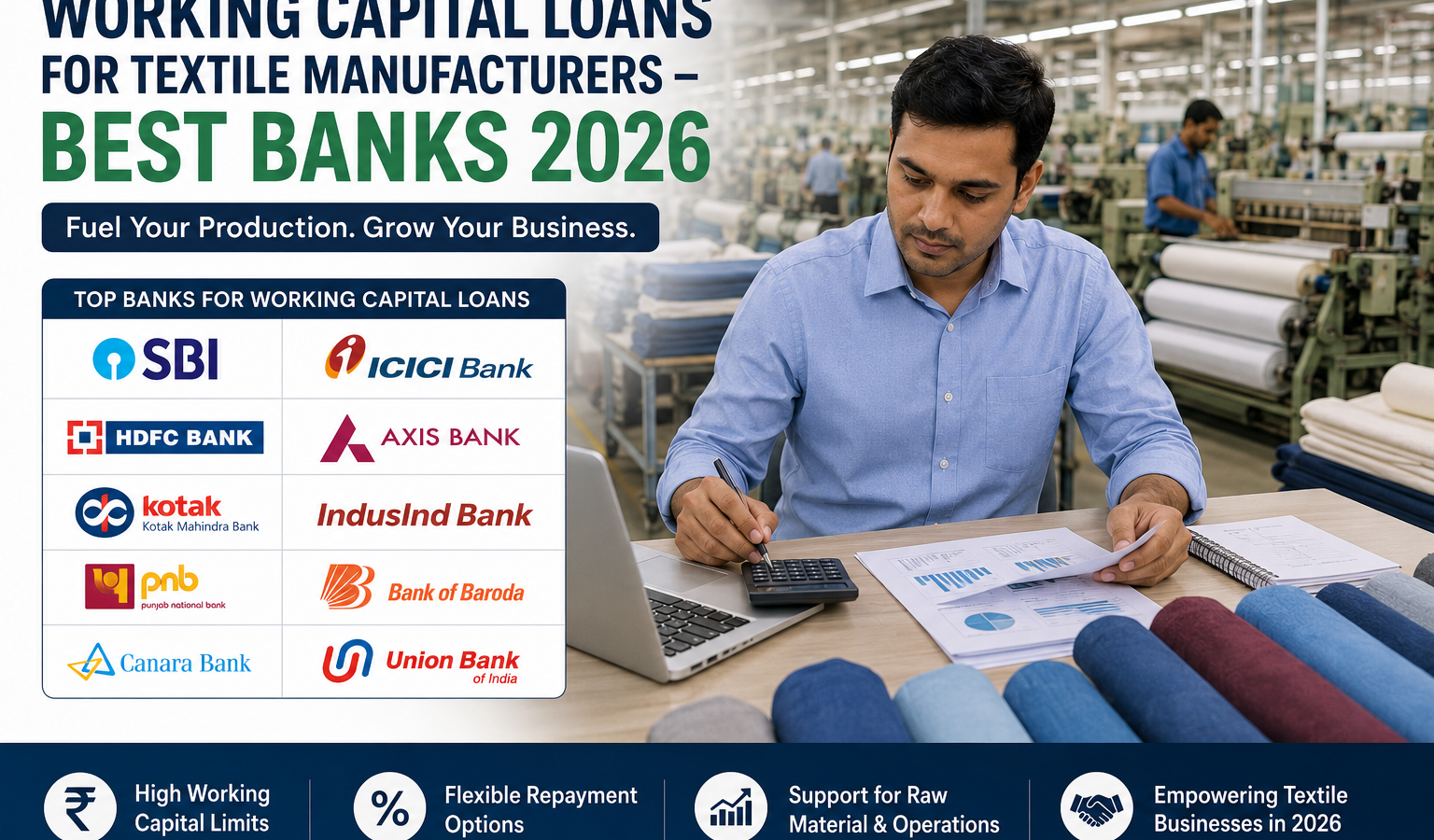
Best banks for textile working capital loans in 2026
1
State Bank of India (SBI)
Best overall
SBI is the largest working capital lender to MSMEs in India. Their SME Credit Card and CC against stock are popular among textile units. Dedicated SME branches exist in all major textile clusters — Surat, Tirupur, Ludhiana, Panipat. Rates are competitive at RLLR + 1.5%–3%. If you bank with SBI already, start here first.
Best for Gujarat & Rajasthan
Strong penetration in Surat (synthetic textiles), Bhilwara (suiting fabric), and Jodhpur (handicraft textiles). Their Baroda MSME Working Capital loan suits mid-size weaving and processing units. Good track record for cluster-based lending with faster turnaround than most PSU banks.
Best for south India clusters
Excellent coverage in Tirupur (knitwear exports) and Erode (handloom). Officers understand seasonal cash flow patterns of knitwear exporters well. Strong for packing credit facilities paired with domestic CC limits for exporters.
4
Punjab National Bank (PNB)
Best for north India
Widely used in Ludhiana (hosiery), Panipat (recycled textiles), and Delhi-NCR garment exporters. PNB MSME Udyami scheme supports working capital up to ₹2 crore without excessive collateral. Good for first-time borrowers in the north India textile belt.
Best for speed
If you need working capital fast — within 7–10 days — HDFC Bank’s digital processing is unmatched. Business Loan and CC facility can be set up quickly for established textile businesses with good GST turnover. Rates are higher (11%–14%) but processing speed can be worth it for time-sensitive order fulfilment.
6
SIDBI – Working Capital Assistance
Best for tech-upgraded units
SIDBI directly lends working capital to MSMEs that have recently invested in technology upgradation or energy efficiency. If your unit has taken a TUF loan or installed new looms, SIDBI’s working capital assistance is competitively priced (9%–11%) with a simpler evaluation for existing SIDBI borrowers.
Eligibility criteria
- ✓Udyam-registered MSME in textile manufacturing or allied trade
- ✓Minimum 1–2 years of business operations (2 years preferred by most PSU banks)
- ✓GST registration with regular filing — lenders verify turnover via GSTR-3B directly
- ✓CIBIL score of 700+ (750+ for the best interest rates)
- ✓No existing loan default or NPA with any bank
- ✓Separate business bank account with at least 6 months of transactions
- ✓Annual turnover of at least ₹25–50 lakh (varies by bank and product)
Documents required
- ✓Udyam Registration Certificate
- ✓KYC — Aadhaar and PAN of all promoters
- ✓GST registration certificate + last 12 months GSTR-3B returns
- ✓Last 2–3 years ITR with P&L and balance sheet (CA-certified)
- ✓6–12 months business bank statement
- ✓Current stock statement — raw materials + finished goods inventory
- ✓Debtors list — buyers who owe you money and amounts outstanding
- ✓Business address proof
- ✓Purchase orders or buyer contracts (significantly strengthens the application)
Lesser-known tip: If you have confirmed purchase orders from reputed buyers — large retail chains, export houses, or government tenders — attach them to your application. Banks treat confirmed POs as virtual collateral and often sanction higher limits.
How to grow your working capital limit over time
1
Submit stock statements on time every month. Most CC facilities require a monthly stock statement. Missed submissions give banks a reason to reduce or freeze your limit — always file on time even when there’s nothing unusual to report.
2
Route all business receipts through your CC account. Banks measure credit turnover in your CC account. High turnover relative to your limit signals strong business activity and leads to limit enhancements at annual renewal.
3
Renew your CC facility every year without delay. CC limits are reviewed annually. Missing the renewal date or providing incomplete documents can lead to the limit being withdrawn. Set a calendar reminder 3 months before your renewal date.
4
File ITR and GST returns on time, every year. Banks directly access your GST data. A growing GST turnover is the strongest argument for a limit enhancement — more powerful than anything you tell the bank officer verbally.
5
Request a formal enhancement after 12–18 months. Prepare an enhancement request with updated turnover, new POs, and an enhanced stock statement. Most banks approve 20%–40% enhancements for clean borrowers with growing business.
Packing credit for textile exporters — explained
If your textile business exports goods, Packing Credit (PC) is one of the cheapest working capital products available in India — and many exporters underuse it.
Packing Credit is a pre-shipment loan against a confirmed export order or Letter of Credit (LC) from a foreign buyer. It lets you buy raw materials, process, and pack the goods before the payment arrives from overseas.
| Feature |
Packing Credit |
Regular CC |
| Purpose |
Export order fulfilment |
General working capital |
| Interest rate |
7%–9% p.a. (subsidised) |
9.25%–14% p.a. |
| Tenure |
90–180 days per shipment |
Revolving, annual renewal |
| Repayment |
On receipt of export payment |
As per drawing power |
| Documentation |
Export order or LC required |
Stock + debtor statements |
For garment exporters: Always use Packing Credit for export orders and keep domestic CC separate. Mixing the two makes accounting messy and makes it harder to claim interest subvention benefits available specifically to exporters.
Frequently asked questions
Can a new textile unit (1 year old) get a working capital loan?
Yes, but options are limited. Most PSU banks want 2 years of ITR history. For newer units, MUDRA Loans (Kishor or Tarun), NBFC working capital products, or invoice discounting against confirmed purchase orders are more accessible starting points.
Is collateral required for working capital CC limits?
For limits up to ₹5 crore, CGTMSE coverage makes it possible to get collateral-free CC. For larger limits, banks typically ask for a charge on stocks and debtors — assets already in the business — rather than external property. This varies by bank and borrower profile.
How long does it take to get a CC limit sanctioned?
PSU banks typically take 3–6 weeks from complete document submission to disbursement. Private banks like HDFC and ICICI can do it in 7–15 days for established businesses. NBFCs can process in 3–7 days but at significantly higher rates.
Can I have working capital limits from two different banks?
Yes — this is called multiple banking. Both banks must be informed of each other’s exposure. For limits above ₹5 crore, banks often prefer consortium arrangements. Below that, multiple banking is allowed but lenders will check your total credit exposure via CIBIL and CRILC.
Final thoughts
Working capital is the oxygen of a textile business. Without it, even strong order books and profitable operations can collapse under cash flow pressure. The good news is that in 2026, working capital finance for textile manufacturers is more accessible and affordable than ever — with PSU bank CC rates at multi-year lows and CGTMSE removing the collateral barrier for most borrowers.
Start with SBI or your current banker. Prepare clean financials — GST returns, ITR, bank statements — and have your stock and debtor statements ready. If you export, specifically ask for a Packing Credit facility alongside your domestic CC.
Your buyers won’t wait. Neither should your working capital. Get it in place before the orders come — not after.
Related articles:
Loans
MSME Loan for Textile Business – Eligibility, Banks & Schemes 2026
Credit
CGTMSE for Textile Businesses – Collateral-Free Loans Explained
Export
Export Credit Insurance for Textile Exporters – ECGC Guide 2026
working capital loan textile
CC limit textile manufacturer
packing credit garment exporter
best bank MSME textile 2026
textile working capital India
invoice discounting fabric business
SBI working capital textile
AM
Arjun Mehta
SME Banking & Textile Finance Advisor
Arjun spent 9 years as an SME relationship manager at two leading PSU banks before becoming an independent finance advisor for textile businesses. He has structured working capital facilities totalling over ₹120 crore for manufacturers across Surat, Panipat, and Tirupur. He specialises in helping textile businesses get the most out of their CC limits, manage bank renewals, and navigate packing credit for export orders. He writes to simplify banking jargon for factory floor entrepreneurs.
Leave a Reply