Finance & Credit Guarantee
NK
Nisha Kulkarni
MSME Finance & Credit Specialist
|June 28, 2026
|10 min read
|Last updated: June 2026
If you’ve ever walked into a bank for a business loan and been told — “we need collateral” — you’re not alone. For most textile entrepreneurs in India, the collateral barrier is the single biggest reason loan applications don’t go through. CGTMSE was designed specifically to solve this problem. In this guide, we’ll break down exactly what CGTMSE is, how it helps textile businesses, how to apply, and what you need to watch out for in 2026.
What is CGTMSE?
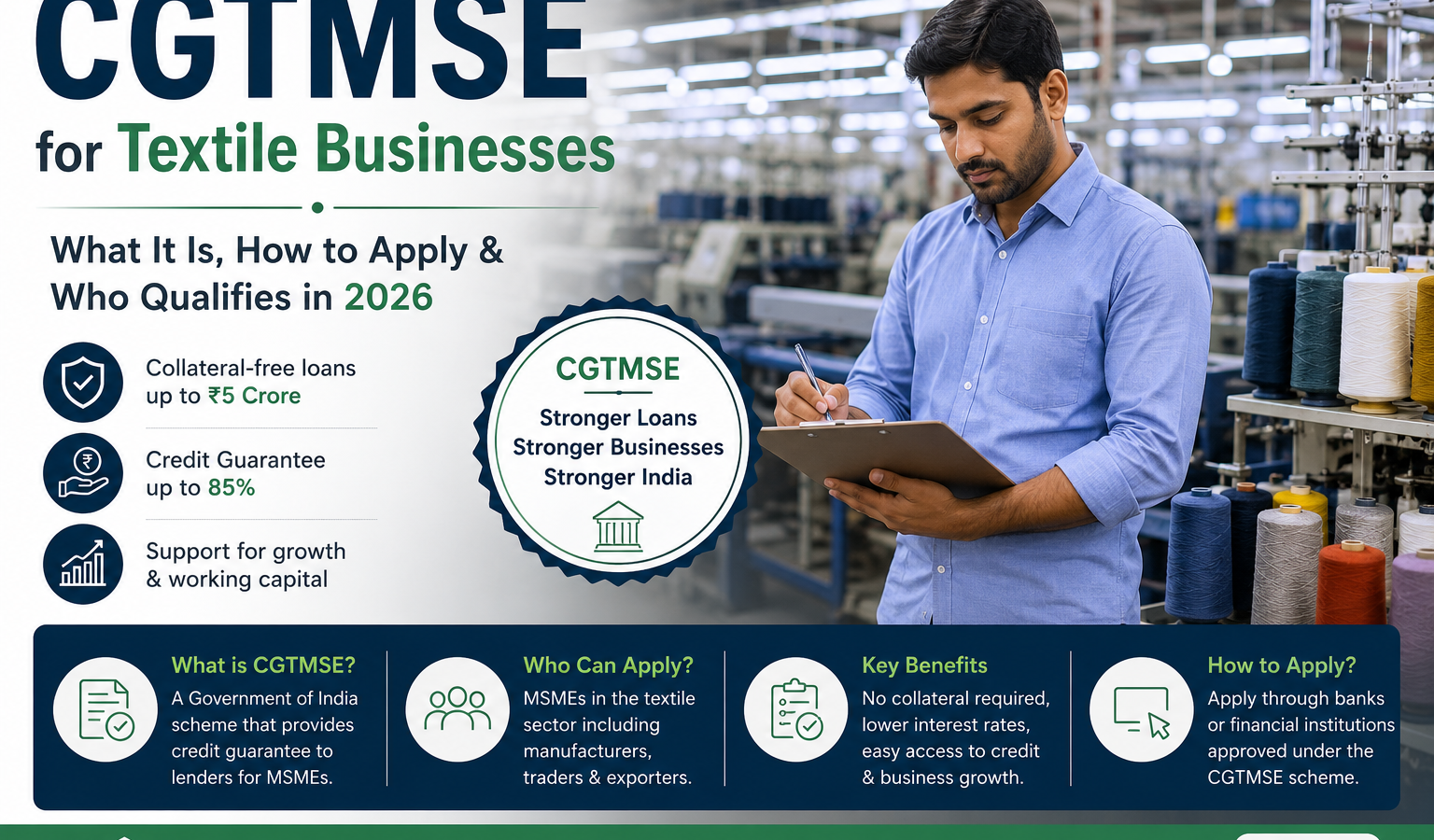
CGTMSE stands for Credit Guarantee Fund Trust for Micro and Small Enterprises. It is a government-backed credit guarantee scheme run jointly by the Ministry of MSME and SIDBI (Small Industries Development Bank of India).
Here’s the core idea: when you apply for a business loan, the bank worries — “what if this borrower doesn’t repay?” Normally, they solve this by demanding collateral (your factory, land, or house). CGTMSE steps in and tells the bank: “If this borrower defaults, we’ll cover up to 85% of your loss.” With that guarantee in place, the bank no longer needs to demand physical assets from you.
For textile manufacturers, garment exporters, power loom operators, and fabric traders — this is a game-changer. It means you can get a loan based on the strength of your business, not just what property you can pledge.
CGTMSE in one line: The government acts as your guarantor so the bank lends you money without collateral.
Why does CGTMSE matter specifically for textile businesses?
The textile sector has specific characteristics that make collateral-free lending extremely relevant:
- ✓Many textile units are located on rented premises — no owned land to pledge
- ✓Machinery (looms, dyeing machines) depreciates fast — banks don’t value it highly as security
- ✓First-generation entrepreneurs often have no property in their personal name
- ✓Working capital needs are seasonal and urgent — long collateral evaluation delays hurt business
- ✓Small weavers and power loom operators often have high skill but low fixed assets
CGTMSE removes all of these barriers in one go. A weaver in Bhiwandi with no owned premises can still get a ₹50 lakh loan based on his GST turnover, bank statements, and Udyam registration — with CGTMSE covering the bank’s risk.
Key features of CGTMSE in 2026
| Feature |
Details |
| Maximum loan covered |
Up to ₹5 crore (up to ₹20 crore for eligible textile exporters — Budget 2026) |
| Guarantee coverage |
75%–85% of loan amount (85% for loans up to ₹5 lakh) |
| Who runs it |
Ministry of MSME + SIDBI jointly |
| Eligible borrowers |
Micro and Small Enterprises — manufacturing + services |
| Collateral required |
None — that’s the entire point |
| Annual guarantee fee |
Reduced to 1% for 27 focus sectors including textiles (Budget 2026) |
| Who applies to CGTMSE |
The bank applies on your behalf — not you directly |
Budget 2026 update: For well-run MSME exporters in focus sectors like textiles, the CGTMSE guarantee cover for term loans has been enhanced to ₹20 crore, and the annual guarantee fee reduced to just 1%. This is a significant improvement from previous years.
Who qualifies for CGTMSE?
CGTMSE is available to Micro and Small Enterprises only. Your textile unit must meet these conditions:
- ✓Registered as a Micro or Small Enterprise under Udyam Registration
- ✓Engaged in manufacturing, trading, or services — all textile sub-sectors qualify
- ✓Loan from an eligible Member Lending Institution (MLI) — most scheduled banks are registered
- ✓No existing NPA (Non-Performing Asset) with any bank
- ✓Loan purpose must be for business use — not personal expenses
Textile sub-sectors that commonly access CGTMSE include: spinning units, weaving factories, dyeing & processing units, garment manufacturing, hosiery, embroidery units, yarn traders, fabric wholesalers, and power loom operators.
Who does NOT qualify: Medium Enterprises (turnover above ₹50 crore) are not eligible. Retail trade has limited 50% coverage only. Agricultural activity, self-help groups, and educational institutions are excluded.
What types of loans are covered under CGTMSE?
For purchasing machinery, looms, dyeing machines, generators, or ETP plants. The most common use in the textile sector — upgrading from old shuttle looms to modern air-jet looms, for example.
2
Working capital loans / cash credit
For buying yarn, grey fabric, dyes, chemicals, or paying wages before receiving buyer payments. Seasonal businesses especially benefit — festive season stocking, export order cycles.
A combination of term loan + working capital in a single facility. Banks often offer this as one sanction to cover both capital expenditure and operational needs — practical for a growing textile unit.
Pre-shipment and post-shipment credit for textile exporters is now covered under the enhanced CGTMSE norms (Budget 2026). Particularly useful for garment exporters supplying global brands.
How CGTMSE actually works — step by step
This is the most misunderstood part. You do not apply to CGTMSE directly. Here’s how the process works:
1
Apply to a bank or NBFC for a business loan. Tell them upfront: “I want this covered under CGTMSE.”
2
The bank evaluates your application — your Udyam certificate, ITR, GST returns, bank statements, and project report.
3
If your loan is approved, the bank applies to CGTMSE on your behalf and pays the guarantee fee (1% for textile exporters in 2026).
4
CGTMSE issues a guarantee certificate to the bank, covering 75%–85% of the loan. The bank is now protected against default risk.
5
The bank disburses the loan to you — without asking for collateral or a third-party personal guarantee.
6
You repay as per the EMI schedule. If you default, the bank claims from CGTMSE. Your credit history is affected either way — repay on time.
Key insight: The guarantee fee is typically passed on to you as a small annual charge built into the loan cost. At 1% for textile exporters in 2026, this is very affordable — far cheaper than pledging property or paying a guarantor.
Documents needed
- ✓Udyam Registration Certificate (mandatory — no exceptions)
- ✓Aadhaar and PAN of all promoters
- ✓GST registration and last 6-month GST returns
- ✓Last 2–3 years ITR with profit & loss and balance sheet
- ✓6-month business bank statement
- ✓Project report (for term loans or new machinery)
- ✓Equipment quotations for term loan proposals
- ✓Business address proof — rent agreement or utility bill
Remember: You do NOT submit a separate CGTMSE application form. Just tell the bank you want the loan under CGTMSE. They handle the paperwork with the Trust on your behalf.
Which banks offer CGTMSE loans for textile businesses?
Most scheduled commercial banks and select NBFCs are registered as Member Lending Institutions (MLIs) with CGTMSE:
PSU Banks (most active): State Bank of India, Bank of Baroda, Canara Bank, Punjab National Bank, Union Bank of India, Bank of India, Central Bank of India
Private Banks: HDFC Bank, ICICI Bank, Axis Bank, Kotak Mahindra Bank
Registered NBFCs: Lendingkart, Kinara Capital, Ugro Capital — especially useful for units that don’t meet standard bank thresholds
Common mistakes textile businesses make with CGTMSE
- ✗
Not asking for CGTMSE coverage. Many bank officers don’t proactively mention it. Always ask explicitly: “Can my loan be covered under CGTMSE?”
- ✗
Applying without Udyam registration. CGTMSE is only for Udyam-registered MSMEs. Get this done before approaching the bank.
- ✗
Mismatched ITR and bank statement figures. Banks compare both. Any mismatch kills the application before it even reaches CGTMSE stage.
- ✗
Applying as a Medium Enterprise. CGTMSE only covers Micro and Small. If your turnover is above ₹50 crore, you’re not eligible.
- ✗
Assuming any NBFC qualifies. Only CGTMSE-registered Member Lending Institutions can offer this. Always confirm with the lender first.
Frequently asked questions
Can a new textile unit (less than 1 year old) apply for CGTMSE?
Yes. CGTMSE covers both new and existing businesses. For new units, a detailed and realistic project report becomes extra important since there are no historical financials to show the bank.
Does CGTMSE guarantee mean the bank will definitely approve my loan?
No. CGTMSE removes the collateral barrier, but the bank still evaluates your creditworthiness — CIBIL score, repayment history, and business viability. A CIBIL score of 700+ and clean ITR filings are still essential.
Is there a cost to me for CGTMSE coverage?
Yes — a small annual guarantee fee, typically passed on to you as part of the loan cost. In 2026 this has been reduced to 1% for textile businesses in focus sectors. Over the loan tenure, this is far cheaper than pledging property.
Can I use CGTMSE for a working capital loan to buy yarn or grey fabric?
Absolutely. Working capital loans, cash credit limits, and overdraft facilities for buying raw materials — yarn, grey fabric, dyes, chemicals — are all covered under CGTMSE.
What is the maximum loan I can get under CGTMSE?
Up to ₹5 crore for regular MSMEs. Up to ₹20 crore for eligible textile exporters with a clean track record, as announced in Budget 2026.
Final thoughts
CGTMSE is one of the most borrower-friendly schemes available to Indian textile businesses — and one of the least understood. If you’ve been turned away by banks asking for collateral, this scheme changes the equation completely. The government has actively strengthened it in Budget 2026, especially for textile exporters.
The process is straightforward: get your Udyam registration, walk into any scheduled bank, and specifically ask for a CGTMSE-covered loan. The bank does the paperwork. You focus on running your business.
Collateral shouldn’t be the reason your textile business doesn’t grow. CGTMSE makes sure it isn’t.
Related articles:
Loans
MSME Loan for Textile Business – Eligibility, Banks & Schemes 2026
Finance
MUDRA Loan for Fabric Business – How to Apply & Get Approved
Insurance
Export Credit Insurance for Textile Exporters – ECGC Guide 2026
CGTMSE textile
collateral free loan textile
MSME credit guarantee India
SIDBI textile loan
textile business loan without collateral
CGTMSE 2026
garment manufacturer loan
NK
Nisha Kulkarni
MSME Finance & Credit Specialist
Nisha has 11 years of experience advising textile and garment businesses across India on government credit schemes, bank loan structuring, and MSME compliance. She has worked closely with DIC offices in Surat and Tirupur, helping over 150 small manufacturers access collateral-free financing under CGTMSE, PMEGP, and MUDRA. She writes to make government schemes understandable for real business owners — not just accountants.
Leave a Reply