ERP & Technology
ERP Implementation Cost for Textile Factories – Full Breakdown 2026
SP
Suresh Pillai
Textile ERP Consultant & Manufacturing Tech Advisor
|June 28, 2026
|13 min read
|2,800 words
Every textile manufacturer at some point faces the same question: “How much will an ERP actually cost me?” Vendors give vague answers. Consultants quote wildly different numbers. And the internet is full of figures that are either outdated, too generic, or designed to make you call a sales rep. This guide is different. We’ve broken down every cost component of ERP implementation for textile factories — licensing, customisation, hardware, training, data migration, hidden charges, and ongoing costs — with realistic numbers for the Indian market in 2026. Whether you run a 20-loom weaving unit or a 500-machine garment export factory, this breakdown will help you plan your ERP budget accurately.
📋 What this guide covers
- 01 Why textile factories need ERP — and why it’s worth the cost
- 02 ERP cost by factory size — small, medium, large
- 03 Full breakdown of every cost component
- 04 Implementation timeline and phases
- 05 Best ERP vendors for textile factories — costs compared
- 06 Hidden costs no one warns you about
- 07 ROI — what you actually get back
- 08 How to reduce ERP implementation cost
- 09 FAQ
Why textile factories need ERP — and why cost matters
Before we talk numbers, let’s understand what textile ERP actually does — because the cost only makes sense in context of the value delivered.
A textile factory without ERP typically runs on a combination of Excel sheets, WhatsApp messages, paper job cards, and tribal knowledge stored in the heads of supervisors. This works — until it doesn’t. Orders get mixed up. Yarn stock gets double-counted. A buyer asks for a delivery status and nobody can give a straight answer. Fabric wastage goes untracked. A power loom breaks down and spare parts aren’t in stock.
A textile ERP system connects every department — purchase, production, inventory, quality, sales, dispatch, and accounts — into one platform. When a production order is raised, it automatically checks raw material availability, allocates yarn from the right lot, tracks the job through weaving, dyeing, finishing, and dispatch, and generates the invoice and GST returns automatically.

📊 Textile ERP Software — How It Connects Every Department
A modern textile ERP connects purchase, production, inventory, quality control, and accounts into one unified platform — eliminating data silos across your factory floor.
The result: less wastage, fewer errors, faster order fulfilment, better buyer relationships, and accurate financial data for your bank and auditor. That’s the value side. Now let’s talk about the cost.
Reality check: Most textile factory owners underestimate ERP cost by 40%–60% because they only consider the software licence fee. The actual total cost of ownership — including implementation, customisation, training, data migration, and ongoing support — is 2–4x the licence fee alone.
ERP cost by factory size — quick reference
Before the detailed breakdown, here’s the headline range based on factory size. These are total implementation costs — all-in, including everything.
🏠
Small unit
10–50 looms / <50 employees
₹2L – ₹8L
Cloud SaaS ERP, limited modules, minimal customisation. Suitable for single-location weaving or garment unit.
🏭
Medium unit
50–200 machines / 50–250 employees
₹8L – ₹35L
Mid-range ERP with production, inventory, quality, accounts modules. Moderate customisation for textile workflows.
🏗️
Large factory
200+ machines / 250+ employees
₹35L – ₹2Cr+
Enterprise ERP (SAP, Oracle, or heavy-customised mid-tier). Multi-location, multi-currency, full module suite.
Important: These ranges assume Indian rupee costs for India-based implementation. If you’re implementing a global ERP (SAP S/4HANA, Oracle Fusion) with an international integrator, multiply these numbers by 3–5x. Indian ERP vendors (Tally ERP, Busy, TexBase, Aptus, WeaveMaster) are significantly cheaper for the same functionality at the SME level.
Full cost breakdown — every component explained
Here is every cost item you will encounter in a textile ERP implementation. Not all of these apply to every factory — but you need to understand each one before signing any vendor contract.
This is the price of the ERP software itself — the most visible cost but not always the largest. Two pricing models exist:
SaaS / Cloud (subscription): You pay monthly or annually. Costs range from ₹3,000–₹25,000 per user per month depending on the vendor and modules. A 10-user textile ERP on cloud = ₹3.6L–₹30L per year ongoing.
On-premise (perpetual licence): One-time licence payment, usually ₹5L–₹60L depending on the vendor and number of users. Lower long-term cost, but higher upfront and requires your own server.
For most SME textile factories in India, cloud-based SaaS is now the preferred model — lower upfront cost, automatic updates, and accessible from anywhere including the shop floor via tablets.
2
Implementation & consulting fee
This covers the cost of the implementation team — the consultants who set up the ERP, configure it to your factory’s workflow, and go live with you. It’s often the largest single cost item in a mid-to-large implementation.
Implementation consultants typically charge ₹800–₹3,500 per hour (India-based), or as a fixed project fee. For a medium textile factory implementing a 6-module ERP with 3 months of consulting support, expect ₹8L–₹20L in consulting fees alone.
This cost is directly related to how much customisation you need. A standard industry template (like a pre-built textile ERP with loom tracking and greige fabric workflow) costs far less to implement than building custom modules from scratch.
3
Customisation & development
No standard ERP fits a textile factory perfectly out of the box. Textile manufacturing has highly specific workflows — yarn lot tracking, greige fabric reconciliation, job work management (karigari), shade/count/construction management, loom-wise production tracking, quality checks at each stage. These need to be either configured or custom-developed.
Configuration (using the ERP’s built-in settings): Low cost, ₹50K–₹3L. Sufficient for basic textile setups.
Custom development (writing new code for your specific workflow): ₹2L–₹40L depending on complexity. Required for specialised processes like warp beam tracking, weft insertion monitoring, or integration with loom automation systems.
A common mistake is underestimating customisation during the sales process. Get a detailed scope document from your vendor before signing — every “minor customisation” can add ₹1–5L to your bill later.

🏭 Shop Floor Management — Production Tracking Dashboard
A production floor management dashboard in a textile ERP tracks loom-wise output, shift productivity, quality rejections, and pending orders in real time — replacing manual supervisor reports.
Moving your existing data — item master, vendor list, customer records, opening stock, pending orders, historical transactions — from your old system (Excel, Tally, or a legacy ERP) into the new ERP. This is always underestimated.
The challenge in textile factories is the complexity of item masters. A single fabric SKU can have 50+ variants (shade × count × construction × width × weight). Migrating 5,000–20,000 such items with correct attributes, unit conversions, and pricing is a significant technical effort.
Budget ₹50,000–₹2L for a basic migration of a small unit, and ₹3L–₹8L for a medium-large factory with complex yarn and fabric masters. Doing it poorly means months of data correction after go-live.
5
Hardware & infrastructure
For cloud ERP: Minimal hardware needed. Just good internet connectivity (at least 20 Mbps leased line for a medium factory), tablets or terminals on the shop floor, and a basic UPS/backup system. Budget ₹1L–₹3L for hardware in a cloud ERP setup.
For on-premise ERP: You need a dedicated server (₹2L–₹8L for a good server), UPS, network switches, Wi-Fi access points across the factory floor, and possibly barcode scanners for yarn/fabric tracking. Total hardware for an on-premise mid-size factory: ₹5L–₹20L.
Don’t forget internet costs — a leased line for a medium factory runs ₹3,000–₹8,000 per month, which is ₹36,000–₹96,000 per year ongoing.
6
Training & change management
Training your staff to use the ERP is non-negotiable — and often underfunded. For a textile factory, you need to train:
• Store keeper — GRN entry, stock transfer, yarn issue
• Production supervisor — job card creation, production entry, quality check recording
• Accounts team — purchase bill booking, GST returns, payment entry
• Sales/dispatch team — order entry, delivery challan, invoice generation
• Management — dashboard reading, MIS reports, analysis
Formal training by the vendor typically costs ₹50,000–₹2L for a standard 5–10 day programme. Add ₹1L–₹3L for ongoing training as staff turns over. Skimping on training is the #1 reason ERP implementations fail in textile factories — the software works fine, but nobody uses it correctly.
7
Annual maintenance & support (AMC)
This is the ongoing cost after go-live. For on-premise ERP, most vendors charge 15%–20% of the licence fee as AMC annually. For a ₹10L licence, that’s ₹1.5L–₹2L per year for bug fixes, updates, and support calls.
For cloud SaaS, support is usually included in the subscription — but “premium support” with faster response times and dedicated account managers costs extra (₹50K–₹3L per year additional).
Also budget for: server maintenance (on-premise), security audits, and periodic performance tuning as your data volume grows over years.
Total cost summary table
| Cost component | Small unit (₹) | Medium factory (₹) | Large factory (₹) |
|---|
| Software licence | 1.5L – 3L | 5L – 15L | 20L – 80L+ |
| Implementation / consulting | 50K – 2L | 5L – 20L | 15L – 60L |
| Customisation & development | 50K – 1L | 2L – 10L | 8L – 40L |
| Data migration | 25K – 75K | 1L – 4L | 3L – 8L |
| Hardware & infrastructure | 75K – 2L | 2L – 8L | 8L – 20L |
| Training | 25K – 75K | 75K – 2L | 2L – 5L |
| AMC (Year 1) | 30K – 75K | 1L – 3L | 4L – 15L |
| TOTAL (all-in) | ₹3.5L – ₹10L | ₹16L – ₹62L | ₹60L – ₹2.28Cr |
ERP implementation timeline — phase by phase
Understanding the implementation timeline helps you plan your budget disbursement and manage business disruption. A typical textile ERP implementation goes through these phases:
1
Discovery & requirement mapping
Vendor team visits your factory, maps all processes (purchase, production, store, quality, accounts, dispatch), documents gaps between standard software and your specific workflow, prepares a detailed implementation plan and FRS (Functional Requirement Specification).
⏱ 2–4 weeks | Cost: Usually included in implementation fee
2
System setup & configuration
ERP is installed (cloud or on-premise), basic modules configured, item masters, vendor masters, customer masters created, user roles and access levels defined, tax configuration and GST setup completed.
⏱ 3–6 weeks | This is where most consulting hours are spent
3
Customisation & development
Custom modules built — loom tracking, beam management, job work flows, customer-specific quality parameters, export documentation if needed. This phase often overruns if requirements weren’t documented properly in Phase 1.
⏱ 4–12 weeks | Longest phase for factories with complex workflows
4
Data migration & testing
Historical data migrated from old system. Full User Acceptance Testing (UAT) conducted — every transaction type tested with real factory scenarios. Bugs fixed. Staff begins parallel running (operating both old and new system simultaneously).
⏱ 2–4 weeks | Never skip parallel running — it catches critical errors
5
Training
Department-wise training conducted. Store keeper, production supervisor, accounts team, management — each group gets role-specific training. Training materials (quick reference cards, video tutorials) prepared for ongoing reference.
⏱ 1–2 weeks | Budget extra time for shop floor staff with low digital literacy
6
Go-live & hypercare
System goes live. Vendor team on-site (or on call) for the first 2–4 weeks to resolve issues immediately. This “hypercare” period is critical — most post-go-live problems surface in the first month. After hypercare, transitions to standard AMC support.
⏱ 2–4 weeks on-site hypercare + ongoing AMC
Total implementation timeline: Small unit = 2–3 months. Medium factory = 4–6 months. Large enterprise = 8–18 months. Rushing the timeline to save cost is the most common cause of failed ERP implementations in textile factories.
Best ERP vendors for textile factories — costs compared
Here are the most widely used ERP systems in Indian textile factories, with realistic cost ranges:
TexBase ERP
Best for Indian SME textilePurpose-built for Indian textile manufacturers. Covers spinning, weaving, knitting, processing, garment, and trading. Strong yarn lot tracking, greige fabric reconciliation, and job work modules. Widely used in Surat, Tirupur, and Bhilwara clusters.
💰 ₹3L–₹25L total☁️ Cloud + On-premise⏱ 2–5 months🇮🇳 Indian vendor
Aptus Textile ERP
Best for garment exportersStrong in export documentation, buyer-wise compliance tracking, pre-shipment quality, and packing list generation. Integrates with GSTR-1 and EWay Bill automatically. Good for Tirupur and Bangalore garment export units.
💰 ₹5L–₹30L total☁️ Cloud-first⏱ 3–6 months🇮🇳 Indian vendor
Odoo (Textile module)
Best value for customisationOpen-source base with a large ecosystem of textile-specific modules available. Highly customisable — can be configured for almost any textile workflow. Requires a good Odoo implementation partner. Growing popularity in India among mid-size textile units.
💰 ₹4L–₹35L total☁️ Cloud + Self-hosted⏱ 3–8 months🌍 International
SAP Business One (Textile)
Best for large factoriesSAP B1 with textile add-ons (from partners like Uneecops or Praxis) is the preferred choice for large textile manufacturers with ₹50Cr+ turnover, multiple locations, or export operations requiring robust MIS. Very strong reporting and integration with banking systems.
💰 ₹25L–₹1.5Cr total☁️ Cloud + On-premise⏱ 6–12 months🌍 International
Microsoft Dynamics 365 (Textile)
Best for enterprise + exportUsed by large garment exporters and composite mills with global operations. Strong in multi-currency, multi-entity consolidation, and compliance. Expensive to implement and maintain, but unmatched for data depth and reporting. Typically requires an international implementation partner.
💰 ₹50L–₹2Cr+ total☁️ Cloud-first⏱ 9–18 months🌍 International

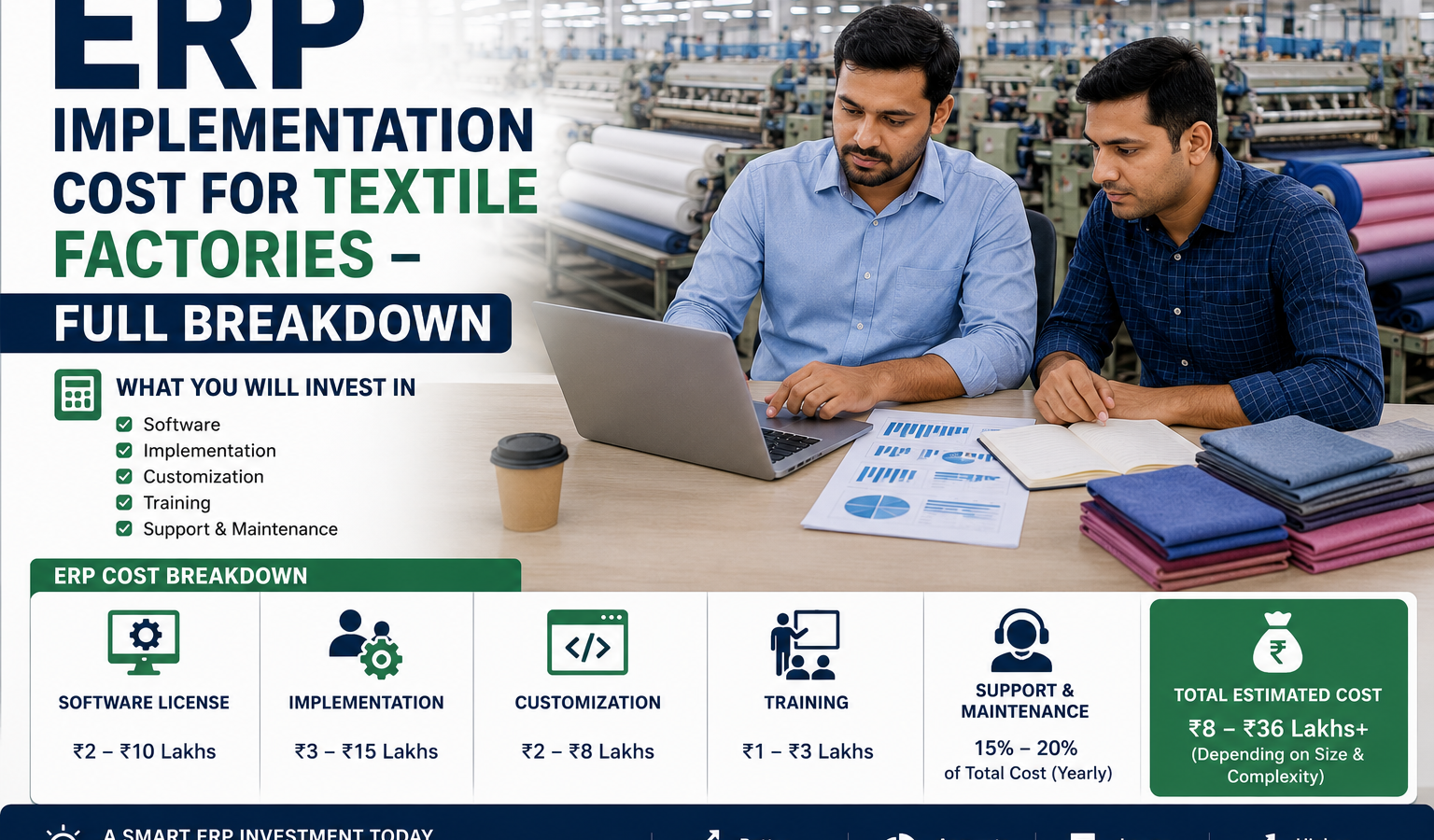
📊 ERP Implementation Cost Breakdown — All Components Visualised
A realistic ERP implementation cost breakdown shows that the software licence is only one part of the total investment — implementation, customisation, training, and ongoing support often cost more than the licence itself.
Hidden costs no one warns you about
These costs don’t appear in any vendor proposal — but they will appear in your final bill or as opportunity costs you never recover:
- !
Productivity loss during implementation (₹2L–₹15L): Your team spends 20%–40% of their time on ERP-related tasks during the 3–6 month implementation. This is real money — either overtime cost or delayed orders. Factor in at least 1–2 months of reduced factory throughput.
- !
Scope creep in customisation (₹1L–₹10L): Every “can you add this field” or “can we track this differently” request after sign-off costs money. Keep a strict change control process. Every change order should be documented and priced before execution.
- !
Internet upgrade (₹50K–₹2L upfront + ₹36K–₹96K/year): Many textile factories in cluster areas have unreliable internet. A cloud ERP on a spotty connection is unusable. Budget for a dedicated leased line — non-negotiable for cloud ERP.
- !
Staff resistance and retraining (₹50K–₹3L): Some supervisors and store keepers actively resist ERP adoption — they feel threatened by the transparency it creates. Budget for change management, additional training rounds, and potentially replacing staff who refuse to adapt.
- !
Data cleaning before migration (₹50K–₹2L): Your Excel item master probably has duplicates, inconsistent names, missing units of measure, and wrong prices. Cleaning this before migration is manual work — budget time and money for it.
- !
Third-party integrations (₹1L–₹8L): Integrating your ERP with your bank (for automatic payment reconciliation), your e-commerce platform, your loom automation system, or your buyer’s EDI system each costs extra — usually ₹1L–₹3L per integration.
ROI — what you actually get back
A textile ERP is a cost — but it’s also an investment. Here’s what factories typically report after 12–18 months of successful ERP usage:
8–15%
Reduction in raw material wastage through accurate yarn lot tracking
20–35%
Reduction in finished goods inventory due to better production planning
3–7 days
Faster order-to-dispatch cycle through automated job card and challan generation
40–60%
Reduction in time spent on MIS reporting by management and accounts team
100%
GST compliance accuracy — automated GSTR-1/3B with zero manual data entry errors
18–30 mo
Typical payback period for mid-size textile ERP investment
Real example: A 120-loom weaving factory in Surat implemented a ₹14L ERP (all-in). Within 18 months, they reduced yarn wastage by 11% (saving ₹8.4L/year), cut their accounts team from 4 people to 2 (saving ₹6L/year in salaries), and reduced debtor days from 72 to 48 (freeing ₹18L in working capital). Full payback in 14 months.
How to reduce ERP implementation cost without cutting corners
1
Choose a textile-specific ERP, not a generic one. A generic ERP needs 3× more customisation to handle yarn lot tracking, shade/count management, and greige reconciliation. A purpose-built textile ERP already has these — your customisation cost drops by 50%–70%.
2
Start with core modules, not everything at once. Phase 1: purchase, inventory, production, basic accounts. Phase 2 (6 months later): quality, HR, advanced MIS, export documentation. This reduces upfront cost and implementation risk simultaneously.
3
Clean your data before going to the vendor. Every hour a consultant spends cleaning your messy item master costs you ₹800–₹3,500. Do this work internally first — it can save ₹1L–₹5L in implementation fees.
4
Choose cloud over on-premise for small and mid-size units. Eliminating the server purchase alone saves ₹3L–₹8L upfront. Cloud also means automatic updates and no IT maintenance overhead.
5
Negotiate a fixed-price implementation contract. Time-and-material contracts expose you to scope creep. A well-defined fixed-price contract with a detailed FRS protects your budget. Always get a scope-of-work document signed before work begins.
6
Use TUF / MSME technology upgrade schemes. If you’re investing in ERP as part of a broader technology upgrade, some schemes (including certain state government MSME incentives) cover up to 25%–50% of software and implementation costs. Ask your DIC office.
Frequently asked questions
Can a small weaving unit with 15 looms afford an ERP?
Yes. Cloud-based textile ERP subscriptions start at ₹3,000–₹5,000 per month for small units with 2–3 users. Total Year 1 cost including setup can be as low as ₹2L–₹4L. Even a 15-loom unit can recover this investment through reduced yarn wastage and faster billing alone.
Is SAP necessary for a large textile factory or are Indian ERPs sufficient?
For factories below ₹100Cr turnover, Indian textile-specific ERPs (TexBase, Aptus, WeaveMaster) are fully sufficient and far more cost-effective than SAP. SAP makes sense above ₹100Cr turnover, with multiple plants, complex consolidation needs, or global operations requiring international compliance.
How long before we see ROI from a textile ERP?
Typically 12–24 months for a medium factory. The first savings come from reduced yarn wastage and faster billing (Month 3–6). Bigger savings from inventory reduction and working capital improvement show up by Month 12–18. Factories that implement ERP without proper training rarely see ROI — the system sits idle and savings never materialise.
Should we buy an ERP or build a custom system?
Almost always buy. Building a custom system costs 5–10× more than purchasing and implementing a textile ERP, takes 2–3 years, and leaves you without support when your developer leaves. The only exception is if your process is genuinely unique and no existing ERP can accommodate it — which is rare in standard textile manufacturing.
What is the most common reason textile ERP implementations fail?
Insufficient training and poor change management — not bad software. Most textile ERP systems work well. What fails is adoption. If the store keeper doesn’t enter GRN correctly, or the supervisor doesn’t fill job cards, the entire system produces garbage data. Invest in training as much as you invest in the software itself.
Can ERP cost be claimed as a business expense for tax purposes?
Yes. ERP software licence fees and implementation costs are typically treated as intangible assets and depreciated under the Income Tax Act. SaaS subscriptions are a revenue expense deductible in the year of payment. Consult your CA for the specific treatment based on your capitalisation policy and the nature of costs incurred.
Final thoughts
ERP implementation is one of the most significant technology investments a textile factory will make. The cost is real — anywhere from ₹3.5 lakh for a small unit to ₹2 crore for a large factory. But so is the return — reduced wastage, faster order cycles, accurate financials, and the ability to scale without chaos.
The biggest mistake is not spending too much on ERP — it’s spending just enough to go live but not enough to make it work. Underinvesting in training, cutting data migration corners, or rushing the timeline typically costs 2–3× the “savings” in post-go-live firefighting.
Get a detailed quotation from at least three vendors. Ask them to visit your factory before quoting. Demand a line-item breakdown — not a single lump-sum number. And always add 25%–30% to whatever number they give you as your implementation contingency budget.
Your competitors are already on ERP. The question isn’t whether you can afford to implement it — it’s whether you can afford not to.
Related articles:
ERP
Best Textile ERP Software 2026 – Compared & Reviewed
Finance
MSME Loan for Textile Business – Eligibility & Schemes 2026
Credit
CGTMSE for Textile Businesses – Collateral-Free Loans Explained
ERP implementation cost textile
textile ERP India 2026
garment factory ERP price
SAP textile manufacturer India
weaving unit ERP software
textile ERP ROI
ERP cost breakdown manufacturing
TexBase Odoo SAP textile
SP
Suresh Pillai
Textile ERP Consultant & Manufacturing Tech Advisor
Suresh has 16 years of experience implementing ERP systems in textile factories across India — from 20-loom weaving units in Surat to 1,000-machine composite mills in Coimbatore. He has led over 80 ERP implementations across spinning, weaving, processing, knitting, and garment sectors. He now works independently, helping textile factory owners evaluate ERP options, negotiate with vendors, and manage implementation projects without the expensive mistakes. He writes to bring honest, no-jargon ERP guidance to factory owners who are tired of being oversold.
Leave a Reply