Introduction
In the textile industry, yarn count is one of the most important parameters used to define yarn thickness, fabric quality, weight, strength, and end-use performance. Whether you’re a spinning mill owner, fabric manufacturer, garment exporter, textile student, or sourcing professional, understanding yarn count conversion is essential.
The challenge is that different countries and textile sectors use different yarn numbering systems.
For example:
- Cotton yarn is commonly measured in Ne (English Count)
- Polyester filament yarn uses Denier
- Technical textiles often use Tex or dTex
- European manufacturers may use Nm (Metric Count)
As a result, textile professionals frequently need to convert one yarn count system into another.
Imagine receiving an inquiry for:
- 150 Denier Polyester Yarn
- 30 Ne Cotton Yarn
- 50 Tex Industrial Yarn
Without understanding yarn count conversion, accurate sourcing and costing become difficult.
This guide explains every major yarn count system, conversion formulas, practical examples, industry applications, and conversion charts used by textile manufacturers worldwide.
What Is Yarn Count?
Yarn count is a numerical expression that indicates the fineness or thickness of yarn.
Simply put:
It tells us how fine or coarse a yarn is.
Example
A 10s cotton yarn is much thicker than a 40s cotton yarn.
Similarly:
A 600 Denier polyester yarn is thicker than a 150 Denier polyester yarn.
Yarn count directly affects:
- Fabric GSM
- Fabric appearance
- Fabric strength
- Fabric cost
- Fabric performance
Why Yarn Count Conversion Is Important
Modern textile supply chains are global.
A spinning mill in India may sell yarn to:
- Europe
- United States
- Bangladesh
- Vietnam
- Turkey
Each market may use different count systems.
Benefits of Accurate Conversion
✔ Better communication with buyers
✔ Accurate fabric development
✔ Improved costing
✔ Easier sourcing decisions
✔ Reduced technical errors
Without proper conversion, production mistakes can become expensive.
Understanding Direct and Indirect Count Systems
Yarn count systems fall into two categories.
Direct Count System
Higher number = Thicker yarn
Examples:
- Tex
- Denier
- dTex
Indirect Count System
Higher number = Finer yarn
Examples:
- Ne
- Nm
- Worsted Count
Understanding this distinction is the first step in successful yarn count conversion.
Major Yarn Count Systems Used in Textiles
English Cotton Count (Ne)
Most commonly used for:
- Cotton yarn
- Poly-cotton yarn
- Blended spun yarns
Definition:
Number of 840-yard hanks per pound.
Example
- 20 Ne = Coarser yarn
- 30 Ne = Medium yarn
- 40 Ne = Fine yarn
Metric Count (Nm)
Widely used in Europe.
Definition:
Number of 1000-meter lengths per kilogram.
Example
Nm 50 means:
50 kilometers of yarn weigh 1 kilogram.
Tex System
Tex is part of the direct count system.
Definition:
Weight in grams of 1000 meters of yarn.
Example
50 Tex means:
1000 meters weighs 50 grams.
Denier System
Common for:
- Polyester filament yarn
- Nylon yarn
- Technical yarns
Definition:
Weight in grams of 9000 meters.
Example
150 Denier means:
9000 meters weighs 150 grams.
dTex (Decitex)
Common in modern synthetic yarn manufacturing.
Definition:
Weight in grams of 10,000 meters.
Widely used by filament producers.
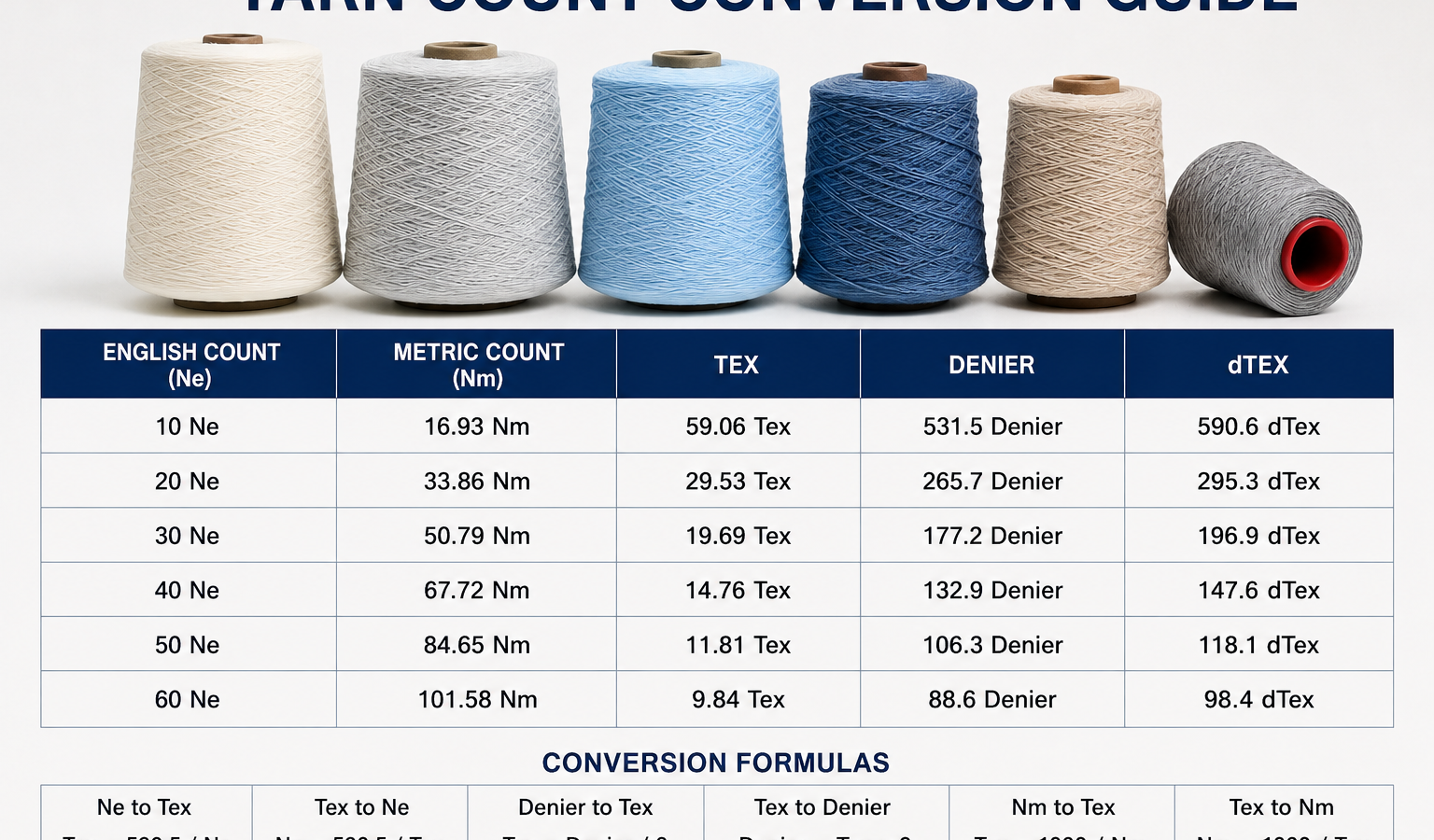
Yarn Count Conversion Formula Chart
Below are the most commonly used textile conversion formulas.
Ne to Tex
Tex=frac{590.5}{Ne}
Tex to Ne
Ne=frac{590.5}{Tex}
Denier to Tex
Tex=frac{Denier}{9}
Tex to Denier
Denier=Textimes9
Tex to Nm
Nm=frac{1000}{Tex}
Nm to Tex
Tex=frac{1000}{Nm}
Practical Example: Converting 30 Ne Cotton Yarn
Suppose a fabric manufacturer wants to convert:
30 Ne Cotton Yarn
to Tex.
Calculation:
Tex = 590.5 ÷ 30
= 19.68 Tex
Result:
30 Ne ≈ 19.7 Tex
This conversion is commonly used during fabric costing and yarn sourcing.
Practical Example: Converting 150 Denier Polyester Yarn
Formula:
Tex = Denier ÷ 9
Calculation:
150 ÷ 9
= 16.67 Tex
Result:
150 Denier = 16.67 Tex
This is one of the most common conversions in polyester filament manufacturing.
Practical Example: Converting 20 Tex to Ne
Formula:
Ne = 590.5 ÷ Tex
Calculation:
590.5 ÷ 20
= 29.5
Result:
20 Tex ≈ 29.5 Ne
This conversion is frequently used by spinning mills working with export customers.
Quick Yarn Count Conversion Chart
| Ne | Tex |
|---|---|
| 10 Ne | 59.05 Tex |
| 20 Ne | 29.53 Tex |
| 30 Ne | 19.68 Tex |
| 40 Ne | 14.76 Tex |
| 50 Ne | 11.81 Tex |
| 60 Ne | 9.84 Tex |
Denier to Tex Chart
| Denier | Tex |
|---|---|
| 75D | 8.33 Tex |
| 100D | 11.11 Tex |
| 150D | 16.67 Tex |
| 300D | 33.33 Tex |
| 600D | 66.67 Tex |
| 900D | 100 Tex |
These charts are useful for daily textile calculations.
Yarn Count Conversion in Fabric Manufacturing
Fabric designers often use yarn conversion when developing new fabrics.
Example
Fabric Construction:
64 × 64
30 Ne × 30 Ne
To calculate fabric weight and GSM accurately, many software systems first convert yarn counts into Tex values.
This standardizes calculations across different yarn systems.
Yarn Count Conversion in Textile Exports
Export buyers frequently use different count systems.
Example
Indian Supplier:
30 Ne Cotton Yarn
European Buyer:
Requests Nm equivalent
Conversion:
Nm = Ne × 1.693
Result:
30 Ne = 50.79 Nm
Accurate conversion helps avoid communication issues and production mistakes.
Yarn Count Conversion for Polyester Filament Yarn
Polyester manufacturers typically use:
- Denier
- dTex
Examples:
75D Polyester
Fine fabric applications
150D Polyester
Pocketing fabrics
300D Polyester
Industrial fabrics
600D Polyester
Bags and luggage fabrics
Understanding Denier-Tex relationships is critical for synthetic textile production.
Common Yarn Counts Used in Textile Industry
Cotton Spinning
- 20s
- 24s
- 30s
- 40s
- 60s
Pocketing Fabrics
Common counts:
- 20 PC
- 30 PC
- 45 PC
Shirting Fabrics
Common counts:
- 40s
- 50s
- 60s
Denim Fabrics
Common counts:
- 6s
- 8s
- 10s
- 16s
Each application requires different yarn thickness and performance characteristics.
Common Mistakes During Yarn Count Conversion
Mixing Direct and Indirect Systems
This is the most common mistake.
Remember:
Direct count:
Higher number = thicker yarn
Indirect count:
Higher number = finer yarn
Using Wrong Conversion Factors
Always verify formulas before calculation.
Ignoring Ply Structure
For example:
40/2 yarn differs from 40/1 yarn.
Ply structure affects actual yarn size.
Incorrect Unit Interpretation
Tex, Denier, and dTex are similar but not identical.
Always confirm the unit.
Benefits of Using Yarn Count Conversion Calculators
Modern textile professionals increasingly use online calculators.
Advantages include:
Faster Calculations
Instant results.
Improved Accuracy
Reduces manual errors.
Better Productivity
Useful for:
- Costing
- Product development
- Sales quotations
Easy International Communication
Supports buyers using different count systems.
Frequently Asked Questions
What is yarn count?
Yarn count indicates yarn fineness or thickness.
Which yarn count system is used for cotton yarn?
English Cotton Count (Ne).
Which count system is used for polyester filament yarn?
Denier and dTex.
What is Tex?
Weight in grams of 1000 meters of yarn.
Is higher Ne finer or thicker?
Higher Ne means finer yarn.
Is higher Denier finer or thicker?
Higher Denier means thicker yarn.
Why is yarn count conversion important?
It helps textile manufacturers, exporters, and buyers communicate accurately across different measurement systems.
Conclusion
Yarn count conversion is a fundamental skill for textile professionals involved in spinning, weaving, knitting, garment manufacturing, sourcing, and exports. As global textile trade continues to expand, understanding how to convert between Ne, Nm, Tex, Denier, and dTex becomes increasingly important.
Whether you’re developing a new fabric, purchasing yarn, preparing export quotations, or calculating production costs, accurate yarn count conversion helps ensure consistency, precision, and efficiency.
By mastering the formulas, understanding direct and indirect systems, and using reliable conversion tools, textile businesses can reduce errors, improve communication, and make better technical decisions.
In today’s competitive textile industry, a strong understanding of yarn count systems is not just technical knowledge—it’s a valuable business advantage.
Leave a Reply