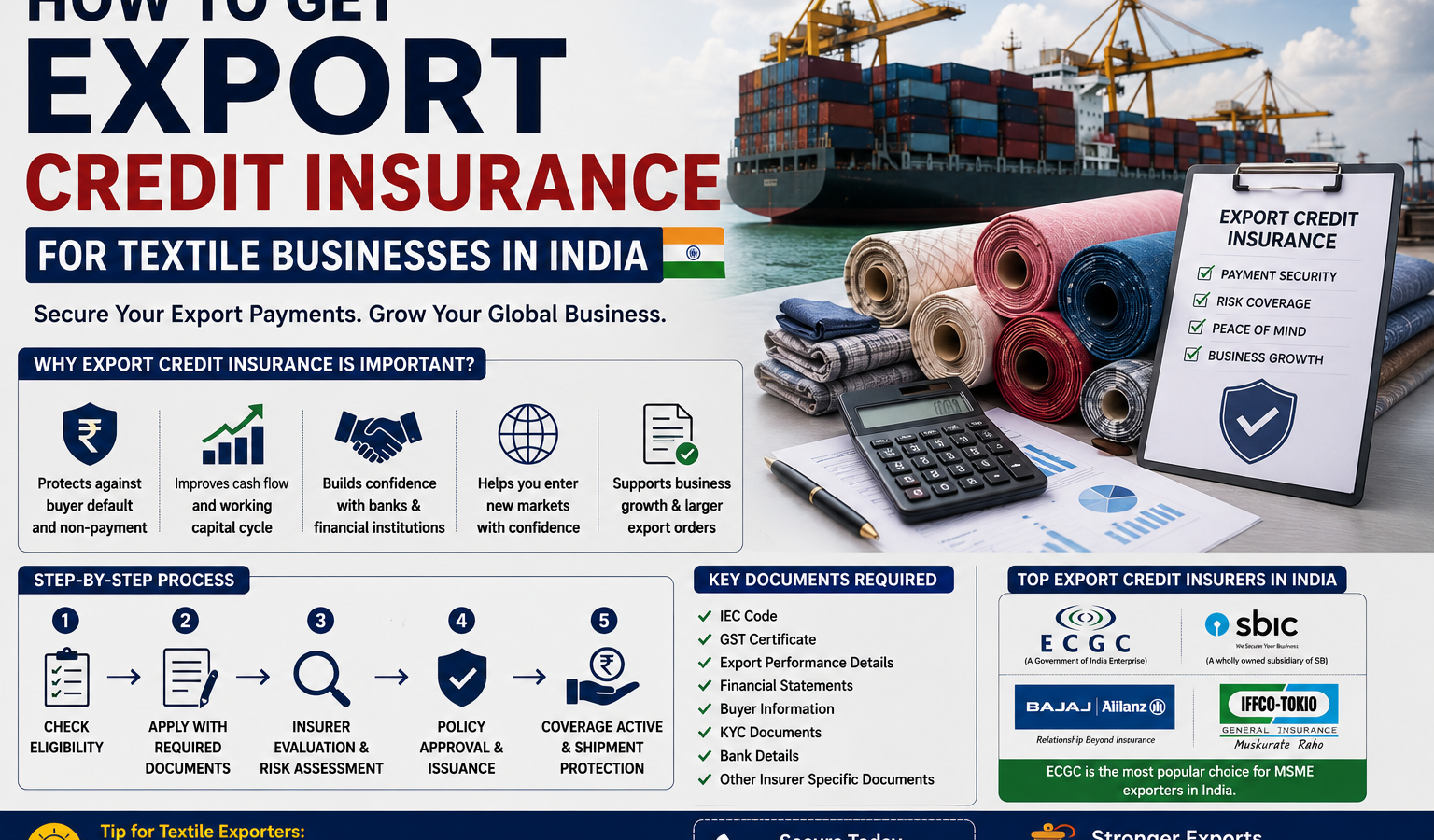
You’ve shipped the fabric. The buyer goes silent. ECGC export credit insurance is what protects Indian textile exporters from non-payment, buyer insolvency, and political risk. Here’s everything you need to know — and how to get it.
The Risk Every Textile Exporter Carries
Indian fabric and garment exporters collectively ship billions of dollars of goods abroad every year — mostly on open account terms with 30–90 day payment cycles. When a buyer defaults, goes bankrupt, or a country imposes payment restrictions, the exporter loses not just profit but often the entire cost of production. Export credit insurance is the financial safety net that makes exporting manageable — and bankable.
What Is Export Credit Insurance?
Export credit insurance is a financial protection product that covers an exporter against the risk of not getting paid after shipping goods abroad. Think of it as insurance for your invoice — if the buyer fails to pay (due to insolvency, default, or political events in their country), the insurance company compensates you for most of the loss.
There are two broad categories of risk covered:
- Commercial Risk: The buyer fails to pay because of financial difficulty, insolvency, or simply refusing to pay without a valid reason. This is the most common claim scenario for textile exporters dealing with fashion retailers or garment manufacturers abroad.
- Political Risk: The buyer cannot pay because of war, civil unrest, currency inconvertibility, import restrictions, or government actions in their country that prevent payment transfer to India. This matters especially for exporters dealing with buyers in politically volatile or economically stressed markets.
In India, export credit insurance is provided primarily by ECGC Limited (formerly Export Credit Guarantee Corporation of India) — a government-owned enterprise under the Ministry of Commerce that has been protecting Indian exporters since 1957. For large-value or specialised coverage, private trade credit insurers like Euler Hermes, Atradius, and Coface also operate in India.
A Letter of Credit (LC) ensures payment before shipment by making a bank the guarantor. Export credit insurance protects you after shipment when payment fails. Both serve different purposes — and many experienced textile exporters use both together: LC for large new buyers, and insurance as a portfolio-level safety net across all buyers.
Why Textile Exporters Specifically Need Export Credit Insurance
Not every export industry faces the same risk profile. Textile and garment exporters in India face a particularly high need for credit insurance, for reasons specific to how the industry works:
- Fashion buyers demand open credit terms: Unlike commodity exporters who can insist on LC, textile and garment buyers — especially fast fashion retailers in Europe and the US — expect 30–90 day open account terms as standard. Refusing means losing the order.
- Order volumes are high but margins are thin: A single ₹50 lakh fabric shipment that goes unpaid can wipe out six months of profit. The margin for absorbing losses is simply not there for most SME textile exporters.
- Buyers concentrate in volatile markets: Indian fabric exporters sell heavily to Bangladesh (garment factories with their own cash flow risks), UAE (re-export hub with opaque ultimate buyers), and increasingly to African and Central Asian markets with higher political risk profiles.
- Buyer concentrations create single-point risk: Many Indian fabric units have 2–3 buyers who account for 60–80% of export turnover. If one major buyer defaults, the impact is devastating without insurance.
- Banks require insurance for export credit: For pre-shipment and post-shipment bank credit at concessional rates, many banks now require ECGC coverage as a condition of the facility. Insurance unlocks better financing terms.
With ECGC coverage in place, you can confidently extend credit to new buyers — opening markets that would otherwise feel too risky. Many Indian textile exporters find that getting insured allows them to win orders from buyers they would have turned down before because the payment risk felt unmanageable.
ECGC Limited — India’s Export Credit Insurer
ECGC Limited (Export Credit Guarantee Corporation of India) is a government enterprise under the Ministry of Commerce and Industry, fully backed by the Government of India. It has been operating since 1957 and is the primary provider of export credit insurance to Indian exporters of all sizes.
ECGC serves two critical functions for the Indian export ecosystem:
- Direct coverage to exporters: Insurance policies that protect exporters against non-payment by overseas buyers.
- Guarantee to banks: Guarantees that protect banks which provide export credit (pre-shipment and post-shipment loans) to exporters — making banks more willing to lend to exporters at lower rates.
ECGC has a wide network across India with regional offices in all major textile export hubs — Mumbai, Chennai, Surat, Delhi, Kolkata, Bangalore, and Ahmedabad. Their textile and garment sector specialists understand the specific risk profile of fabric, yarn, and garment exports.
| Feature | ECGC Coverage |
|---|---|
| Founded | 1957 — government-backed, Ministry of Commerce |
| Coverage Countries | 200+ countries across all risk categories |
| Max Commercial Risk Coverage | Up to 90% of invoice value |
| Max Political Risk Coverage | Up to 90% of invoice value |
| Minimum Exporter Eligibility | Registered Indian exporter with IEC code |
| Policy Types Available | Shipment-based, turnover-based, bank guarantees |
| Claim Settlement Time | Typically 4–6 months after buyer default confirmed |
| Premium Payment | Monthly, quarterly, or annually depending on policy |
Types of ECGC Policies Available to Textile Exporters
ECGC offers several policy types designed for different exporter profiles — from small occasional exporters to large multi-buyer exporters with complex portfolios. Here are the most relevant ones for textile businesses:
The Standard Policy — also called the Shipment Comprehensive Risks Policy — is the most widely used ECGC product among Indian textile exporters. It covers all shipments made to all approved buyers during the policy period. You declare each shipment to ECGC monthly, and coverage applies automatically as long as you stay within your approved buyer credit limits.
The policy covers both commercial risk (buyer default, insolvency) and political risk (transfer restrictions, war, cancellation of import licences). This is the go-to policy for fabric and garment exporters with multiple buyers and ongoing shipment schedules.
The Small Exporters Policy offers the same comprehensive coverage as the Standard Policy but is specifically designed for smaller exporters with annual export turnover up to ₹5 crore. The premium rates are lower, the documentation requirements are simpler, and the on-boarding process is faster — making it accessible to small fabric traders and emerging garment exporters.
If you’re a power loom owner just starting to export, a fabric trader exploring international markets, or a garment unit with annual exports under ₹5 crore, this is your natural starting point with ECGC.
For exporters who don’t ship frequently or want to cover a single large shipment to a specific buyer, the Specific Shipment Policy provides one-time coverage without committing to an annual policy. You declare the shipment, ECGC approves the buyer credit limit, you ship, and you’re covered for that specific invoice.
This is particularly useful for textile businesses exploring a new market or testing a new buyer relationship with a high-value shipment before committing to a full trading relationship.
This is not a direct exporter policy — it’s a guarantee issued to your bank, covering the bank’s risk of providing you pre-shipment packing credit. When your bank has ECGC backing, they’re more willing to lend at the concessional export credit rate (7.5–9% vs 11–14% for regular loans) and with higher limits.
As a textile exporter, you benefit indirectly: cheaper working capital, higher credit limits, and a banking relationship that treats your export orders as bankable security. Many Indian textile exporters apply for this alongside a direct ECGC shipment policy.
Designed for large textile exporters with annual export turnover above ₹25–50 crore and multiple buyers. The Whole Turnover Policy provides blanket coverage across all export transactions during the year — without needing to declare each shipment individually. Monthly aggregate declarations suffice, making administration much lighter for high-volume operations.
This policy is common among integrated textile groups, large garment exporters, and yarn trading houses with established multi-country buyer portfolios.
NIRVIK Scheme — Enhanced Export Credit Insurance
The NIRVIK (Niryat Rin Vikas Yojana) Scheme, launched under the Ministry of Commerce, is a higher-coverage variant of ECGC insurance specifically designed to make export credit more accessible and affordable for MSME exporters — including small and mid-sized textile businesses.
NIRVIK addresses one of the biggest pain points of traditional ECGC policies: the gap between the insured amount and the actual loan outstanding. Under the standard scheme, banks still bear significant residual risk. NIRVIK eliminates this by:
- Providing insurance coverage of up to 90% of the principal and interest on the export credit outstanding — a significant increase from earlier norms.
- Reducing the premium rates for small exporters (below ₹80 crore in annual export turnover) to make coverage more affordable.
- Simplifying the documentation and claim process to speed up settlement.
- Making banks more willing to extend export credit to MSME textile exporters who don’t have large collateral bases.
Under NIRVIK, a small garment exporter with a ₹50 lakh pre-shipment packing credit limit can have up to ₹45 lakh of the bank’s exposure covered by ECGC. This dramatically reduces the bank’s hesitation to lend — and the exporter benefits through faster loan approvals, higher limits, and lower interest rates. Apply for NIRVIK through your bank’s trade finance desk — they initiate the ECGC coverage.
Country Risk — Where You Export Matters
ECGC classifies every country in the world into risk categories based on political stability, economic health, foreign exchange reserves, and payment history with Indian exporters. The category your buyer’s country falls into determines premium rates, coverage limits, and whether ECGC will cover that country at all.
For Indian textile exporters, Bangladesh is a critical market — it absorbs massive volumes of Indian grey fabric and yarn. Its C-category risk rating means ECGC coverage is available but premiums are higher and buyer credit limits are more conservative. For exporters selling heavily to Bangladesh, ECGC’s buyer-specific limit approvals are especially important.
Before quoting a large open-account order to a new buyer — especially in a medium or high-risk country — request a buyer credit limit from ECGC. This tells you the maximum credit ECGC will cover for that specific buyer. If ECGC declines or sets a very low limit, that’s a warning signal worth heeding, regardless of how well the buyer presents themselves.
Eligibility Criteria for ECGC Insurance
| Requirement | Details |
|---|---|
| IEC Code | Valid Import Export Code from DGFT — mandatory for all ECGC policies |
| GST Registration | Active GSTIN linked to your business entity |
| Business Registration | Registered entity — proprietorship, partnership, LLP, or Pvt Ltd |
| Bank Account | Active business current account with a bank handling foreign exchange |
| Export History | Preferred but not mandatory — new exporters eligible for Small Exporters Policy |
| No Overdue Claims | No pending unsettled ECGC claims or policy violations |
| Clean RBI Caution List Status | Your export account should not be on RBI’s caution list |
| Udyam Registration | Recommended for MSME-specific premium discounts and NIRVIK eligibility |
Documents Required to Apply for ECGC Policy
The ECGC application process is largely online (ecgc.in), but you’ll need the following documents ready for submission and verification:
How to Apply for ECGC Insurance — Step by Step
How to File an ECGC Claim — When a Buyer Doesn’t Pay
If a buyer defaults on payment, here’s exactly what you need to do to claim your insurance. Timing and documentation are critical — missing deadlines can invalidate your claim.
If a buyer asks for extended payment terms, a partial payment plan, or any change to the original invoice — you must inform ECGC immediately before agreeing. Restructuring a debt without ECGC’s consent can void your claim for that invoice entirely, even if you acted in good faith.
Tips to Maximise Your ECGC Coverage
Frequently Asked Questions
Is ECGC insurance mandatory for textile exporters in India?
No — ECGC insurance is not legally mandatory. However, it is strongly recommended, and many banks make it a de-facto requirement when providing pre-shipment packing credit or post-shipment credit to exporters. Exporting without any credit insurance is a significant financial risk, especially for SME textile businesses where a single default can be devastating.
Does ECGC cover all countries where I export fabric?
ECGC covers 200+ countries but not all at the same level. Countries are classified into risk categories — and for the highest-risk countries (typically conflict zones or countries with severe foreign exchange restrictions), ECGC may decline to provide cover or offer only partial coverage. Before entering a new market, check the country’s ECGC risk rating at ecgc.in.
What percentage of my invoice does ECGC actually pay if there’s a default?
Under current ECGC policies (and especially under the NIRVIK scheme), coverage is up to 90% of the insured invoice value. The remaining 10% is your retention — the portion you bear as the exporter. So if a buyer defaults on a ₹20 lakh invoice, ECGC pays up to ₹18 lakh (subject to the claim being admitted and within your approved buyer limit).
How long does ECGC take to settle a claim?
From the date of formal claim filing (which itself can only happen after 4–6 months of default and recovery attempts), ECGC typically takes another 4–6 months to investigate and settle. Total time from the original due date to receiving settlement money is typically 8–12 months. This is why maintaining cash reserves and a working capital buffer is important — insurance is a recovery tool, not an instant cash replacement.
Can I get ECGC insurance if I’m a new exporter with no export history?
Yes. ECGC’s Small Exporters Policy is specifically designed to be accessible to new exporters. You don’t need 2–3 years of export history — your IEC code, GST registration, and basic business documents are sufficient to apply. ECGC may set conservative buyer limits initially, which can be increased as your export track record grows.
Does ECGC insurance cover disputes where the buyer rejects the goods?
This is a grey area. ECGC covers non-payment, not disputed transactions. If a buyer rejects goods for a genuine quality reason (and there’s documented evidence of quality failure), ECGC may not admit the full claim. However, if the buyer is using a manufactured quality dispute as a pretext for not paying (a common tactic), ECGC does investigate and often sides with the exporter if shipping documents and quality certificates are in order. The lesson: always get pre-shipment inspection done and keep documentation immaculate.
Leave a Reply