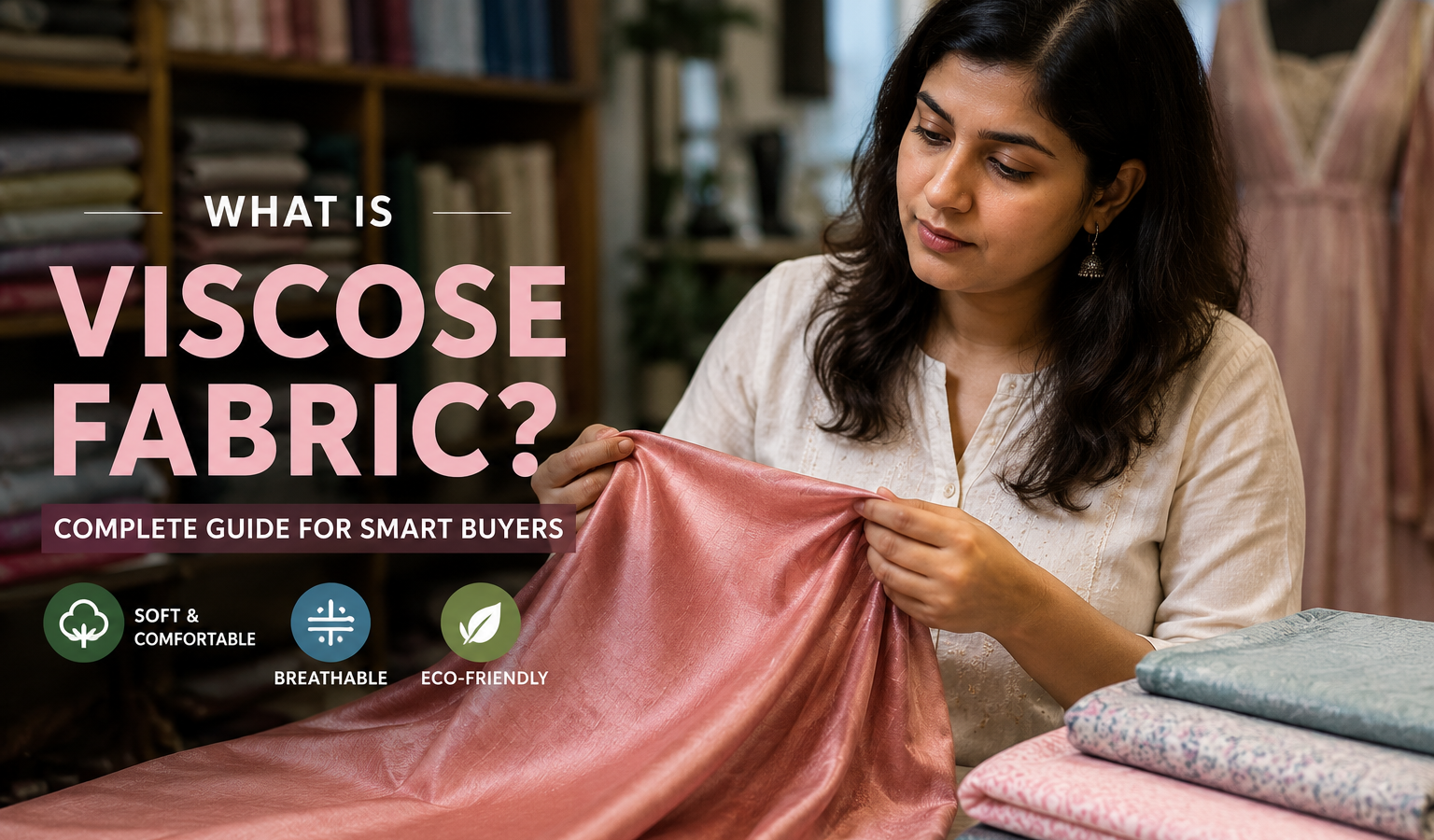
In short: Viscose is a semi-synthetic fabric made from wood pulp — soft, breathable, and beautifully drapey. It’s not fully natural like cotton, but not fully synthetic like polyester either. It sits right in the middle, which is exactly why it’s one of the most popular fabrics in India’s textile industry — especially for kurtis, sarees, dress material, and ethnic wear. This guide explains everything about viscose: what it is, how it’s made, what it’s good for, how to wash it, and whether it’s worth buying.
Walk into any fabric market in Surat, Jaipur, or Chandni Chowk and you’ll hear the word “viscose” at least a dozen times before you’ve touched your second roll. Shopkeepers will tell you it’s “like silk but cheaper.” Garment manufacturers will tell you it “flows beautifully.” Export buyers will ask if it’s certified sustainable.
They’re all right, in their own way. Viscose really is all of those things — and also a few things none of them will mention, like its habit of wrinkling the moment you sit down, or how it loses strength the second it gets wet.
If you’re buying viscose fabric to sell, manufacture, or wear, it helps to understand exactly what you’re dealing with. This guide covers everything — plainly, without the marketing fluff.
What Exactly Is Viscose Fabric?
Viscose is a fabric made from natural cellulose — typically from wood pulp from trees like beech, eucalyptus, pine, or bamboo — that has been dissolved and chemically reformed into soft, continuous fibres. The result is a smooth, lightweight material that looks and drapes like silk, feels comparable to cotton against the skin, but costs significantly less than either.
The name “viscose” actually comes from the thick, viscous liquid created during the manufacturing process — not from the final fabric’s properties. In many countries, the same fabric is called rayon. In India, you’ll commonly see it labelled as viscose, viscose rayon, or simply “rayon” on garment tags and fabric bills.
Viscose sits in an unusual middle ground — the raw material comes from trees, but the transformation process uses heavy chemistry. That makes it semi-synthetic, not natural and not fully artificial.
It’s worth understanding this classification because it affects everything — how the fabric behaves, how to care for it, and what sustainability claims are actually valid.
The five-stage process of turning wood pulp into viscose fabric. Despite starting from a natural source, the heavy chemical processing makes viscose “semi-synthetic.”
Key Properties of Viscose Fabric
Viscose has a very specific set of strengths and weaknesses. If you know them going in, you won’t be surprised later — and you’ll know exactly which situations it’s perfect for and which ones to avoid.
What viscose does really well
- Drape: This is viscose’s party trick. It flows and falls in a way that cotton simply cannot match. That fluid, almost liquid drape is why viscose is the go-to fabric for anarkalis, flowy kurtas, wrap dresses, and palazzos.
- Softness: Viscose is genuinely soft from the very first wear — no break-in period needed. It doesn’t scratch or irritate, making it comfortable for sensitive skin.
- Breathability: It doesn’t trap heat. For India’s climate, this matters enormously — viscose moves with your body and lets air circulate, unlike polyester.
- Moisture absorption: Viscose actually absorbs moisture better than cotton does. It pulls sweat away from the skin and lets it evaporate, keeping you cooler.
- Dye uptake: Viscose takes colour beautifully. It holds deep, vibrant shades and doesn’t fade quickly. This is why digitally printed viscose has become popular — the colours look stunning.
- Price: For the look and feel it delivers, viscose is remarkably affordable — typically ₹150–₹350 per metre wholesale in India, depending on weight and finish.
What viscose doesn’t do well
- Wet strength: Viscose weakens significantly when wet. If you scrub it, wring it, or put it in a harsh machine cycle while damp, it can stretch out of shape or even tear at the seams.
- Wrinkling: Viscose wrinkles easily and badly. Fold it once and you’ll see a crease that needs an iron to fix.
- Shrinkage: If washed in hot water or put in a dryer on high heat, viscose will shrink — sometimes noticeably. Always cold wash or hand wash.
- Durability: It’s not the toughest fabric in the room. With proper care it lasts well, but it doesn’t have the rugged, wash-it-a-hundred-times resilience of cotton.
- Stretch: Pure viscose has almost no elasticity. If you want a fitted or body-con garment, you need a viscose-elastane blend.
Types of Viscose Fabric
“Viscose” isn’t a single thing — it’s a family of related fabrics, all made from regenerated cellulose but with different manufacturing refinements:
| Type | Key Feature | Common Use |
|---|---|---|
| Standard viscose (rayon) | Soft, lightweight, excellent drape | Kurtis, dresses, sarees, lining |
| Modal | Made from beech pulp; softer and more shrink-resistant than standard viscose | Innerwear, T-shirts, loungewear |
| Lyocell (Tencel) | Closed-loop production; most eco-friendly variant | Premium denim, active wear, sustainable fashion |
| Bamboo viscose | Cellulose sourced from bamboo; marketed as sustainable | Baby clothing, bed linen, activewear |
| High Wet Modulus (HWM) | Engineered for better wet strength and durability | Upholstery, towels, industrial use |
| Viscose georgette | Sheer, light, crinkled texture | Dupattas, scarves, party wear |
| Viscose challis | Soft, matte finish, light weight | Summer dresses, blouses, ethnic wear |
What Is Viscose Used For?
Walk through any ready-made garment market in India and you’ll find viscose in more places than you might expect. It’s popular precisely because it looks like something more expensive than it is.
Ethnic and fashion wear: Kurtis, anarkalis, salwar suits, palazzos, wrap dresses, maxi dresses, blouses. Viscose’s drape makes it ideal for any silhouette that needs to fall gracefully from the shoulder or waist.
Sarees and dress material: Viscose georgette and challis are used extensively in printed sarees. The fabric takes digital and screen printing beautifully, and the final drape rivals that of chiffon or georgette at a much lower price point.
Garment lining: Viscose is a preferred lining fabric for jackets, blazers, coats, and formal suits. It’s smooth against the skin, lightweight, and doesn’t add bulk.
Home textiles: Viscose blends are used in bedsheets, pillowcases, and curtains — particularly when a silky finish is desired without the cost of real silk.
Accessories: Scarves, stoles, dupattas, and ties in viscose have a sheen and softness that makes them look premium.
Side-by-side comparison of viscose, cotton, and polyester. Viscose wins on drape and softness; cotton on durability; polyester on wrinkle resistance and price.
How to Identify Viscose Fabric
If you’re buying fabric without a label — common in wholesale markets — here’s how you can recognise viscose from touch and basic testing:
Touch test: Viscose feels cool, soft, and slightly silky. It’s lighter than cotton at the same apparent thickness. If you rub it between your fingers and it feels both smooth and slightly slippery, you’re likely holding viscose.
Drape test: Hold a piece up and let it fall. Viscose drapes in long, smooth folds that fall close to vertical. Cotton will drape with more body and volume. Polyester will hold its shape and spring back slightly.
Burn test: This is the most reliable field test. Take a small thread from the fabric and hold it to a flame carefully. Viscose burns quickly with an orange flame, smells like burning paper (because it’s cellulose-based), and leaves a fine, soft grey ash — just like cotton or linen. Polyester melts and beads, and smells like chemicals. Silk chars and smells like burning hair.
Water test: Wet a small corner of the fabric. Viscose will feel noticeably weaker when wet — you can pull it apart more easily. Cotton maintains its strength. This is one of the defining physical differences.
How to Care for Viscose Fabric
Viscose gets a bad reputation for being “difficult” — but it’s only difficult if you treat it like cotton. Follow these rules and your viscose garments will last well:
Do this
- Hand wash in cold water with a gentle detergent
- Use a delicate machine cycle at 30°C or below
- Air dry flat or hanging — never in a dryer
- Iron on low heat (silk setting) while slightly damp
- Store loosely folded or hung — don’t crush
- Dry clean for structured or heavily embroidered pieces
Avoid this
- Hot water wash — will shrink and weaken fibres
- Wringing or twisting when wet — can permanently distort shape
- Tumble drying — heat causes shrinkage and damage
- Harsh scrubbing or vigorous washing
- Leaving wet for a long time — can lose shape
- High iron temperature — will shine or scorch
Is Viscose Fabric Sustainable?
This is where the marketing and the reality start to part ways. You’ll see viscose described as “plant-based,” “eco-friendly,” and “natural” in a lot of brand communications. Some of that is true. A lot of it is incomplete.
What’s genuinely good: Viscose is biodegradable — it will break down naturally, unlike polyester which can persist in landfills for centuries. The raw material comes from wood pulp, which is a renewable resource when sourced from responsibly managed forests.
What’s genuinely concerning: The manufacturing process uses heavy chemicals — sodium hydroxide and carbon disulfide — that are harmful to workers and can pollute water sources if not managed properly. Conventional viscose factories in some countries have serious environmental compliance issues.
The better alternatives: Lyocell (sold commercially as Tencel) uses a closed-loop process where around 99% of the chemicals are recycled and reused. Bamboo viscose sounds greener because bamboo grows fast without pesticides — but the process of turning bamboo into fibre still uses the same chemicals as conventional viscose. The “EcoVero” brand label (a product from Lenzing) is a more credible certification for sustainable viscose — it uses certified wood sources and significantly lower water and emissions than standard production.
Bottom line: viscose is better than polyester on biodegradability, but it’s not as clean as many brands imply. If sustainability is a purchasing priority, look for Lenzing EcoVero certification or Tencel (lyocell).
Viscose in the Indian Textile Market
India is one of the world’s largest consumers and processors of viscose fabric. Surat, in particular, is a major hub for viscose georgette and challis — the fabric powering India’s massive domestic ethnic wear market and a significant chunk of export volumes to the Middle East, Southeast Asia, and the US.
Why viscose works so well for Indian fashion: The climate is the most obvious reason — viscose is cool, breathable, and moisture-absorbing, which makes it ideal for the Indian summer that lasts more than half the year. Its drape makes it perfect for kurtas, dupattas, and sarees where the way fabric falls is as important as how it feels. And its ability to hold vivid printed colours makes it the fabric of choice for India’s huge digital and block print fashion market.
In wholesale markets, viscose fabric typically runs between ₹150 and ₹350 per metre depending on weight (GSM), finish, and whether it’s plain or printed. Viscose georgette tends to be on the lighter end (around 60–80 GSM), while viscose challis or crepe runs heavier (100–140 GSM) and feels more structured.
A practical guide to when viscose is your best choice — and when another fabric will serve you better.
Frequently Asked Questions About Viscose
- Is viscose the same as rayon?
- Yes, essentially. Viscose and rayon refer to the same type of fibre — regenerated cellulose made from wood pulp. In India and the UK, the term “viscose” is most common. In the US, the same material is usually called “rayon.” Both names are used interchangeably on garment care labels and fabric bills.
- Does viscose shrink when washed?
- It can, especially if washed in hot water or put in a tumble dryer. Viscose is sensitive to heat and mechanical agitation when wet. Always wash viscose in cold or lukewarm water on a gentle cycle, and air dry flat. If you’re manufacturing in viscose, pre-wash the fabric before cutting to account for any first-wash shrinkage.
- Is viscose fabric good for summer in India?
- Yes, it’s excellent for Indian summers. Viscose is lightweight, breathable, and absorbs moisture better than cotton, which makes it genuinely cooling to wear in heat. The fabric doesn’t cling uncomfortably and allows air circulation. Its main summer limitation is that it wrinkles easily, so it needs an iron after washing.
- Is viscose fabric safe for sensitive skin?
- Generally yes. Viscose is a smooth fibre with no scratchy or abrasive surface texture, making it comfortable for people with sensitive skin. It’s also considered hypoallergenic. However, some people react to residual chemicals from the manufacturing process — if you’re very sensitive, look for certified organic viscose or Lyocell/Tencel, which use cleaner production methods.
- Can viscose be ironed?
- Yes, but carefully. Use a low heat setting — the silk or synthetic setting on your iron — and ideally iron while the fabric is still slightly damp. Ironing viscose on high heat will cause it to shine, scorch, or in some cases permanently damage the fibres. A pressing cloth between the iron and fabric adds an extra layer of protection.
- Is viscose fabric expensive?
- No, viscose is one of the more affordable fabric options for the quality it delivers. In Indian wholesale markets, plain viscose fabric typically ranges from ₹150 to ₹350 per metre, and printed viscose from ₹200 to ₹500 depending on print quality and GSM. It costs significantly less than real silk but delivers a comparable look and drape for most garment applications.
- What is the difference between viscose and polyester?
- Viscose is semi-synthetic (made from natural wood pulp with chemical processing) while polyester is fully synthetic (made from petroleum-based chemicals). Viscose is more breathable, softer, and biodegradable. Polyester is more durable, wrinkle-resistant, and cheaper. For Indian fashion and ethnic wear, viscose is generally preferred because of its drape and comfort in heat. Polyester is better for items that need to hold shape and withstand frequent washing.
Final Word
Viscose is one of those fabrics that rewards you when you understand it properly. It’s not the most durable thing in your wardrobe. It requires a bit more care than cotton. And it’s not as eco-friendly as some brands would like you to believe.
But for drape, for softness, for that liquid fall that makes an anarkali or a wrap dress look effortlessly elegant — there’s very little that matches viscose at its price point. India’s huge ethnic wear market figured this out decades ago. The fabric has stuck around because it genuinely delivers.
If you’re sourcing viscose for manufacturing or buying it to wear, just match it to the right application, wash it gently, and don’t put it in the dryer. Do that, and viscose will look good for a long time.
Looking to calculate fabric cost for a viscose order? Try our Fabric Cost Calculator — it works for any fabric type and helps you build accurate pricing from GSM, width, and material cost.
Leave a Reply