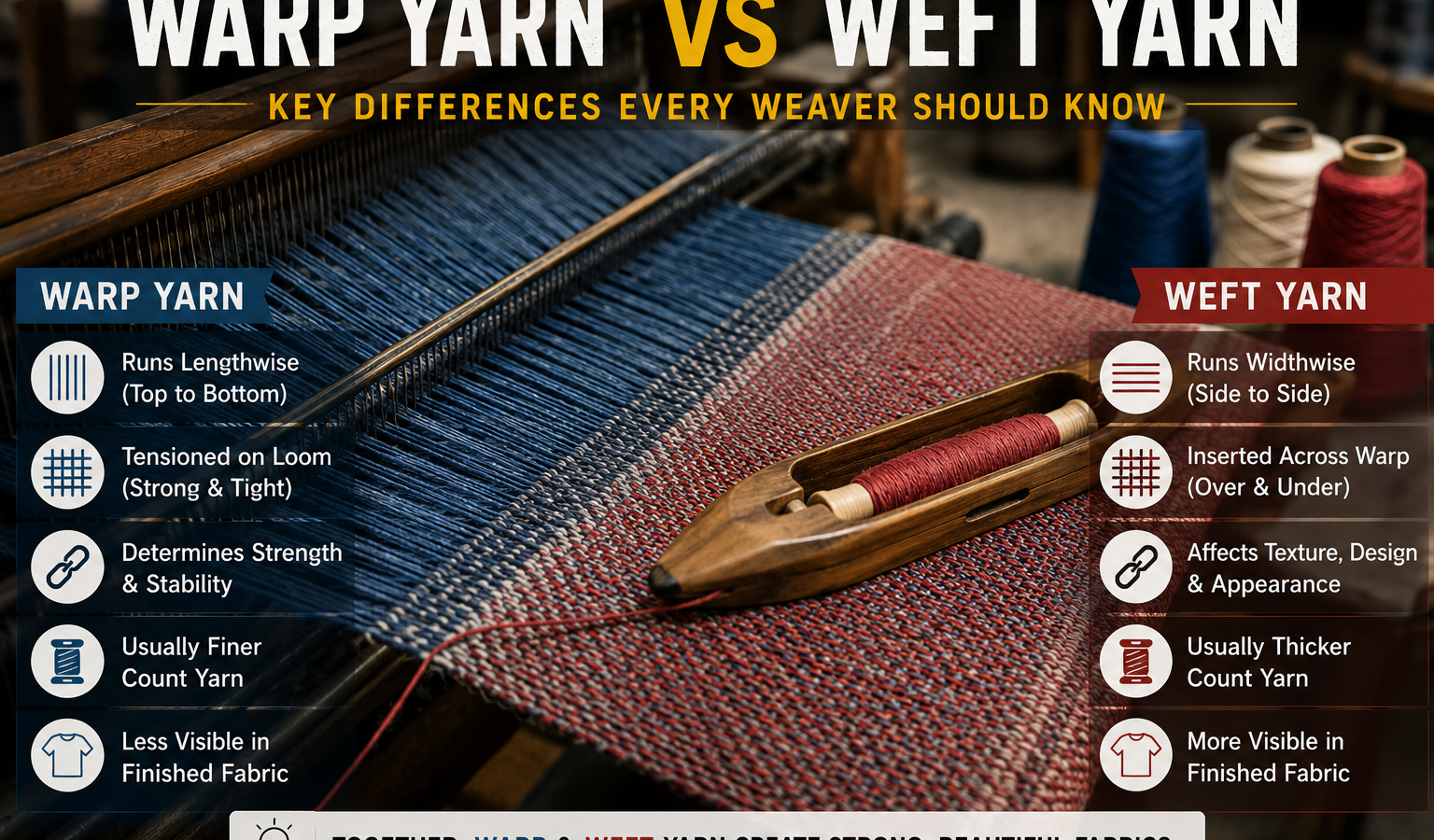
The quick answer: Warp yarn runs lengthwise along the fabric, stays fixed under tension on the loom, and must be strong, smooth, and tightly twisted. Weft yarn runs crosswise, moves through the warp during weaving, and can be softer, bulkier, and more creative. They do different jobs, so they need different qualities — and understanding the difference changes how you select yarn, set up your loom, design your fabric, and troubleshoot weaving problems.
Ask someone new to weaving what the difference between warp and weft is and they’ll usually say something like “one goes this way and the other goes that way.” Which is true, but barely scratches the surface of what actually matters.
The real differences between warp and weft run much deeper than direction. They affect what kind of yarn you choose, how tightly you spin or buy it, whether it needs chemical treatment, which direction you cut your garment patterns, why some fabrics stretch more in one direction than the other, and what goes wrong when things go wrong on the loom.
Whether you’re a handloom weaver setting up a new project, a garment cutter figuring out grain lines, a textile student preparing for an exam, or a fabric buyer trying to understand a spec sheet — this guide covers everything that actually matters about the warp and weft distinction.
The Fundamental Difference: What Each Yarn Does
At its most basic, weaving is the interlacing of two sets of perpendicular threads. The system only works because these two sets have completely different roles — and their physical requirements follow directly from those roles.
Warp yarns are the yarns that are wound onto the loom beam and stretched taut before weaving begins. They are the skeleton of the fabric — held under constant tension throughout the entire weaving process. Every time a weft thread passes through, it’s the warp threads that open and close, being lifted and lowered repeatedly by the heddles. Warp yarn has a hard job: it must endure constant tension, repeated bending, friction from the reed and heddles, and abrasion from shuttle or rapier passage — all without breaking.
Weft yarns (also called filling, picks, or in Indian handloom tradition, the bana) are the yarns that travel crosswise through the shed — the gap created when alternate warp threads are lifted. The weft’s job is comparatively simple: pass through the shed smoothly, pack down evenly, and contribute to the colour, texture, pattern, and hand of the finished fabric. Weft yarn doesn’t bear tension the way warp does. It’s the creative element of the fabric.
“Think of the warp as the infrastructure and the weft as the expression. The warp holds everything up. The weft makes it interesting.”
On a loom, warp yarns (purple) run lengthwise under constant tension between the beams. Weft yarns (green) pass crosswise through the shed row by row, interlacing with the warp to create fabric. The tightly woven edges are the selvedge.
Warp Yarn: The Load-Bearer
Direction, Role & Function
Warp yarn runs parallel to the selvedge — the finished edge of the fabric. On a fabric roll, the warp direction is the length of the roll. In garment cutting, this direction is called the grain line, and most pattern pieces are placed along it because the warp provides dimensional stability. Warp-cut garments hold their shape better, resist twisting after washing, and drape cleanly from the shoulder.
During weaving, warp yarns are under constant mechanical stress. They’re stretched taut on the loom beam and remain under tension for the entire weaving process, which can run for hours on a handloom or continuously on a power loom. Every cycle of the heddles bends the warp threads up and down as the shed opens and closes. Every pass of the reed packs the weft threads against the fell of the cloth, abrading the warp yarns in the process. The warp must survive all of this without breaking — hundreds of thousands of times on an industrial loom.
Why Warp Yarn Needs Special Properties
Because of the mechanical demands, warp yarn must have four essential characteristics that weft yarn doesn’t need to the same degree:
Low stretch (inelasticity). Warp yarn must stay the same length under tension without stretching or recovering. If warp yarn stretches under the loom’s tension, the fabric will be uneven — some sections tighter, some looser. Yarns with high elasticity (like wool singles or loosely spun yarns) are problematic in warp unless managed carefully.
High abrasion resistance. The reed, heddles, and lease sticks all rub against warp yarns repeatedly. Any fibre or yarn construction that pills, fuzzes up, or breaks under abrasion will create weaving defects. This is why cotton, linen, hemp, and tightly spun silk have historically dominated warp use — their naturally smooth surfaces resist abrasion.
Consistent diameter. Variations in warp yarn thickness create visible streaks in the finished fabric, called “warp bars” or “reed marks.” Industrial buyers class these as major defects. For handweavers, thick-and-thin yarns in warp create a rustic effect — but only when intentional.
Integrity under bending. Warp yarns flex thousands of times as the heddles move up and down. Yarns with low twist or brittle fibre structures (like certain novelty yarns) simply don’t survive this without breaking.
Sizing — The Treatment That Makes Warp Possible
In industrial weaving, warp yarn goes through an additional preparation step that most weavers — especially handweavers — never think about: sizing. Sizing is the application of a starch or polymer coating (typically starch, PVA, or CMC) to the warp yarn before it goes onto the loom. The size fills the gaps between fibres, smooths the yarn surface, and temporarily bonds fibres together, dramatically increasing the yarn’s ability to withstand the repeated abrasion of the heddle eyes, lease rods, and reed.
Without sizing, the fine cotton or synthetic yarns used in industrial weaving would break constantly, grinding production to a halt. After weaving, the size is washed out of the fabric in the “desizing” step of the finishing process. The consumer never sees it, but it’s what makes it possible to weave fine-count fabrics at speed.
Handweavers using plied or mercerised yarn at lower thread counts often don’t need to size at all. But if you’re weaving with single, low-twist yarn, or at high EPI, sizing (even a light spray starch) can dramatically reduce breakage.
Weft Yarn: The Creative Element
Direction, Role & Function
Weft yarn runs perpendicular to the selvedge — across the width of the fabric. In garment cutting, the weft direction is sometimes called the cross-grain. Fabric cut on the cross-grain has slightly more stretch than fabric cut on the grain — which is why a bias cut (at 45° to both warp and weft) gives the most stretch and the most fluid drape of any cutting direction.
The weft yarn’s job during weaving is comparatively gentle. It is wound onto a shuttle, pirn, or bobbin and passed through the shed created when alternate warp threads are lifted. It doesn’t bear tension the way warp does. It doesn’t need to survive thousands of cycles of up-and-down bending. It just needs to pass smoothly through the shed without tangling, knotting, or breaking, and then be beaten evenly into the fell of the cloth by the reed.
The Creative Freedom of Weft
Because the weft doesn’t have to survive the loom’s mechanical abuse the way the warp does, weavers have tremendous creative latitude in weft selection. Almost any yarn can become a weft if it can pass through the shed without tangling:
Textured yarns — bouclé, mohair, chenille, slub yarn — all work well as weft. These would cause constant breakage in warp position but are perfectly functional and beautiful in weft.
Novelty and specialty yarns — metallic threads, ribbon yarn, rags, cord, even wire — are used as weft in artistic and craft weaving.
Natural fibres in less-spun forms — wool roving, silk hankies, raw cotton — can be used as weft in ways that would be impossible as warp.
Colour variation — most stripe effects and colour changes across a fabric come from changing the weft colour. Horizontal stripes = changing weft. Vertical stripes = changing warp.
Luxurious fibres — in traditional Indian weaving, expensive fibres like pure silk or zari (metallic thread) are often used as weft against a more economical cotton warp. The expensive fibre shows on the face of the fabric without bearing the mechanical load of the weaving process.
Complete property comparison of warp and weft yarn across 12 characteristics. The differences flow directly from their contrasting roles during weaving.
How to Identify Warp and Weft in Any Fabric
You’ve been handed a piece of unmarked fabric and need to figure out which direction is warp and which is weft. Here are the reliable tests, in order of ease:
Test 1: The Selvedge Test (most reliable)
Find the selvedge — the finished, non-fraying edge that runs the length of the fabric. The warp yarns run parallel to the selvedge. The weft yarns run perpendicular to it. If you have a full width of fabric with selvedges intact, you already know the answer.
Test 2: The Stretch Test (quick and practical)
Hold the fabric in both hands and pull in one direction, then the other. The direction that stretches less is the warp. The warp has been under tension during weaving and is more tightly locked into the structure, so it has less give. The weft direction almost always has slightly more stretch, even in a tightly woven fabric.
Test 3: The Yarn Count Test
Use a pick glass (thread counting magnifier) and count the number of threads per inch in each direction. The direction with more threads per inch is usually the warp — most fabrics have higher EPI than PPI because warp yarns are set closer together. This is not universal, but it holds for most standard fabrics.
Test 4: The Thickness and Twist Test
Pull a thread from each direction and examine it. Warp yarn is typically finer (thinner diameter) and more tightly twisted. Weft yarn is typically slightly coarser and less tightly twisted. In some fabrics, you can see that one direction has a slight Z-twist visible and the other S-twist — Z-twist is usually the warp.
Test 5: The Burn and Pull Test
Pull a few threads in each direction and test their tensile strength by pulling between your hands. The direction whose threads are harder to break is the warp. Warp threads are stronger because they’ve been engineered (through higher twist and sometimes sizing) to be tougher.
Why This Matters for Garment Cutting
Understanding warp and weft is not just theoretical knowledge for weavers. It has direct, practical consequences for garment makers and tailors.
Grain line and pattern placement. Every sewing pattern has a grain line — an arrow that indicates which direction of the fabric the pattern should be placed along. In most garments, the grain line is placed parallel to the warp (along the selvedge). This is because warp-direction fabric resists stretching and maintains the garment’s shape. A skirt panel cut on the warp grain hangs straight. The same panel cut on the weft grain may sag or pull because weft has slightly more give. And anything cut on the bias (45° to both warp and weft) will stretch and drape dramatically — deliberately, in bias-cut dresses and skirts.
Stripe alignment. In a horizontally striped fabric, the stripes run in the weft direction. When cutting, you need to align the stripes across the seam — which requires careful attention to where the weft threads fall at each cutting line. Stripe misalignment is one of the most common and most visible quality defects in garment production.
Fabric twist and garment shape. If a garment panel is cut slightly off-grain — not quite parallel to the warp — the garment will twist to one side after washing. This is the cause of trouser legs that spiral around the leg and shirts whose button plackets curl to one side. These defects are entirely preventable by cutting on grain, which requires knowing which direction the warp runs.
Three grain line directions and their practical effects on garment behaviour. Understanding warp and weft direction is essential for correct pattern placement.
EPI and PPI: Measuring Warp and Weft Density
Thread density — how many threads per inch in each direction — is one of the most important specifications when ordering or evaluating fabric. Warp density is measured in EPI (Ends Per Inch) and weft density in PPI (Picks Per Inch).
| Fabric | EPI (Warp) | PPI (Weft) | What it means |
|---|---|---|---|
| Muslin (light) | 44 | 40 | Open, breathable, economical |
| Poplin shirting | 120 | 80 | Fine, crisp, more warp than weft |
| Denim (3×1 twill) | 68 | 42 | Heavy, strong, typical denim spec |
| Sateen (bed sheet) | 160 | 120 | Dense, smooth — “400 thread count” |
| Handloom cotton voile | 80 | 70 | Balanced, sheer, even |
| Gabardine suiting | 100 | 70 | More warp density for firm structure |
Higher thread counts in both directions generally mean a smoother, finer, denser fabric — and a higher price, because finer yarns and denser weaving require more precise equipment and slower production. The EPI and PPI numbers, combined with the yarn count, define a fabric more precisely than its commercial name alone.
Warp and Weft in Indian Handloom Tradition
In India’s handloom tradition, the distinction between warp and weft — tana and bana — is not just technical. It’s artistic and cultural. The warp is the given structure: once set up on the loom, it commits the weaver to a width, a density, and a length. The bana (weft) is where the weaver expresses their craft — choosing colour, texture, and pattern row by row.
In many of India’s most celebrated woven textiles, this tension between the structured warp and the expressive weft is the heart of the craft. In a Pochampally ikat saree, both warp and weft threads are resist-dyed before weaving to create the characteristic blurred, jewel-like pattern. In a Banarasi brocade, the warp provides the silk base structure while the weft — often worked with fine gold or silver zari thread on an extra weft system — creates the intricate floral and foliate motifs that give Banarasi its value. In a Kanjivaram silk, the warp and weft are sometimes woven from different silk qualities, with the more lustrous warp creating the face of the fabric.
Understanding which yarn is which isn’t just useful for the technical weaver. It’s what lets you appreciate what you’re looking at when you hold a handwoven textile — and understand why it was made the way it was.
Frequently Asked Questions
- What is the difference between warp yarn and weft yarn?
- Warp yarn runs lengthwise along the fabric, parallel to the selvedge. It is held under tension on the loom and must be strong, tightly twisted, and abrasion-resistant. Weft yarn runs crosswise through the warp, passing through the shed. It doesn’t bear the same mechanical stress and can be softer, coarser, or textured. Warp determines the grain and structural strength; weft determines texture, colour pattern, and hand feel.
- Which is stronger — warp or weft yarn?
- Warp yarn is stronger in almost all fabrics. It must withstand constant loom tension and repeated abrasion during weaving, so it’s spun with higher twist and finer, more uniform fibres. The warp direction of a finished fabric is also stronger and more stretch-resistant than the weft direction.
- How do I identify warp and weft in a piece of fabric?
- The simplest tests: find the selvedge (the finished non-fraying edge) — the warp runs parallel to it. Or pull the fabric in both directions — the direction with less stretch is the warp. You can also look at thread density with a pick glass — the direction with more threads per inch is usually the warp.
- What is EPI and PPI in fabric?
- EPI stands for Ends Per Inch — the number of warp threads per inch of fabric width. PPI stands for Picks Per Inch — the number of weft threads per inch of fabric length. Together, EPI and PPI specify how densely a fabric is woven. Higher numbers generally mean a finer, denser, smoother fabric.
- What is tana and bana in Indian handloom?
- Tana (ताना) is the Hindi/Urdu term for warp yarn — the lengthwise threads set up on the loom before weaving begins. Bana (बाना) is the term for weft yarn — the crosswise thread that is woven through the tana. These terms are used across handloom traditions in Varanasi, Andhra Pradesh, Gujarat, and other major weaving regions of India.
- Why do garment patterns have a grain line?
- The grain line on a sewing or cutting pattern indicates the warp direction. Most pattern pieces are placed with the grain line parallel to the warp because warp-direction fabric is more stable and resists stretching, so garments cut on the grain hold their shape better, hang straighter, and don’t twist after washing. Cutting off-grain is one of the most common causes of garment quality problems in production.
- Can any yarn be used as warp?
- Not all yarns are suitable for warp. Good warp yarn needs to be strong enough to withstand loom tension, smooth enough to resist abrasion from the reed and heddles, inelastic (low stretch) so the fabric stays even, and consistent in diameter. Highly textured yarns (bouclé, mohair, slub), loosely spun singles, and very elastic yarns are usually unsuitable as warp. Most of these yarns work beautifully as weft, however, where the demands are much gentler.
Final Thoughts
Warp and weft are the most fundamental concept in all of woven textile work. Everything else — the weave structure, the pattern, the drape, the grain line, the thread count, the defect names — only makes sense when you understand what these two directions do and why they behave differently.
The warp is discipline and structure. The weft is flexibility and expression. A good woven fabric needs both: the firm backbone of the warp and the generous creativity of the weft. Getting the balance right — choosing the right yarns, setting the right densities, understanding the grain — is what separates fabric that merely holds together from fabric that performs, drapes, and lasts.
If you work with woven fabrics in any capacity — weaving, garment cutting, fabric buying, or quality control — keeping this distinction clear will save you from a surprisingly large number of problems.
For calculations related to fabric structure and thread count, the Warp & Weft Calculator and Fabric GSM Calculator on this site will help you work through EPI, PPI, and GSM calculations for any woven fabric specification.
Leave a Reply