Introduction
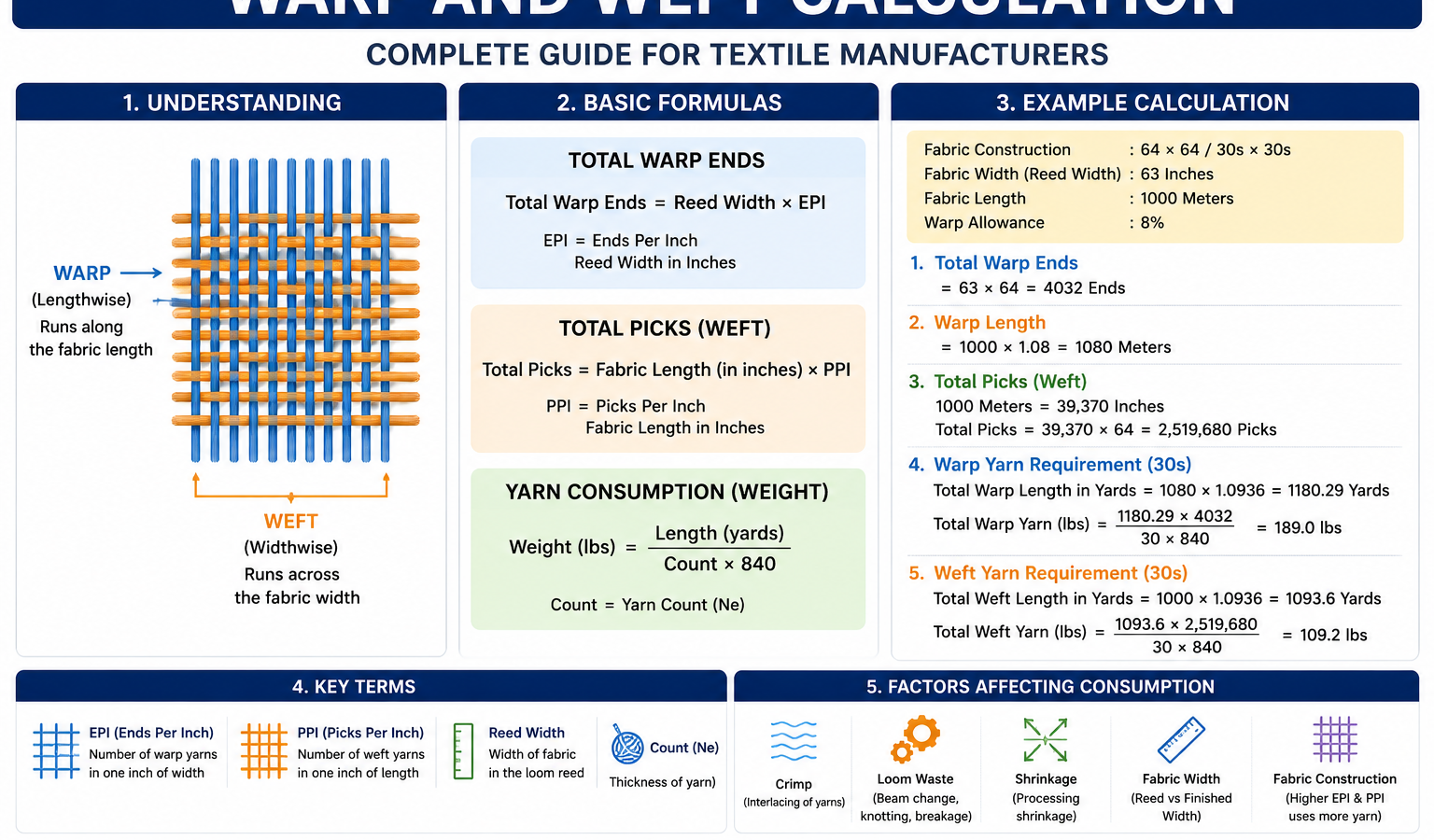
Every woven fabric begins with two fundamental elements: warp and weft. Whether you’re manufacturing shirting fabric, pocketing fabric, denim, bedsheets, uniforms, or industrial textiles, understanding warp and weft calculations is essential for accurate production planning, costing, and fabric quality control.
For textile students, fabric designers, weaving supervisors, and textile entrepreneurs, warp and weft calculations often appear complicated at first. However, once you understand the formulas and logic behind them, the process becomes surprisingly simple.
A small mistake in warp or weft calculation can result in:
- Incorrect yarn consumption
- Higher production costs
- Fabric shortages
- Delivery delays
- Profit margin losses
This guide explains warp and weft calculations in practical terms, using real-life textile examples, industry formulas, and easy-to-understand calculations that can be applied directly in weaving operations.
What Is Warp in Weaving?
Warp refers to the yarns running lengthwise in a woven fabric.
These yarns are placed on the loom before weaving begins.
Characteristics of Warp Yarn
- Runs along fabric length
- Generally stronger than weft yarn
- Subjected to higher tension during weaving
- Mounted on warp beams
Examples:
In a 100-meter fabric roll, the yarns running continuously throughout the 100-meter length are warp yarns.
What Is Weft in Weaving?
Weft refers to yarns inserted across the width of the fabric.
These yarns interlace with warp yarns to create fabric structure.
Characteristics of Weft Yarn
- Runs across fabric width
- Inserted by shuttle or modern insertion systems
- Generally experiences less tension
Examples:
In a 58-inch wide pocketing fabric, the yarns crossing from one side to another are weft yarns.
Why Warp and Weft Calculations Matter
Accurate calculations help manufacturers determine:
Yarn Requirements
Avoid excess inventory and shortages.
Fabric Costing
Estimate production costs accurately.
Production Planning
Calculate beam requirements and loom efficiency.
Fabric Specifications
Maintain required construction and quality.
For weaving units, warp and weft calculations are the foundation of production management.
Understanding Fabric Construction
Fabric construction is usually expressed as:
Example
64 × 64 / 30s × 30s
Meaning:
- 64 Ends Per Inch (EPI)
- 64 Picks Per Inch (PPI)
- 30s warp yarn
- 30s weft yarn
This information forms the basis of warp and weft calculations.
Key Terms Used in Warp and Weft Calculation
Ends Per Inch (EPI)
Number of warp yarns present in one inch of fabric width.
Picks Per Inch (PPI)
Number of weft yarns present in one inch of fabric length.
Reed Width
Width of fabric in loom reed.
Finished Width
Width after processing and finishing.
Warp Count
Yarn count used in warp direction.
Weft Count
Yarn count used in weft direction.
Understanding these terms is critical before performing calculations.
Warp Calculation Formula
The total number of warp ends is calculated as:
Total Warp Ends=Reed Widthtimes EPI
Example
Fabric Width:
63 inches
EPI:
64
Calculation:
Total Warp Ends
= 63 × 64
= 4032 Ends
Thus:
4032 warp yarns are required across the fabric width.
Warp Yarn Requirement Calculation
To calculate warp yarn consumption:
Warp Length=Fabric Length+Warp Allowance
Warp allowance includes:
- Loom waste
- Knotting loss
- Shrinkage allowance
Example
Fabric Length:
1000 meters
Warp Allowance:
8%
Calculation:
Warp Length
= 1000 × 1.08
= 1080 meters
This becomes the working warp length.
Weft Calculation Formula
Weft consumption depends on:
- Fabric width
- Picks per inch
- Fabric length
Formula
Total Picks=Fabric Lengthtimes PPI
Example
Fabric Length:
100 meters
PPI:
64
Convert length:
100 meters = 3937 inches
Calculation:
Total Picks
= 3937 × 64
= 251,968 Picks
Thus:
251,968 weft insertions are required.
Warp Weight Calculation
For cotton yarn:
Formula
Weight (lbs)=frac{Length (yards)}{Counttimes840}
For metric calculations, conversions are applied accordingly.
Example
Warp Count:
30s
Warp Length:
4,800,000 yards
Calculation:
Weight
= 4,800,000 ÷ (30 × 840)
≈ 190.5 lbs
This determines warp yarn requirement.
Weft Weight Calculation
The same principle applies to weft yarn.
Example
Total Weft Length:
3,500,000 yards
Count:
30s
Calculation:
Weight
= 3,500,000 ÷ (30 × 840)
≈ 138.9 lbs
Practical Example: Pocketing Fabric Calculation
Let’s calculate warp and weft for a common pocketing fabric.
Fabric Specification
Construction:
64 × 64
Yarn:
30s PC × 30s PC
Width:
58 inches
Production:
1000 meters
Warp Ends
58 × 64
= 3712 Ends
Warp Length
1000 × 1.08
= 1080 meters
Total Warp Yarn
3712 × 1080
= 4,008,960 meters
Total Picks
1000 meters
= 39,370 inches
39,370 × 64
= 2,519,680 picks
This forms the basis for yarn consumption calculations.
Warp and Weft Calculation for Bedsheet Fabric
Consider:
Fabric Specification
68 × 68
30s × 30s
Width:
92 inches
Production:
5000 meters
Warp Ends
92 × 68
= 6256 Ends
Warp Length
5000 × 1.08
= 5400 meters
Total Warp Yarn
6256 × 5400
= 33,782,400 meters
These calculations help estimate yarn procurement requirements.
Factors Affecting Warp and Weft Consumption
Several factors influence final consumption.
Crimp Percentage
Yarns interlace and bend during weaving.
This increases actual yarn usage.
Loom Waste
Some yarn is lost during:
- Beam changes
- Knotting
- Breakages
Processing Shrinkage
Fabric dimensions change after processing.
Fabric Construction
Higher EPI and PPI increase yarn consumption.
Width Changes
Wider fabrics require more warp yarn.
Understanding these factors improves calculation accuracy.
Warp vs Weft: Key Differences
| Parameter | Warp | Weft |
|---|---|---|
| Direction | Lengthwise | Widthwise |
| Tension | Higher | Lower |
| Strength Requirement | Higher | Moderate |
| Mounted Before Weaving | Yes | No |
| Continuous During Weaving | Yes | Inserted Continuously |
These differences explain why warp and weft calculations are performed separately.
Common Mistakes in Warp and Weft Calculation
Ignoring Crimp
Can lead to underestimation of yarn requirements.
Ignoring Warp Allowance
May result in beam shortages.
Incorrect Width Assumptions
Reed width and finished width are different.
Wrong Unit Conversions
Always verify:
- Inches
- Meters
- Yards
before calculations.
Using Incorrect Yarn Counts
Consumption calculations depend heavily on yarn count accuracy.
Modern Software for Warp and Weft Calculation
Most textile mills now use:
Textile ERP Systems
Automatically calculate:
- Warp requirement
- Weft requirement
- Yarn consumption
- Costing
Weaving Planning Software
Provides:
- Beam planning
- Loom scheduling
- Production optimization
These tools reduce manual errors significantly.
Frequently Asked Questions
What is warp in fabric?
Warp refers to yarns running lengthwise in woven fabric.
What is weft in fabric?
Weft refers to yarns inserted across the fabric width.
What is EPI?
Ends Per Inch, representing warp density.
What is PPI?
Picks Per Inch, representing weft density.
Why are warp calculations important?
They help determine yarn requirements, costing, and production planning.
Which yarn experiences higher tension?
Warp yarn typically experiences higher tension during weaving.
Can ERP software calculate warp and weft automatically?
Yes. Modern textile ERP systems can automate most calculations.
Conclusion
Warp and weft calculations form the backbone of weaving production planning. Whether you’re manufacturing pocketing fabric, shirting material, bedsheets, denim, or industrial textiles, accurate calculations ensure smooth production, better cost control, and improved profitability.
By understanding EPI, PPI, yarn count, fabric width, crimp allowances, and yarn consumption formulas, textile professionals can make better decisions regarding procurement, production planning, and fabric costing.
As textile manufacturing becomes increasingly data-driven, mastering warp and weft calculations remains one of the most valuable technical skills for anyone involved in weaving and fabric production.
Leave a Reply