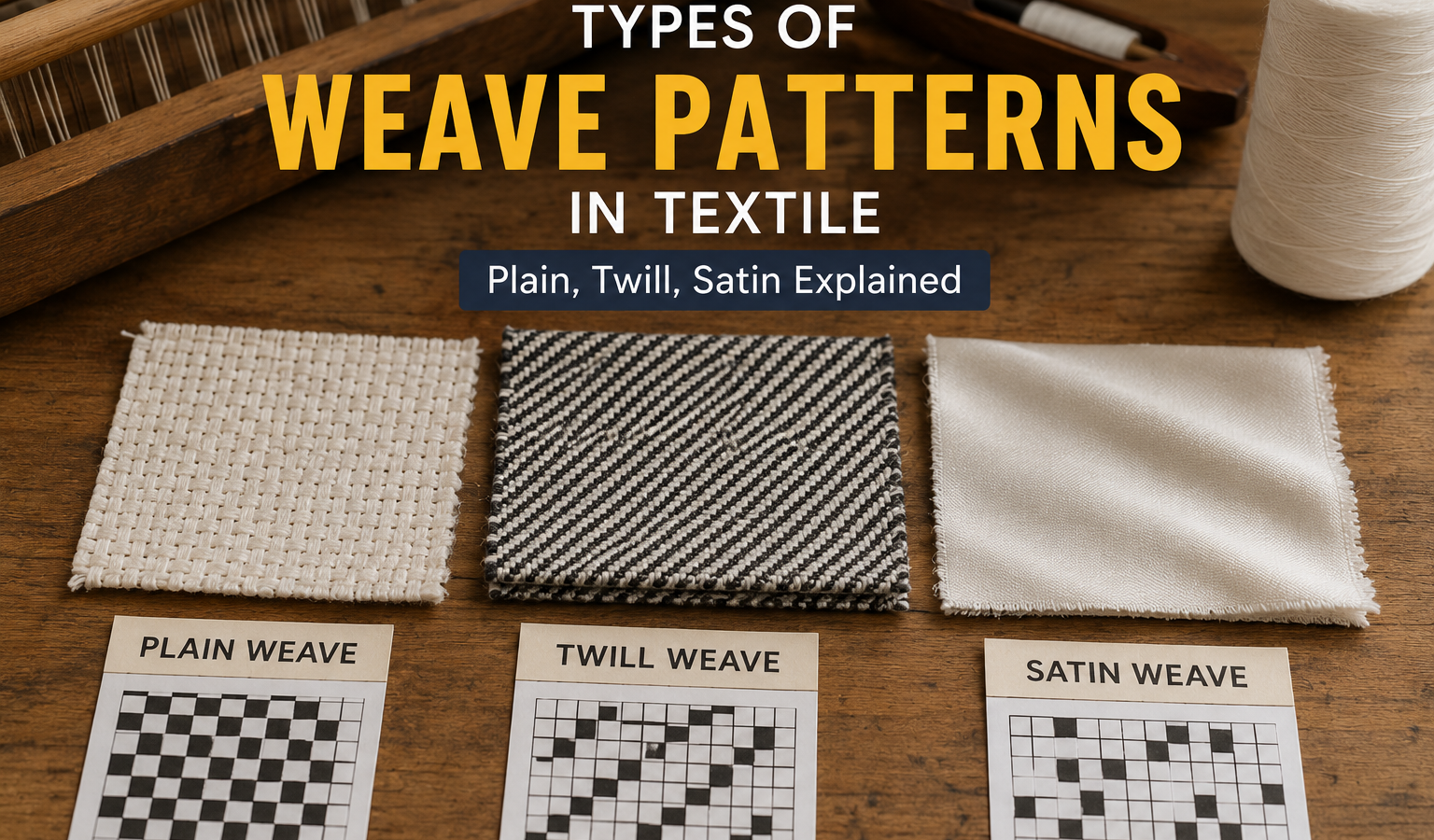
What this covers: All three fundamental weave structures — plain, twill, and satin — explained from first principles, plus five important derived weaves: basket, herringbone, dobby, jacquard, and leno. Each weave includes its structure, key properties, recognisable fabric examples, and practical applications. Useful for buyers, manufacturers, fashion students, and anyone who wants to understand why fabric behaves the way it does.
Every woven fabric you’ve ever touched — a crisp poplin shirt, worn-in denim, a silky satin blouse, a Banarasi brocade saree — gets its character from one thing above everything else: the pattern in which the warp and weft threads cross each other. That pattern is the weave structure, and it controls almost everything about a fabric’s personality. How it feels. How it drapes. Whether it wrinkles. How strong it is. How it catches light.
There are three fundamental weave structures. Plain, twill, and satin. Every other weave in existence — herringbone, jacquard, dobby, basket, leno — is either a variation of one of these three or a combination of them. Understanding the fundamentals means you can look at any woven fabric and start to understand what you’re working with, without needing a lab or a microscope.
This guide goes through all of them, starting from the basics and building up to the more complex structures, with real fabric examples you’ll recognise from everyday use.
First: What Is Warp and Weft?
Before getting into weave types, the most essential vocabulary: warp and weft. These are the two sets of threads in any woven fabric.
Warp threads run lengthwise — parallel to the selvedge, along the length of the fabric roll. They’re stretched taut on the loom before weaving begins. Warp threads are generally stronger and more tightly twisted than weft, because they have to withstand the tension of the loom throughout production.
Weft threads (also called filling threads) run crosswise — perpendicular to the selvedge, from one edge of the fabric to the other. They’re passed through the raised warp threads by a shuttle or rapier, one row at a time. The pattern in which the weft passes over and under the warp threads defines the weave structure.
The weave is the rule that decides which warp threads lift up and which stay down each time a new weft thread passes through. Change the rule, and you get a different fabric entirely — even if the yarn is exactly the same.
The weave structure grid for plain (1/1), twill (2/1), and satin (4/1). Darker squares = warp on top. The progression from plain to satin shows fewer interlacing points, longer floats, and increasing surface smoothness.
The Three Fundamental Weaves
Plain Weave — The Oldest and Most Common
Plain weave is the simplest weave structure possible: the weft thread passes over one warp thread and under the next, alternating all the way across. The next row does the opposite — over where the previous row went under, and under where it went over. The result is a tight, even checkerboard of interlacing points.
Because every single thread crosses every adjacent thread, plain weave has the maximum number of interlacing points of any weave. This is what makes plain weave fabrics firm, flat, and relatively crisp — and also what makes them less smooth and less lustrous than twill or satin.
Fabrics you know that are plain weave: Poplin (used in formal shirts), muslin, voile, chiffon (fine yarns, very open), taffeta, organza, canvas, calico, flannel (before brushing), georgette, crepe de chine.
Where it’s used: Formal shirting, dress material, lining fabric, printed fabric (plain weave is the best background for printing because it’s flat and even), bed sheets, handkerchiefs, filters, and industrial textile applications.
Variations: Rib weave (heavier weft yarns create horizontal ribs — example: faille, ottoman, bengaline, poplin’s subtle rib). Basket weave (two or more threads treated as one in each direction — creates a more open, textured surface — example: Oxford cloth, monk’s cloth).
Twill Weave — The Diagonal That Does Everything
In twill weave, the weft thread passes over two or more warp threads, then under one (or more), and the key feature is that each row shifts the interlacing point one step to the left or right. This staggered shift is what creates the characteristic diagonal line — called a wale or rib — that runs across the surface of every twill fabric. You can see it clearly in denim if you look closely at the fabric surface.
Because the shift reduces the total number of interlacing points compared to plain weave, twill fabrics are less crisp and more fluid. The longer yarn floats between interlacing points also means the surface feels softer and shows more lustre than plain weave in the same yarn. Twill fabrics also tend to drape better and resist wrinkles more effectively.
Fabrics you know that are twill weave: Denim (3×1 twill — three warp threads over one weft), gabardine (steep twill, used in formal trousers), chino and khaki, drill cloth, flannel (after brushing), serge, tweed, corduroy (ribbed twill), and most suiting materials.
Where it’s used: Trousers, jeans, jackets, school uniforms, workwear, heavy dress material, suiting, outerwear, and upholstery. Anywhere you need strength, drape, and resistance to wear.
Key twill variations:
Herringbone — twill direction reverses at regular intervals, creating a V-shaped zigzag (resembles the bones of a herring). Used in wool suiting and traditional tweed.
Houndstooth — a two-colour broken twill that creates the characteristic four-pointed star pattern. Popular in suiting fabric and classic fashion.
Satin twill (sateen) — a long-float twill variant that approaches satin in smoothness, used in linings and formal wear.
Satin Weave — Luxury, Lustre, and Long Floats
Satin weave has the fewest interlacing points of the three fundamental structures. In a standard 5-harness satin weave, the warp thread floats over four weft threads before going under one — and the next interlacing point is placed two or more steps away from the previous one, so no diagonal line forms on the surface. The result is a very smooth surface with long, unbroken yarn segments reflecting light uniformly.
This is why satin fabrics look shiny and feel silky — the long floats minimise the interruptions in the surface that would scatter light. The downside is structural: fewer interlacing points means the yarns can shift, the surface can snag, and the fabric is generally less durable than plain or twill weave in the same yarn.
Fabrics you know that are satin weave: Silk satin, polyester satin, charmeuse, duchess satin, satin-back crepe, bridal satin, sateen (weft-faced version of satin, commonly in bed sheets). The distinction: satin usually refers to the weave structure, while sateen is specifically a weft-faced version where the weft floats form the shiny surface.
Where it’s used: Bridal wear and formal gowns, lining fabric inside suits and jackets, evening blouses, bedsheets (high-thread-count sateen), luxury upholstery, cushion covers, sash and ribbon, and dress dupattas.
Familiar fabrics mapped to their weave structure. Most fabric names you know trace back to one of these three foundational patterns.
Derived and Specialty Weaves
Beyond the three fundamentals, a number of important weave structures are used widely in textiles — each derived from or combining aspects of the basic three. Here are the most practically important ones for garment and fabric buyers:
Basket Weave
A variation of plain weave where two or more warp threads are treated as one unit, and two or more weft threads pass together. The pattern looks like woven basket reeds — an open, squared texture. Basket weave is more flexible and breathable than tight plain weave but less firm and more prone to yarn slippage and shrinkage. Classic example: Oxford cloth (2×1 basket), used in casual shirts. Monk’s cloth (4×4) is a heavier version used in upholstery.
Herringbone Weave
A twill variation where the diagonal direction reverses at regular intervals, creating a repeating V or chevron pattern that resembles a herring fish skeleton. Herringbone retains all the strength and drape of twill while adding a sophisticated visual texture that reads as more formal at fine scales and more casual at large scales. Widely used in wool suiting, tweed, and knitwear-inspired wovens. Popular in India for worsted suiting and structured blazer fabric.
Dobby Weave
Dobby weave uses a special attachment on the loom (the dobby mechanism) to create small, repeating geometric patterns woven directly into the fabric. The designs are subtle — small diamonds, dots, squares, stripes, or florals — and read as texture rather than print. Dobby fabric has more visual interest than plain weave but is simpler and cheaper to produce than jacquard. Piqué fabric (used in polo shirts) is a dobby weave. Other examples include self-striped shirting, end-on-end fabric, and textured suiting cloth.
Jacquard Weave
Jacquard is the most complex weave structure, produced on a special loom (the Jacquard loom, invented in France in 1801 and an ancestor of computer programming) that controls every single warp thread individually. This allows virtually unlimited pattern complexity — large florals, intricate geometrics, tapestry effects, images woven in thread. Jacquard fabrics are the most labour and equipment-intensive wovens.
In India, jacquard weave is at the heart of many of the country’s most famous textiles: Banarasi brocade sarees, kanjivaram silk, damask table linen, and luxury upholstery fabric. Famous jacquard fabrics globally include brocade, damask, matelassé, and tapestry. The key distinction: in jacquard, the pattern is woven into the structure of the fabric itself, not printed or embroidered on after.
Leno Weave
Leno (also called gauze weave) is an open, lace-like weave where pairs of warp threads twist around each other between each weft row, locking the structure open. This prevents the yarns from sliding together even in a very open layout — which is what allows fabrics like mosquito net, marquisette, and gauze to be so sheer without falling apart. In Indian textile use, leno weave appears in dupattas, lightweight scarves, fine net fabric, and some saree borders.
How Weave Affects Fabric Properties: The Complete Picture
Seven key fabric properties compared across six weave types. Green = strong/high/favourable. Amber = moderate. Red = low/weak/unfavourable.
Which Weave to Choose for Which Application
The right weave depends on what you need the fabric to do. Here’s a quick decision guide by garment type and end use:
| Application | Best Weave | Why |
|---|---|---|
| Formal dress shirts | Plain (poplin, Oxford) | Smooth, flat surface for crispness; excellent for printing and dyeing |
| Dress trousers / formal suiting | Twill (gabardine, serge) | Drape, strength, wrinkle resistance, and professional finish |
| Denim jeans | Twill (3×1 denim) | Maximum strength and durability from the diagonal structure |
| Bridal wear / evening gowns | Satin or Jacquard | Lustre, drape, or woven design pattern for luxury effect |
| Printed kurtas and ethnic wear | Plain (poplin, cambric, voile) | Flat surface takes digital and screen print cleanly |
| Sarees (daily wear) | Plain, light twill, or crepe | Drape and breathability for daily comfort |
| Banarasi and luxury sarees | Jacquard (brocade weave) | Complex woven zari patterns cannot be achieved any other way |
| Workwear and uniforms | Twill (drill, gabardine) | Abrasion resistance, strength, and shape retention under stress |
| Polo shirts | Dobby (piqué) | Textured surface, moisture management, structured collar |
| Dupattas and scarves | Plain (chiffon, georgette) or leno | Lightness, drape, sheerness |
| Suit linings | Satin or twill (satin-back crepe) | Smooth interior that slides easily over inner garments |
| Upholstery and home décor | Jacquard, twill, or basket | Durability plus design capability; basket for casual, jacquard for luxury |
Weave Patterns and Indian Textile Heritage
India’s extraordinary handloom tradition is fundamentally a tradition of weave mastery. Many of India’s most celebrated textiles are defined entirely by their weave structure — not just by their fibre or their colour.
The Banarasi brocade saree gets its signature woven gold and silver motifs from jacquard weave on a silk warp satin base. The Chanderi saree combines plain and satin weaves within the same fabric to create that characteristic transparent body with a lustrous border. Kanjivaram silk uses a heavy, closely-packed twill structure that gives the fabric its characteristic weight and rigidity. Pochampally and Patola ikat fabrics use plain weave so the resist-dyed yarn patterns show cleanly without visual interference from a textured weave surface.
Understanding weave structure isn’t just useful for industrial fabric buyers and garment manufacturers. It’s what allows you to appreciate why a Banarasi costs what it does, why Kanjivaram feels and hangs the way it does, and why a chiffon dupatta drapes so differently from a georgette one — even though both are made from similar yarns and worn similarly.
Frequently Asked Questions
- What are the three basic types of weave patterns in textile?
- The three fundamental weave structures are plain weave (1 over, 1 under — maximum interlacing), twill weave (diagonal rib pattern — 2 or more over, 1 under with a step shift), and satin weave (long floats, fewest interlacing points, smooth lustrous surface). All other weaves — basket, herringbone, jacquard, dobby, leno — are derived from or combine these three.
- What is the difference between plain weave and twill weave?
- In plain weave, every weft thread crosses every warp thread one at a time, creating maximum interlacing, a flat surface, and the most durable but stiffest fabric. In twill weave, each weft thread passes over two or more warps before going under one, and each row shifts the pattern one step, creating a diagonal rib. Twill fabrics are stronger than they look, drape better, and resist wrinkles more effectively than plain weave in the same yarn.
- Why does satin fabric look shiny?
- Satin weave creates long yarn floats — warp threads that lie across four or more weft threads without interlacing. These uninterrupted thread surfaces reflect light uniformly and in the same direction, producing a characteristic sheen. The more consistent and longer the float, the more lustrous the fabric appears. This is why satin in silk or high-quality polyester can look almost mirror-like.
- What is the strongest type of weave?
- Plain weave is technically the strongest per unit of yarn because it has the maximum number of interlacing points — every thread locks every adjacent thread in place. However, twill weave is often considered more practically durable because its structure distributes stress diagonally, making it more resistant to tearing along a single line. Denim (3×1 twill) is a classic example of a very durable twill fabric.
- What is the difference between satin and sateen?
- Both are satin-structure weaves with long floats creating a smooth, lustrous surface. Satin is warp-faced — the warp threads form the floats on the surface. Sateen is weft-faced — the weft threads form the floats. In practice, sateen (usually cotton) has the shiny surface formed by the weft, while satin (often silk or polyester) has it formed by the warp. Sateen is commonly used for bed linen; satin for garments.
- What is a jacquard weave and how is it different from regular weaving?
- In regular weaving, entire rows of warp threads are lifted or lowered together (by harnesses), which limits how complex a pattern can be. In jacquard weaving, every single warp thread is controlled individually by the Jacquard mechanism, allowing patterns of virtually unlimited complexity — intricate florals, large geometric repeats, figurative designs — to be woven directly into the fabric structure. Jacquard fabrics include brocade, damask, Banarasi sarees, and luxury upholstery.
- Is denim a plain weave or twill weave?
- Denim is a twill weave, specifically a 3×1 twill — the warp thread passes over three weft threads before going under one. This structure gives denim its characteristic diagonal line (clearly visible on the reverse of unwashed denim), its strength, and its drape. The typical blue-and-white colour of denim comes from the warp being dyed indigo while the weft remains undyed — not from the weave itself.
Final Thoughts
Learning to read weave structure is one of those skills that seems technical at first but very quickly becomes intuitive. Once you’ve understood why a gabardine trouser doesn’t wrinkle as easily as a poplin shirt (the twill structure, not just the weight), or why a chiffon dupatta floats so differently from an organza one (similar plain structure, wildly different yarn twist and weight), you start seeing fabric differently.
The weave is the architecture of a textile. Everything else — the fibre, the colour, the finish — is decoration applied to that structure. Get the weave right for your application, and the rest becomes much easier to manage.
For fabric weight calculations related to any woven structure, try the Fabric GSM Calculator on this site — it works for all woven fabric types and helps you understand how GSM relates to fabric construction and end use.
Leave a Reply