Introduction
In today’s highly competitive textile industry, quality is no longer just a selling point. It is a business necessity.
Whether you’re manufacturing cotton fabrics, polyester textiles, denim, garments, home textiles, uniforms, or technical fabrics, maintaining consistent quality directly impacts customer satisfaction, profitability, and brand reputation.
A single shipment containing defects can result in:
- Customer complaints
- Order cancellations
- Payment delays
- Export rejections
- Loss of future business
This is why successful textile manufacturers invest heavily in quality control systems.
Textile quality control is not simply about checking finished products. It begins with raw material inspection and continues through spinning, weaving, dyeing, printing, finishing, cutting, stitching, packing, and shipment.
This comprehensive guide explains everything you need to know about textile quality control, including inspection methods, testing procedures, quality standards, defect prevention strategies, and best practices used by leading textile manufacturers worldwide.
What Is Textile Quality Control?
Textile Quality Control (TQC) is the process of monitoring, inspecting, and maintaining product quality throughout textile manufacturing.
The primary objective is to ensure that products meet specified standards before reaching customers.
Key Goals of Textile Quality Control
- Reduce defects
- Improve consistency
- Meet customer specifications
- Increase production efficiency
- Minimize waste
- Improve profitability
Quality control serves as a bridge between production and customer satisfaction.
Why Textile Quality Control Is Important
Quality problems can become expensive very quickly.
Imagine a manufacturer exporting 50,000 meters of fabric.
If the buyer discovers major defects after shipment, the consequences may include:
- Claim settlements
- Replacement costs
- Freight losses
- Reputation damage
Strong quality control systems prevent these issues before they occur.
Benefits of Effective Quality Control
✔ Higher customer satisfaction
✔ Lower rejection rates
✔ Reduced production waste
✔ Better brand reputation
✔ Increased profitability
✔ Improved export performance
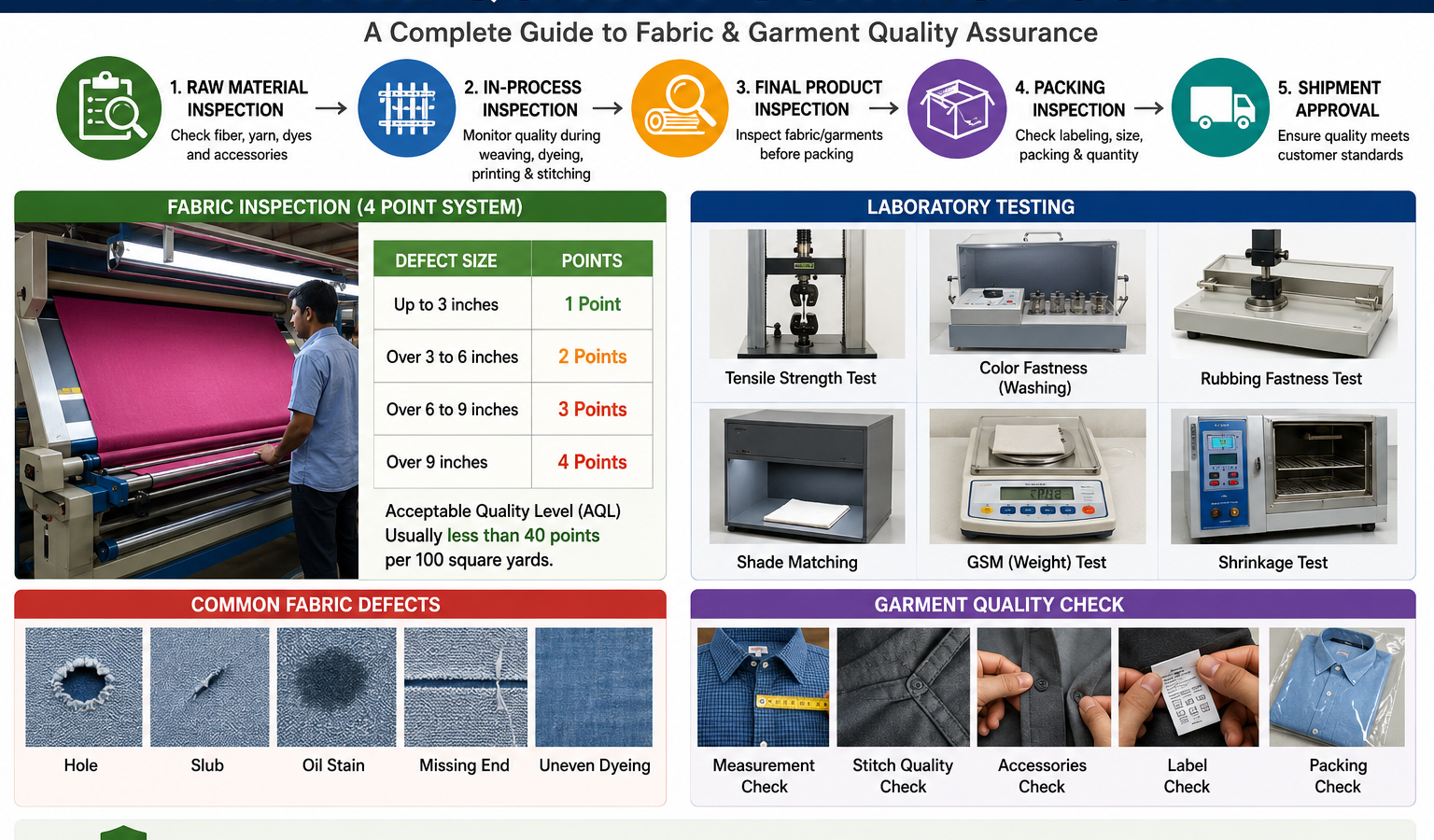
Stages of Textile Quality Control
Quality control should be implemented throughout the manufacturing process.
Raw Material Inspection
The process begins before production starts.
Materials inspected include:
- Cotton fiber
- Polyester fiber
- Yarn
- Dyes
- Chemicals
- Accessories
Poor raw materials often lead to quality issues later in production.
In-Process Quality Control
Monitoring during production helps identify problems early.
Examples:
- Yarn defects
- Weaving faults
- Dyeing issues
- Printing defects
Early detection reduces rework and waste.
Finished Product Inspection
Final inspection ensures products meet customer requirements before shipment.
This is often the last opportunity to identify quality issues.
Raw Material Quality Control
Quality products begin with quality raw materials.
Fiber Testing
Important parameters include:
Fiber Length
Affects yarn strength and uniformity.
Fiber Strength
Impacts yarn durability.
Micronaire
Measures cotton fineness and maturity.
Moisture Content
Critical for storage and processing.
Yarn Inspection
Before weaving or knitting, yarn quality is evaluated.
Parameters include:
- Count
- CSP (Count Strength Product)
- Unevenness
- Hairiness
- Twist
Consistent yarn quality improves fabric performance.
Quality Control in Spinning
Spinning quality directly influences fabric quality.
Key Quality Parameters
Yarn Count Accuracy
Ensures correct yarn specifications.
Yarn Strength
Prevents breakages during weaving.
Uster Testing
Measures:
- Unevenness
- Imperfections
- Hairiness
Most modern spinning mills rely heavily on Uster systems.
Quality Control in Weaving
Weaving defects are among the most common textile quality issues.
Common Weaving Defects
Missing Ends
Warp yarn absent in fabric.
Missing Picks
Weft insertion failure.
Double Ends
Extra warp yarns present.
Reed Marks
Visible weaving lines.
Float Marks
Improper interlacement.
Regular loom inspection helps reduce defect occurrence.
Fabric Inspection Systems
Fabric inspection is one of the most important quality control activities.
4 Point System
The most widely used inspection method globally.
Defects receive:
- 1 point
- 2 points
- 3 points
- 4 points
depending on size and severity.
Acceptance Standard
Most buyers accept:
Less than 40 points per 100 square yards.
Dyeing Quality Control
Dyeing significantly influences customer perception.
Critical Dyeing Parameters
Shade Matching
Color must match approved standards.
Color Fastness
Resistance to:
- Washing
- Rubbing
- Light
- Perspiration
Dye Penetration
Ensures uniform coloration.
Common Dyeing Defects
- Uneven shade
- Streaks
- Patches
- Oil stains
- Water marks
Modern laboratories help reduce dyeing variations.
Printing Quality Control
Printed textiles require additional quality checks.
Inspection Parameters
Design Accuracy
Pattern must match approved artwork.
Registration
Colors should align correctly.
Print Sharpness
Edges should remain clear.
Color Consistency
Maintains visual appeal.
Common Printing Defects
- Misregistration
- Smudging
- Blurred prints
- Missing prints
Regular machine calibration improves print quality.
Finishing Quality Control
Finishing determines the final appearance and performance of fabric.
Key Tests
Width Measurement
Ensures correct dimensions.
GSM Testing
Verifies fabric weight.
Shrinkage Testing
Measures dimensional stability.
Bowing and Skewness
Checks fabric alignment.
Garment Quality Control
Quality control becomes even more important during garment manufacturing.
Pre-Production Inspection
Checks:
- Fabric
- Trims
- Patterns
before production begins.
In-Line Inspection
Performed during stitching.
Focus areas:
- Stitch quality
- Measurements
- Construction
Final Inspection
Conducted before packing.
Parameters include:
- Appearance
- Measurements
- Packaging
- Labeling
Textile Laboratory Testing
Modern textile quality control relies heavily on laboratory testing.
Physical Tests
Tensile Strength
Measures fabric strength.
Tear Strength
Evaluates resistance to tearing.
Abrasion Resistance
Measures durability.
Dimensional Tests
Shrinkage
Assesses size stability.
Spirality
Important for knitted fabrics.
Color Fastness Tests
Includes:
- Washing fastness
- Rubbing fastness
- Light fastness
- Perspiration fastness
These tests are often required by export buyers.
International Quality Standards
Many global buyers require compliance with recognized standards.
ISO Standards
Widely accepted globally.
OEKO-TEX
Ensures textile safety.
GOTS
Required for organic textiles.
GRS
Used for recycled textile products.
Certification increases buyer confidence and export opportunities.
Real-Life Example: Fabric Export Quality Control
A fabric exporter receives an order for:
100,000 meters of poly-cotton uniform fabric.
Quality control includes:
Before Production
- Yarn testing
- Shade approval
During Production
- Loom inspection
- Fabric inspection
Before Shipment
- 4-point inspection
- GSM verification
- Color fastness testing
Because of strong quality controls, shipment rejection risk is minimized.
Common Textile Quality Problems
Shade Variation
One of the most common complaints.
Fabric Defects
- Holes
- Slubs
- Stains
Incorrect GSM
Can affect customer specifications.
Shrinkage Issues
Common in poorly controlled processes.
Measurement Errors
Especially important in garment production.
Identifying root causes helps prevent recurrence.
Best Practices for Textile Quality Control
Establish Standard Operating Procedures
Document all inspection processes.
Train Employees Regularly
Quality awareness improves performance.
Use Modern Testing Equipment
Accurate instruments produce reliable results.
Maintain Inspection Records
Useful for audits and problem-solving.
Analyze Defect Trends
Continuous improvement reduces recurring issues.
Future of Textile Quality Control
Technology is rapidly transforming quality management.
Artificial Intelligence
AI-powered systems detect defects automatically.
Machine Vision Inspection
Identifies fabric defects in real time.
Smart Sensors
Monitor production conditions continuously.
ERP Integration
Quality data becomes instantly available across departments.
These technologies improve accuracy and efficiency significantly.
Frequently Asked Questions (FAQ)
What is textile quality control?
Textile quality control is the process of monitoring and maintaining product quality throughout manufacturing.
Why is quality control important in textiles?
It helps reduce defects, improve customer satisfaction, and prevent costly rejections.
What is the 4 Point System?
A standardized fabric inspection method that assigns penalty points to defects.
Which tests are commonly performed in textile laboratories?
Tests include:
- GSM
- Strength
- Shrinkage
- Color fastness
- Abrasion resistance
What are common fabric defects?
Examples include:
- Holes
- Missing ends
- Missing picks
- Oil stains
- Shade variation
How can textile manufacturers improve quality?
By implementing systematic inspections, laboratory testing, employee training, and continuous improvement programs.
Conclusion
Textile quality control is not a single activity performed at the end of production. It is a continuous process that begins with raw material inspection and continues through every stage of manufacturing.
Companies that invest in strong quality control systems benefit from lower rejection rates, improved customer satisfaction, stronger brand reputation, and increased profitability. In today’s global textile market, where buyers expect consistent quality and fast delivery, effective quality management is often the difference between success and failure.
Whether you’re running a spinning mill, weaving unit, processing house, garment factory, or export business, implementing structured quality control procedures is one of the most valuable investments you can make.
Leave a Reply