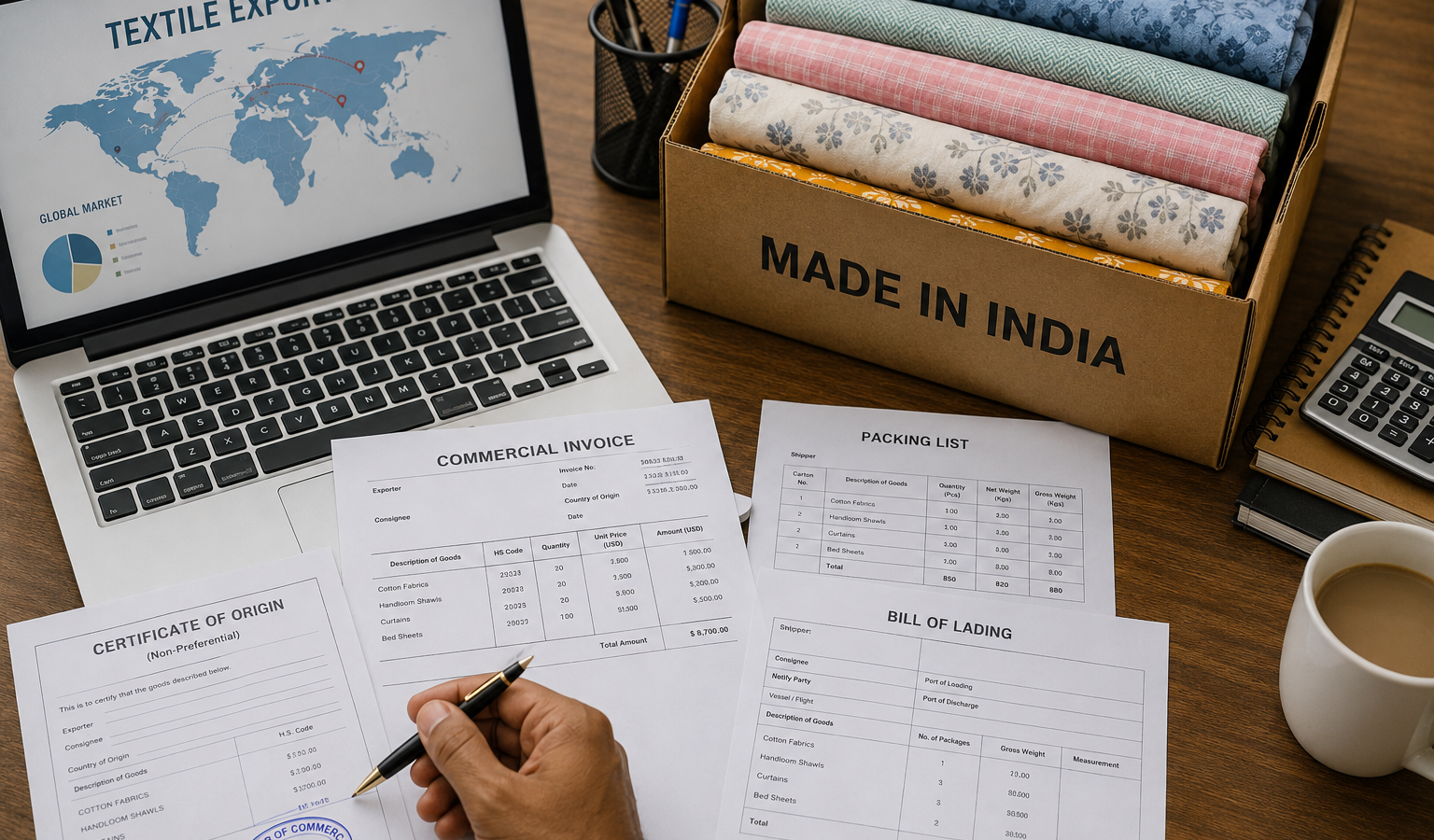
Introduction
Exporting textiles can be one of the most profitable business opportunities for manufacturers, traders, and exporters. India is among the world’s largest exporters of cotton fabrics, home textiles, garments, yarns, towels, bedsheets, and technical textiles. Buyers from the United States, Europe, the Middle East, Africa, and Asia continue to source textile products from India due to competitive pricing, quality manufacturing, and a strong supply chain.
However, many new exporters underestimate one critical aspect of international trade: documentation.
A single missing document can delay shipments, create customs issues, increase costs, or even result in payment delays. Whether you are exporting bedsheets to the USA, cotton fabrics to Bangladesh, towels to Europe, or garments to the UAE, understanding textile export documentation is essential.
This guide explains every major export document, why it matters, who issues it, and how exporters can ensure smooth international shipments.
Why Export Documentation Matters
Export documentation serves several purposes:
- Proves ownership of goods
- Enables customs clearance
- Facilitates international payments
- Confirms product specifications
- Supports insurance claims
- Helps buyers clear goods at destination
Think of export documentation as the passport for your shipment. Without it, your goods cannot legally move through international trade channels.
Overview of the Textile Export Process
Before understanding documents, it’s useful to understand the export workflow.
Step 1: Receive Buyer Order
The buyer confirms:
- Product specifications
- Quantity
- Price
- Delivery terms
- Payment terms
Step 2: Production and Quality Inspection
Products are manufactured according to buyer requirements.
Examples:
- Bedsheets
- Towels
- Fabrics
- Garments
- Uniforms
Step 3: Packing and Labeling
Goods are packed according to export standards.
Step 4: Documentation Preparation
Required export documents are prepared.
Step 5: Customs Clearance
Indian customs verify shipment details.
Step 6: Shipment Dispatch
Goods move through:
- Sea freight
- Air freight
- Road transport
Step 7: Buyer Receives Documents
Documents are shared through:
- Bank
- Courier
- Digital channels
depending on payment terms.
Essential Export Registrations Before Exporting
Before creating export documents, certain registrations are mandatory.
Import Export Code (IEC)
IEC is issued by the Directorate General of Foreign Trade (DGFT).
Without IEC:
You cannot legally export goods from India.
Why It Is Important
IEC acts as the primary identification number for exporters.
GST Registration
Most textile exporters require GST registration for compliance and tax benefits.
MSME Registration
Provides:
- Government incentives
- Easier financing
- Subsidy benefits
RCMC Registration
Registration Cum Membership Certificate is often required for claiming export benefits.
Textile exporters commonly obtain it through relevant export promotion councils.
Commercial Invoice
The Commercial Invoice is one of the most important export documents.
What Is a Commercial Invoice?
It is the official bill issued by the exporter to the buyer.
It contains:
- Buyer details
- Seller details
- Product description
- Quantity
- Unit price
- Total value
- HS code
- Country of origin
Why It Matters
Customs authorities use it to determine:
- Shipment value
- Duties
- Taxes
- Trade statistics
Textile Example
A bedsheet exporter may mention:
Product:
100% Cotton Printed Bedsheets
Size:
225 x 250 cm
Quantity:
5,000 sets
Unit Price:
USD 8.50
Total Value:
USD 42,500
Packing List
The packing list complements the commercial invoice.
Purpose
It provides physical shipment details.
Includes:
- Number of cartons
- Number of bales
- Carton dimensions
- Gross weight
- Net weight
- Packing details
Why Buyers Need It
Buyers use packing lists to:
- Verify received goods
- Manage warehouse inventory
- Facilitate customs clearance
Example
A textile shipment may contain:
Cartons: 500
Gross Weight: 12,500 kg
Net Weight: 12,000 kg
Container Number: XYZ123456
Shipping Bill
The Shipping Bill is the primary customs document for exports from India.
Issued Through
Indian Customs ICEGATE system.
Purpose
Acts as:
- Export declaration
- Customs clearance authorization
Information Included
- Exporter details
- Buyer details
- Product details
- FOB value
- HS code
- Port of loading
Without a Shipping Bill, export customs clearance cannot be completed.
Bill of Lading (B/L)
The Bill of Lading is one of the most powerful documents in international trade.
What Is a Bill of Lading?
Issued by the shipping line after cargo is loaded.
It serves three functions:
- Receipt of goods
- Contract of carriage
- Document of title
Information Included
- Shipper name
- Consignee name
- Port of loading
- Port of discharge
- Container details
- Cargo description
Importance for Textile Exporters
Many buyers and banks require original Bills of Lading before releasing payment.
Airway Bill (AWB)
Used when goods move by air.
Similar To B/L
However, it is not a document of title.
Common Uses
- Urgent garment shipments
- Textile samples
- Small consignments
Air freight exporters often rely on AWBs instead of Bills of Lading.
Certificate of Origin (COO)
The Certificate of Origin confirms where goods were manufactured.
Why It Is Important
Many countries offer preferential duties based on origin.
Issuing Authorities
Typically issued by:
- Chambers of Commerce
- Authorized trade bodies
Textile Example
If cotton bedsheets are manufactured in India, the COO certifies India as the country of origin.
This document can help buyers claim tariff benefits under trade agreements.
Insurance Certificate
International shipments face risks such as:
- Damage
- Theft
- Fire
- Natural disasters
Insurance protects exporters and buyers against such losses.
Information Included
- Policy number
- Shipment value
- Coverage details
- Consignment information
Common Incoterm Example
Under CIF contracts, exporters usually arrange marine insurance.
Letter of Credit (LC) Documents
Many textile exports use Letters of Credit for secure payments.
Banks release payment only when documents comply exactly with LC terms.
Typical documents include:
- Commercial Invoice
- Packing List
- Bill of Lading
- Certificate of Origin
- Insurance Certificate
- Inspection Certificate
Even minor errors can result in discrepancies and delayed payments.
Inspection Certificate
Some buyers require third-party inspection before shipment.
Inspection agencies verify:
- Quality
- Quantity
- Packaging
- Compliance
Commonly used for:
- Government tenders
- Large retail chains
- Institutional buyers
Quality Certificates in Textile Exports
Depending on buyer requirements, exporters may need:
OEKO-TEX Certification
Demonstrates textile safety.
GOTS Certification
Required for organic textiles.
GRS Certification
Used for recycled products.
ISO Certifications
Support quality management systems.
These certifications enhance buyer confidence and improve export opportunities.
Fumigation Certificate
Although textiles are not agricultural products, certain countries may require fumigation certificates when goods are packed using wooden pallets or wooden packaging materials.
Purpose
The certificate confirms that wooden packaging has been treated to prevent the spread of pests and insects.
Common Situations
Required when exporting:
- Bedsheets
- Towels
- Fabrics
- Garments
packed on wooden pallets.
Issuing Authority
Authorized fumigation service providers.
Phytosanitary Certificate
Most textile products do not require a phytosanitary certificate.
However, certain textile-related products containing natural fibers, plant-based materials, or untreated packing materials may require it depending on destination country regulations.
Exporters should always verify buyer and destination-country requirements before shipment.
Bank Realisation Certificate (BRC)
The Bank Realisation Certificate is an important document for exporters.
Purpose
It confirms that export proceeds have been received from overseas buyers.
Why It Matters
Required for:
- Export incentive claims
- Regulatory compliance
- Financial documentation
Example
If an exporter ships cotton fabric worth USD 50,000 and receives payment from the buyer, the bank issues evidence of realization of export proceeds.
Foreign Inward Remittance Certificate (FIRC)
Many exporters use FIRC as proof of foreign currency receipt.
Benefits
Used for:
- Accounting records
- Export compliance
- Government scheme applications
Export Payment Documents
Payment security is one of the biggest concerns in textile exports.
Common Payment Methods
Advance Payment
Buyer pays before shipment.
Risk level:
Lowest for exporter.
Letter of Credit (LC)
Bank guarantees payment.
Risk level:
Low.
Documents Against Payment (D/P)
Buyer receives documents after payment.
Risk level:
Medium.
Open Account
Goods shipped before payment.
Risk level:
Highest for exporter.
Generally used with long-term trusted buyers.
Textile Export Documentation Checklist
Before dispatching any shipment, verify the following checklist.
Mandatory Documents
✔ Commercial Invoice
✔ Packing List
✔ Shipping Bill
✔ Bill of Lading or Airway Bill
✔ Certificate of Origin
✔ Insurance Certificate (if applicable)
✔ Export Order or Purchase Order
✔ GST Documentation
✔ IEC Details
Buyer-Specific Documents
✔ Inspection Certificate
✔ Testing Reports
✔ OEKO-TEX Certificate
✔ GOTS Certificate
✔ GRS Certificate
✔ Product Specification Sheet
Banking Documents
✔ Letter of Credit Documents
✔ BRC/FIRC Records
✔ Payment Instructions
Using a standardized checklist helps prevent shipment delays.
Common Documentation Mistakes Textile Exporters Make
Documentation errors remain one of the biggest reasons for export delays.
Mistake 1: Product Description Mismatch
Product descriptions should be identical across:
- Invoice
- Packing List
- Bill of Lading
Even small inconsistencies may create customs issues.
Mistake 2: Incorrect HS Code
Using the wrong HS code can result in:
- Customs delays
- Incorrect duty calculations
- Compliance issues
Always verify product classification carefully.
Mistake 3: Quantity Discrepancies
The quantities mentioned in:
- Purchase Order
- Invoice
- Packing List
must match exactly.
Mistake 4: Missing Buyer Requirements
Large retailers often require:
- Testing reports
- Compliance certificates
- Factory audits
Failure to provide these documents can delay payment.
Mistake 5: LC Document Errors
Banks are extremely strict regarding Letter of Credit documents.
Common errors include:
- Typographical mistakes
- Date discrepancies
- Missing signatures
Even a small mistake can create payment delays.
Real-Life Example: Bedsheet Export to the USA
Consider a home textile exporter shipping:
10,000 cotton bedsheet sets
Destination:
United States
Documents Required
- Commercial Invoice
- Packing List
- Shipping Bill
- Bill of Lading
- Certificate of Origin
- Insurance Certificate
- Purchase Order
- Payment Documents
Additional Buyer Requirements
- OEKO-TEX certification
- Product testing reports
When all documents are prepared correctly, customs clearance becomes smooth and payment processing is faster.
Real-Life Example: Fabric Export to Bangladesh
An Indian fabric manufacturer exports:
65/35 Poly Cotton Pocketing Fabric
Shipment:
One 40-foot container
Required Documents
- Commercial Invoice
- Packing List
- Shipping Bill
- Bill of Lading
- Certificate of Origin
Because Bangladesh imports large quantities of textile raw materials, accurate documentation is essential for customs clearance and duty benefits.
Digitalization of Textile Export Documentation
Modern export operations increasingly use digital platforms.
Benefits
- Faster processing
- Reduced paperwork
- Improved compliance
- Better record management
Popular Digital Systems
ICEGATE
Used for customs filing.
DGFT Portal
Used for IEC and export-related services.
Shipping Line Portals
Used for Bill of Lading management.
ERP Systems
Many textile exporters integrate documentation into ERP software for improved efficiency.
Customs Compliance Tips for Textile Exporters
Successful exporters treat documentation as a critical business function.
Best Practices
Maintain Standard Templates
Create templates for:
- Invoices
- Packing Lists
- Certificates
Double-Check Data
Verify:
- Quantities
- Weights
- Values
- Product descriptions
before submission.
Train Documentation Staff
Documentation specialists can save exporters significant time and money.
Keep Digital Records
Maintain organized records for:
- Audits
- Tax filings
- Future reference
Monitor Regulatory Changes
Export regulations change frequently.
Stay updated through:
- DGFT notifications
- Customs advisories
- Export promotion councils
Textile Export Documentation Flow
A simplified document flow looks like this:
Buyer Purchase Order
↓
Production
↓
Quality Inspection
↓
Commercial Invoice
↓
Packing List
↓
Shipping Bill Filing
↓
Customs Clearance
↓
Bill of Lading / Airway Bill
↓
Certificate of Origin
↓
Document Submission to Buyer or Bank
↓
Payment Realization
Frequently Asked Questions (FAQ)
Which document is most important for textile exports?
The Commercial Invoice, Shipping Bill, and Bill of Lading are among the most critical documents.
Is IEC mandatory for textile exports?
Yes. Exporting from India requires a valid Import Export Code (IEC).
What is the purpose of a Packing List?
It provides detailed information regarding shipment contents, packaging, dimensions, and weights.
Why is the Certificate of Origin important?
It proves where goods were manufactured and may help buyers claim tariff benefits.
What happens if export documents contain errors?
Errors can result in:
- Customs delays
- Payment delays
- Additional charges
- Shipment holds
Do textile exporters need insurance?
While not always mandatory, insurance is strongly recommended to protect against transit risks.
Which payment method is safest for new exporters?
Advance payment and Letters of Credit generally offer the highest level of security.
Key Takeaways
✔ Export documentation is essential for smooth international trade.
✔ Every textile exporter should maintain a standard document checklist.
✔ Commercial Invoice, Packing List, Shipping Bill, and Bill of Lading are core export documents.
✔ Certificates such as COO, OEKO-TEX, GOTS, and GRS may be required depending on buyer requirements.
✔ Accurate documentation helps avoid customs delays and payment issues.
✔ Digital systems are making export documentation faster and more efficient.
✔ Strong documentation practices build credibility with international buyers.
Conclusion
Textile exports offer tremendous opportunities for Indian manufacturers and traders, but success depends on more than producing quality products. Proper documentation is the foundation of smooth international trade.
Every shipment, whether it contains bedsheets, towels, fabrics, garments, or technical textiles, must be supported by accurate and complete documents. These documents enable customs clearance, secure payments, reduce disputes, and ensure regulatory compliance.
For new exporters, the documentation process may initially seem complex. However, once standardized systems and checklists are implemented, export documentation becomes a routine and manageable part of business operations.
The most successful textile exporters are not only experts in manufacturing but also masters of compliance, documentation, and international trade procedures.
By understanding the purpose and importance of each export document, you can reduce risk, improve efficiency, and build stronger relationships with global buyers.
Leave a Reply