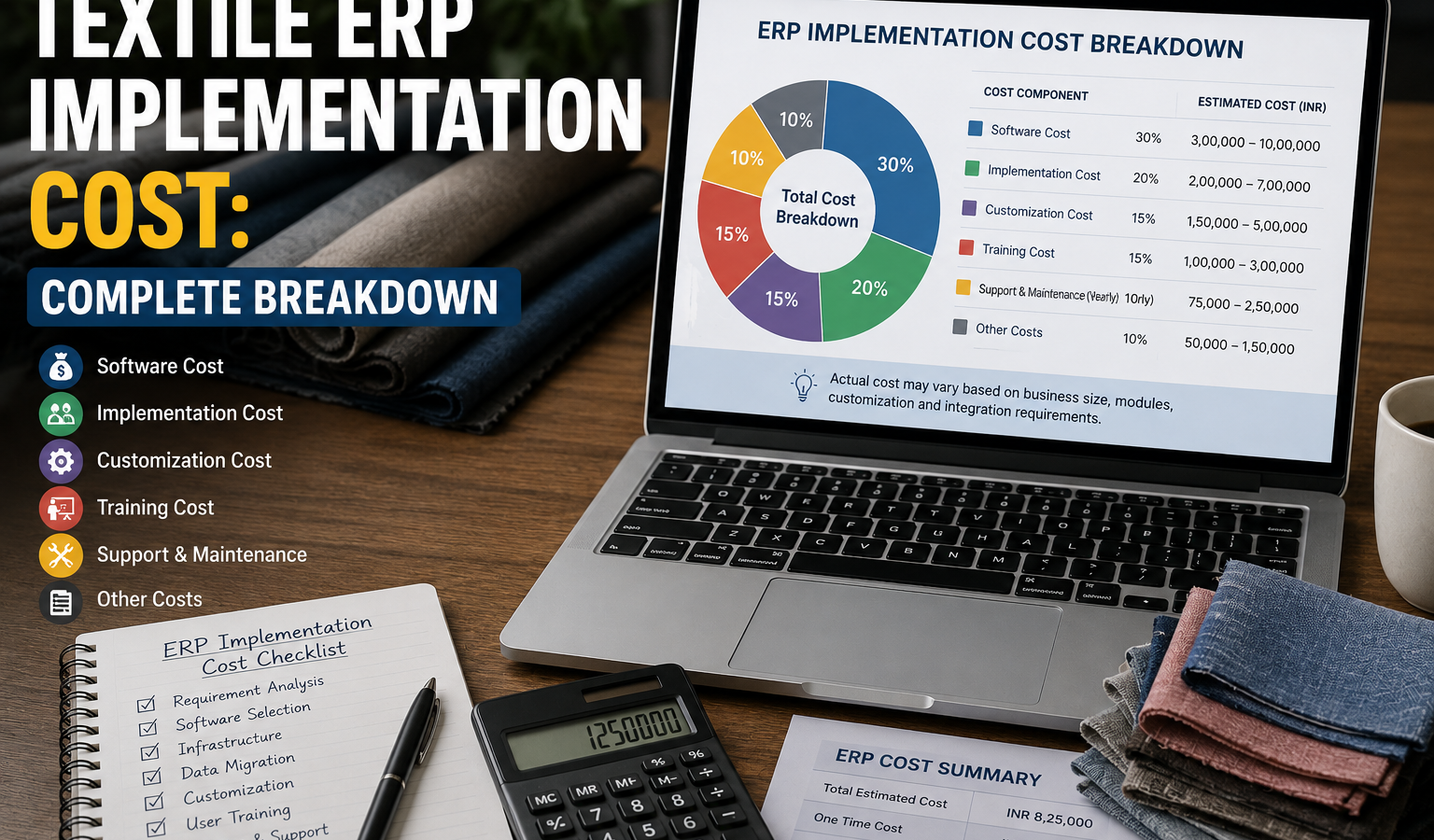
What does a textile ERP actually cost in India? Not the sales pitch number — the real one, including all the fees nobody warns you about until after you’ve signed the contract.
An Honest Note Before We Start
ERP vendors almost never publish their real prices. What you see in demos and brochures is rarely what you pay by go-live day. This guide is built from actual ERP procurement data from Indian textile businesses — weaving mills, fabric traders, garment exporters, and spinning units. The numbers here are real ranges, not marketing estimates.
Why Textile ERP Costs Vary So Much
Ask three different ERP vendors for a quote and you’ll get three wildly different numbers. One tells you ₹3 lakh. Another says ₹18 lakh. A third sends a 12-page proposal with numbers that add up to ₹60 lakh. And somehow, all three are quoting for “the same thing.”
This happens because ERP pricing is genuinely complex — not just vendor games. The final cost depends on a combination of factors that are unique to your business:
- Number of users: Most ERP systems are licensed per user (named or concurrent). A 5-user licence is not the same as a 50-user licence.
- Modules selected: A basic accounting + inventory setup costs far less than a full production planning + quality + HR + export documentation suite.
- On-premise vs cloud (SaaS): On-premise means a higher upfront cost but lower ongoing fees. SaaS means lower setup but higher monthly costs forever.
- Customisation requirements: Every change from the standard system adds developer time — and developer time in ERP is expensive.
- Data migration complexity: Moving 10 years of yarn inventory, pending orders, and supplier ledgers from Tally or Excel is a significant effort.
- Implementation partner: A Tier-1 SAP partner charges very differently from a local Surat-based implementation firm — even for the same software.
- Your readiness: Businesses with clean data, trained staff, and a dedicated project owner cost less to implement than chaotic, multi-location units with no documentation.
In most Indian textile ERP projects, the software licence fee is only about 30–40% of the total cost. The remaining 60–70% goes to implementation, training, customisation, data migration, and support. Always budget for the full project — not just the licence.
The 7 Cost Components of a Textile ERP
Here’s every cost bucket you need to plan for, explained honestly.
1. Software Licence Fee
25–40% of total
This is the fee you pay to the ERP vendor for the right to use their software. Pricing models vary significantly:
2. Implementation & Configuration
30–45% of total
This covers the consultant’s time to install, configure, and set up the ERP for your specific workflows — chart of accounts, fabric categories, loom master data, yarn stock units, jobwork flow, GST configuration, and so on. This is the biggest variable cost in any ERP project.
3. Data Migration
8–15% of total
Moving your existing data — yarn and fabric stock, pending orders, party ledgers, previous transactions — into the new ERP is a significant effort that most businesses underestimate. Bad data migration is one of the top reasons ERP projects fail or go over budget.
4. Training
5–12% of total
Training is where many implementation firms cut corners — and where many post-go-live problems originate. Plan for structured training for every department that will touch the ERP, not just a one-day “click here, click there” session.
5. Hardware & Infrastructure
10–20% of total (on-premise only)
Cloud ERP eliminates most hardware costs. On-premise ERP requires a server, network setup, and often barcode or label printing hardware for the production floor and stores.
6. Annual Maintenance Contract (AMC)
Recurring — 15–22% of licence/year
The AMC is your annual fee to the ERP vendor (or their partner) that covers software updates, bug fixes, and technical support. This is a recurring cost that continues every year — and one of the most negotiable items in your contract.
7. Internal Project Cost
Often ignored — 10–20% of total
This is the cost your business absorbs internally during implementation — and it’s almost never counted in vendor quotes. It’s real money, even if it doesn’t appear on an invoice.
Total ERP Cost by Business Size
To make sense of all the components above, here’s what the complete picture looks like for different types of Indian textile businesses in 2026:
Total first-year
- Focus Garment+, Unisoft, or Tally add-on
- 5–20 users
- 4–8 weeks implementation
- Basic modules: inventory, billing, jobwork
- AMC: ₹20K–50K/year from year 2
Total first-year
- Aptean, Denim ERP, or MS Dynamics
- 20–100 users
- 3–6 months implementation
- Full modules: production, export, finance
- AMC: ₹1.5L–4L/year from year 2
Total first-year
- SAP S/4HANA or Infor CloudSuite
- 100–1000+ users
- 9–18 months implementation
- Multi-plant, multi-entity, full suite
- AMC: ₹8L–25L/year from year 2
| Cost Head | Small (₹<10Cr) | Mid (₹10–100Cr) | Large (₹100Cr+) |
|---|---|---|---|
| Software Licence | ₹50K – ₹2L | ₹3L – ₹15L | ₹25L – ₹1Cr+ |
| Implementation | ₹50K – ₹3L | ₹4L – ₹15L | ₹20L – ₹80L |
| Customisation | Minimal | ₹1L – ₹8L | ₹10L – ₹50L |
| Data Migration | ₹10K – ₹50K | ₹50K – ₹3L | ₹2L – ₹15L |
| Training | ₹15K – ₹50K | ₹50K – ₹2L | ₹2L – ₹10L |
| Hardware (on-premise) | ₹50K – ₹1.5L | ₹1L – ₹5L | ₹10L – ₹50L |
| Internal / indirect cost | ₹30K – ₹1L | ₹2L – ₹8L | ₹10L – ₹40L |
| Total First-Year | ₹2L – ₹8L | ₹11L – ₹40L | ₹80L – ₹2Cr+ |
Phase-by-Phase Cost Timeline
ERP costs don’t all land on day one. Here’s how spending is typically distributed across a mid-sized textile ERP project (₹15–30L total budget):
Ongoing Annual Costs After Go-Live
The implementation cost is a one-time hit. But ERP has real ongoing costs every year that should be part of your 3-year and 5-year business case. Here’s what to plan for after year one:
| Annual Cost Item | Small ERP | Mid ERP | Enterprise ERP |
|---|---|---|---|
| Annual Maintenance (AMC) | ₹20K–60K | ₹1L–4L | ₹8L–25L |
| Cloud hosting / SaaS subscription | ₹1L–3L | ₹3L–12L | ₹15L–50L |
| Additional user licences | ₹5K–15K/user | ₹15K–50K/user | ₹50K–2L/user |
| Compliance updates (GST, e-inv) | Included in AMC | Included / ₹10–50K | Included |
| Refresher training | Minimal | ₹20K–1L | ₹1L–5L |
| Small enhancements / tweaks | ₹10K–50K | ₹50K–3L | ₹2L–15L |
| Estimated Annual TCO (Year 2+) | ₹50K–2L | ₹3L–12L | ₹20L–80L |
For a mid-sized textile mill, the 5-year TCO (implementation + 4 years of ongoing costs) typically runs ₹35–80 lakh. When divided over 5 years, this works out to ₹7–16 lakh per year — roughly the salary of one experienced production manager. A well-implemented ERP should deliver far more value than that.
ROI — When Does a Textile ERP Pay Off?
This is the question every business owner asks — and the one vendors are vaguest about. The honest answer is: a well-implemented textile ERP typically pays back its cost within 18–36 months, through a combination of tangible savings and efficiency gains.
Beyond the hard numbers, there are strategic benefits that don’t show up on a spreadsheet: the ability to onboard larger buyers who require digital documentation, the confidence to scale production without proportionally scaling headcount, and the data visibility to make faster decisions.
How to Negotiate ERP Pricing in India
ERP pricing is almost always negotiable — especially in India, where local implementation partners have significant margin to play with. Here’s how to negotiate effectively:
- Get 3 competitive quotes. Even if you’ve already decided on a vendor, get two other quotes. Vendors respond to competition. Show you’re serious about evaluating alternatives.
- Negotiate milestone-based payments. Don’t pay 70% of the licence upfront. Tie payments to deliverables: business process study completion, UAT sign-off, and go-live. This protects you if the project stalls.
- Ask for AMC to be included in year one. Many vendors will include the first year’s AMC in the implementation price if you ask. It costs them little and saves you a separate budget line.
- Negotiate a fixed-price customisation cap. If you expect customisation, negotiate a fixed price with a defined scope — not an open-ended hourly rate. Agree on what’s “in scope” in writing before work begins.
- Ask for hypercare explicitly. Insist on 60–90 days of post-go-live support at no extra charge. Call it “hypercare” — many vendors have a standard package but won’t offer it unless you ask.
- Buy during quarter-end. ERP sales teams have quarterly targets. The last 2 weeks of March, June, September, and December are the best times to negotiate — vendors are more flexible on price and terms.
- Check references in your specific cluster. If a vendor says “we’ve implemented for 50 textile companies in Ichalkaranji,” ask for 3 names and call them. Implementation quality in your specific cluster is what matters.
Your Pre-Budget Checklist
Before you finalise your ERP budget and shortlist vendors, run through this checklist. Every “no” is a risk to your project and your budget:
- Defined how many users (by department) will need ERP access
- Listed every module you need — inventory, production, jobwork, export, HR, payroll, accounts
- Estimated customisation requirements — and challenged each one to see if process change can replace it
- Audited your existing data quality — fabric stock, supplier ledgers, pending orders — and allocated cleanup time
- Decided on cloud vs on-premise based on your IT capacity and long-term cost preference
- Identified your internal ERP champion who will own the project from your side
- Allocated internal staff time for data preparation, testing, and training — not just vendor fees
- Planned for productivity dip of 15–25% for 4–8 weeks post go-live
- Got at least 3 vendor quotes with detailed scope-of-work breakdowns
- Called 2–3 reference customers from the vendor’s existing textile client list
- Built a 5-year TCO model — not just year-one implementation cost
- Confirmed GST compliance updates are covered in your AMC without extra charges
FAQs on Textile ERP Cost
What is the cheapest ERP for a small textile business in India?
Tally Prime with a textile add-on is the lowest-cost option at ₹30,000–1.5 lakh total setup. For a step up in functionality, Unisoft Infotech or Focus Garment+ are available in the ₹2–5 lakh range for a complete first-year deployment. These are suitable for businesses with revenues under ₹10 crore and fewer than 20 staff.
Is cloud ERP cheaper than on-premise for textile mills?
Cloud ERP has a lower upfront cost (no server hardware, faster deployment) but higher ongoing costs (monthly subscription forever). On-premise has a higher initial outlay but typically lower 5-year TCO if you already have IT infrastructure. For small businesses without IT staff, cloud is usually better. For mid-to-large mills with IT resources, on-premise can be more economical over 5+ years.
How much should I budget for ERP customisation?
As a rule of thumb, customisation should not exceed 15–20% of your total ERP budget. If customisation is going to cost more than that, it’s a signal that either the wrong ERP was chosen, or you need to rethink your process requirements. Over-customised ERPs are expensive to maintain, difficult to upgrade, and often fail to deliver promised ROI.
Does the government offer any subsidy for textile ERP in India?
As of 2026, there is no direct central government subsidy specifically for textile ERP software. However, some state government schemes (under MSME development programs in Gujarat, Maharashtra, and Tamil Nadu) offer partial reimbursement for technology adoption including ERP systems. Check with your state’s MSME or Industries department for current schemes.
Can I implement ERP in phases to reduce upfront cost?
Yes — and for many mid-sized textile businesses, a phased approach is the smartest strategy. Start with core modules: accounting, fabric inventory, and GST billing (Phase 1). Add production planning and jobwork management once the team is comfortable (Phase 2). Then layer on export documentation, quality, and HR (Phase 3). This spreads cost, reduces risk, and allows the team to absorb change gradually.
Leave a Reply