Introduction
Walk into any spinning mill, weaving unit, fabric manufacturing company, or garment factory, and you’ll quickly discover that yarn selection plays a major role in determining fabric quality, performance, and cost.
Among the various yarn manufacturing technologies available today, Ring Spun Yarn and Open End Yarn (Rotor Yarn) are the two most commonly used yarn types across the textile industry.
While both serve the same basic purpose of converting fibers into yarn, their manufacturing processes, physical properties, costs, and end-use applications differ significantly.
For textile manufacturers, exporters, fabric buyers, and garment producers, understanding the difference between ring spun and open end yarn is essential for making informed sourcing and production decisions.
In this comprehensive guide, we’ll compare ring spun and open end yarn in detail, covering manufacturing processes, quality characteristics, strength, cost, applications, advantages, disadvantages, and industry usage.
What Is Ring Spun Yarn?
Ring spun yarn is produced using the traditional ring spinning process.
In this method, fibers are continuously drafted, twisted, and wound onto bobbins through a ring frame.
The process creates a compact yarn structure where fibers are tightly bound together through twist insertion.
Because of its superior quality characteristics, ring spun yarn remains the preferred choice for premium textile applications worldwide.
Key Characteristics of Ring Spun Yarn
- High strength
- Smooth surface
- Better appearance
- Superior softness
- Lower hairiness
- Excellent durability
Ring spinning is considered the benchmark for high-quality yarn production.
What Is Open End Yarn?
Open End Yarn, also known as Rotor Yarn, is produced through an entirely different spinning technology.
Instead of using a ring frame, fibers are fed into a high-speed rotating rotor where they are collected and twisted into yarn.
The process is significantly faster than ring spinning and requires fewer production stages.
Because of its lower manufacturing cost, open end yarn is widely used in value-oriented textile products.
Key Characteristics of Open End Yarn
- Higher productivity
- Lower production cost
- Bulkier structure
- More hairiness
- Lower strength compared to ring spun yarn
Open end spinning has become extremely popular for large-scale production of denim, towels, and basic textile products.
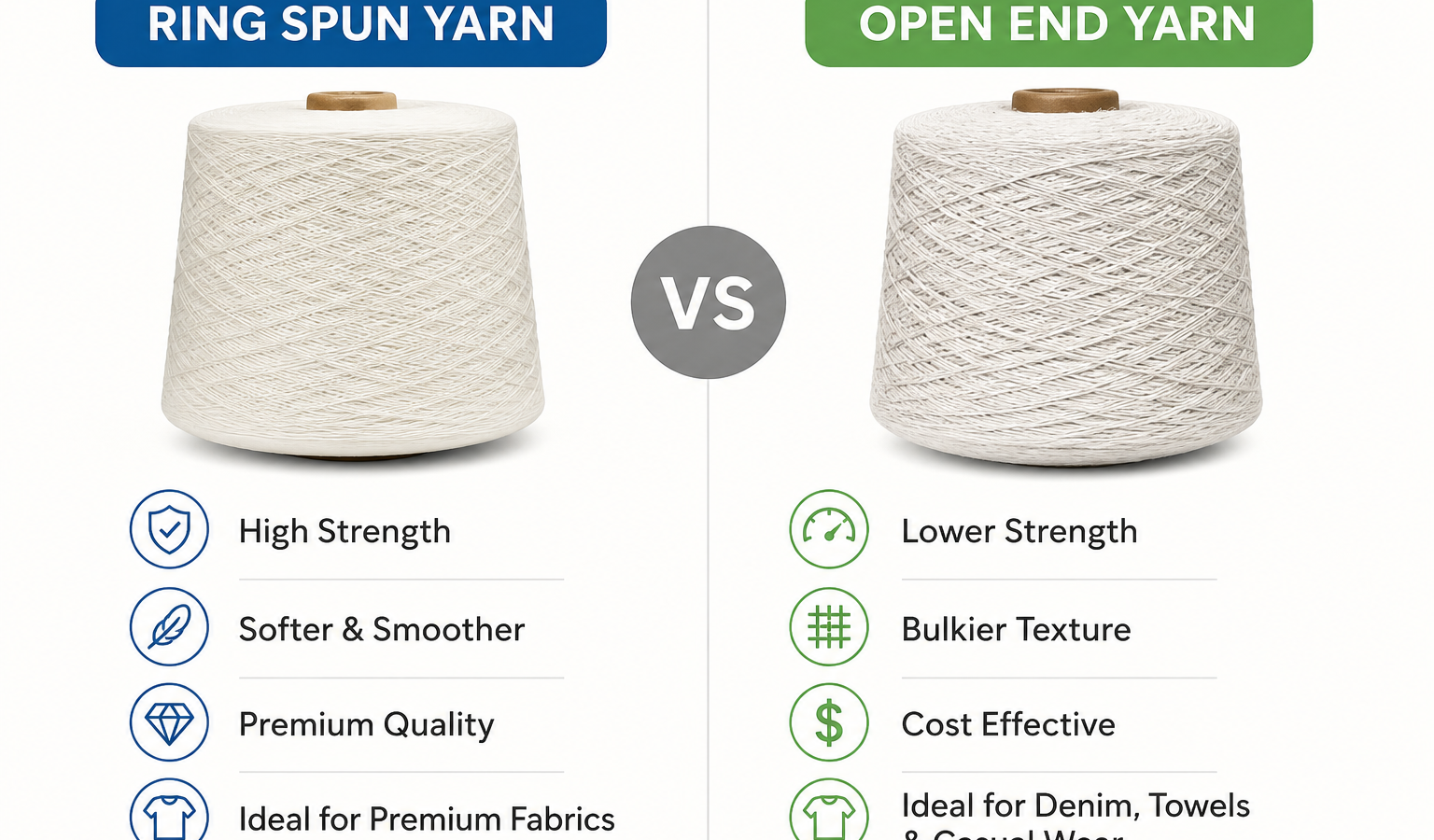
Ring Spun vs Open End Yarn: Quick Comparison
| Parameter | Ring Spun Yarn | Open End Yarn |
|---|---|---|
| Production Speed | Slower | Faster |
| Strength | Higher | Lower |
| Softness | Better | Moderate |
| Uniformity | Excellent | Good |
| Hairiness | Lower | Higher |
| Cost | Higher | Lower |
| Fabric Appearance | Premium | Basic |
| Productivity | Lower | Higher |
| End Uses | Premium textiles | Cost-sensitive products |
How Ring Spun Yarn Is Manufactured
The ring spinning process involves multiple stages.
Step 1: Blow Room
Cotton fibers are opened and cleaned.
Step 2: Carding
Fibers are aligned into slivers.
Step 3: Drawing
Improves fiber parallelization.
Step 4: Roving
Drafting and slight twisting occur.
Step 5: Ring Spinning
Final yarn is produced with desired count and twist.
This multi-stage process contributes to the superior quality of ring spun yarn.
How Open End Yarn Is Manufactured
The open end process is comparatively simpler.
Step 1: Fiber Preparation
Fibers are cleaned and carded.
Step 2: Rotor Feeding
Fibers enter the rotor.
Step 3: Yarn Formation
High-speed rotor rotation creates yarn.
Step 4: Winding
Finished yarn is wound directly onto packages.
Because several intermediate stages are eliminated, production becomes much faster.
Strength Comparison
One of the most important differences between ring spun and open end yarn is strength.
Ring Spun Yarn
Fibers remain more parallel and tightly twisted.
Result:
- Higher tensile strength
- Better abrasion resistance
- Improved durability
Open End Yarn
Fibers are less parallel and have a wrapper fiber structure.
Result:
- Lower strength
- Reduced durability
Industry Example
For premium shirting fabrics or export-quality pocketing fabrics, manufacturers often choose ring spun yarn because fabric strength directly impacts garment performance.
Fabric Appearance Comparison
Fabric appearance significantly influences customer perception.
Ring Spun Fabric
Characteristics:
- Cleaner surface
- Better drape
- Premium appearance
- Smooth texture
Open End Fabric
Characteristics:
- Slightly rougher surface
- Bulkier feel
- More visible fiber protrusions
This difference becomes especially noticeable in light-colored fabrics and high-end apparel.
Softness and Comfort
Consumer comfort is increasingly important in modern textiles.
Ring Spun Yarn
Produces fabrics that feel:
- Softer
- Smoother
- More luxurious
This is why premium T-shirts often advertise:
“100% Ring Spun Cotton”
Open End Yarn
Produces fabrics that may feel:
- Slightly coarser
- Less refined
Although finishing processes can improve softness, ring spun yarn generally retains an advantage.
Cost Comparison
Cost remains one of the biggest deciding factors.
Ring Spun Yarn
Higher cost due to:
- More machinery
- Additional processing stages
- Lower production speed
- Higher energy consumption
Open End Yarn
Lower cost because:
- Faster production
- Fewer processing stages
- Higher productivity
For price-sensitive markets, open end yarn offers significant advantages.
Productivity Comparison
Modern textile mills focus heavily on productivity.
Ring Spinning
Production speed is relatively slower.
Open End Spinning
Production speed can be several times higher than ring spinning.
This makes open end spinning attractive for mass production applications.
Common Applications of Ring Spun Yarn
Ring spun yarn is widely used in:
Premium T-Shirts
Consumers prefer softer, stronger fabrics.
Shirting Fabrics
Smooth appearance is critical.
High-End Fashion Garments
Premium brands often specify ring spun yarn.
Bed Linen
Luxury bedsheets frequently use ring spun yarn.
Export Fabrics
Buyers often demand higher-quality yarn structures.
Common Applications of Open End Yarn
Open end yarn is commonly used in:
Denim Fabrics
Many denim manufacturers use open end yarn for weft insertion.
Towels
Bulkiness improves absorbency.
Workwear
Cost efficiency is important.
Cleaning Cloths
Softness is less critical.
Basic Apparel
Mass-market garments often use open end yarn.
Real-Life Example: T-Shirt Manufacturing
Consider two T-shirts.
T-Shirt A
Made using 30s Ring Spun Cotton Yarn.
Characteristics:
- Softer feel
- Better appearance
- Higher durability
T-Shirt B
Made using Open End Cotton Yarn.
Characteristics:
- Lower cost
- Slightly rougher feel
- Less premium appearance
For a fashion brand targeting premium customers, Ring Spun Yarn is usually preferred.
Real-Life Example: Denim Production
Denim manufacturers often use both yarn types strategically.
Warp Yarn
Frequently ring spun for strength.
Weft Yarn
May use open end yarn for cost optimization.
This combination balances quality and production economics.
Advantages of Ring Spun Yarn
Superior Strength
Improves fabric performance.
Better Appearance
Provides premium aesthetics.
Enhanced Softness
Improves customer comfort.
Higher Durability
Suitable for long-lasting products.
Better Dyeing Performance
Uniform fiber structure enhances dye uptake.
Advantages of Open End Yarn
Lower Manufacturing Cost
Major benefit for mass production.
Higher Productivity
Increases factory output.
Reduced Labor Requirement
Simplified production process.
Suitable for Coarser Counts
Commonly used for thicker yarns.
Disadvantages of Ring Spun Yarn
- Higher production cost
- Slower manufacturing speed
- Increased energy consumption
Disadvantages of Open End Yarn
- Lower strength
- More hairiness
- Reduced softness
- Less premium appearance
Which Yarn Should You Choose?
The answer depends on your product goals.
Choose Ring Spun Yarn If:
✔ Quality is the priority
✔ Producing premium fabrics
✔ Exporting to demanding buyers
✔ Manufacturing high-end garments
Choose Open End Yarn If:
✔ Cost reduction is critical
✔ Producing denim or towels
✔ Targeting value-oriented markets
✔ Large-scale production is required
Frequently Asked Questions
Is Ring Spun Yarn Better Than Open End Yarn?
For quality, softness, and strength, ring spun yarn is generally superior.
For cost efficiency and productivity, open end yarn offers advantages.
Why Is Ring Spun Yarn More Expensive?
Because the manufacturing process is longer, slower, and requires additional machinery.
Which Yarn Is Stronger?
Ring spun yarn typically has higher tensile strength.
Is Open End Yarn Suitable for Denim?
Yes. Many denim fabrics successfully use open end yarn, particularly in weft applications.
Which Yarn Is Softer?
Ring spun yarn produces noticeably softer fabrics.
Can Open End Yarn Replace Ring Spun Yarn?
Not entirely.
Both technologies serve different market requirements and applications.
Conclusion
The choice between Ring Spun Yarn and Open End Yarn ultimately depends on balancing quality, performance, and cost.
Ring spun yarn remains the preferred option for premium fabrics, high-end garments, and export-quality textiles due to its superior strength, softness, and appearance. Open end yarn, on the other hand, provides exceptional productivity and cost advantages, making it ideal for denim, towels, workwear, and mass-market textile products.
Successful textile manufacturers understand that there is no universal “best” yarn. The right choice depends on the intended end use, customer expectations, production goals, and market positioning.
By understanding the strengths and limitations of each spinning technology, textile professionals can make better sourcing decisions, optimize production costs, and deliver products that meet customer expectations.
Leave a Reply