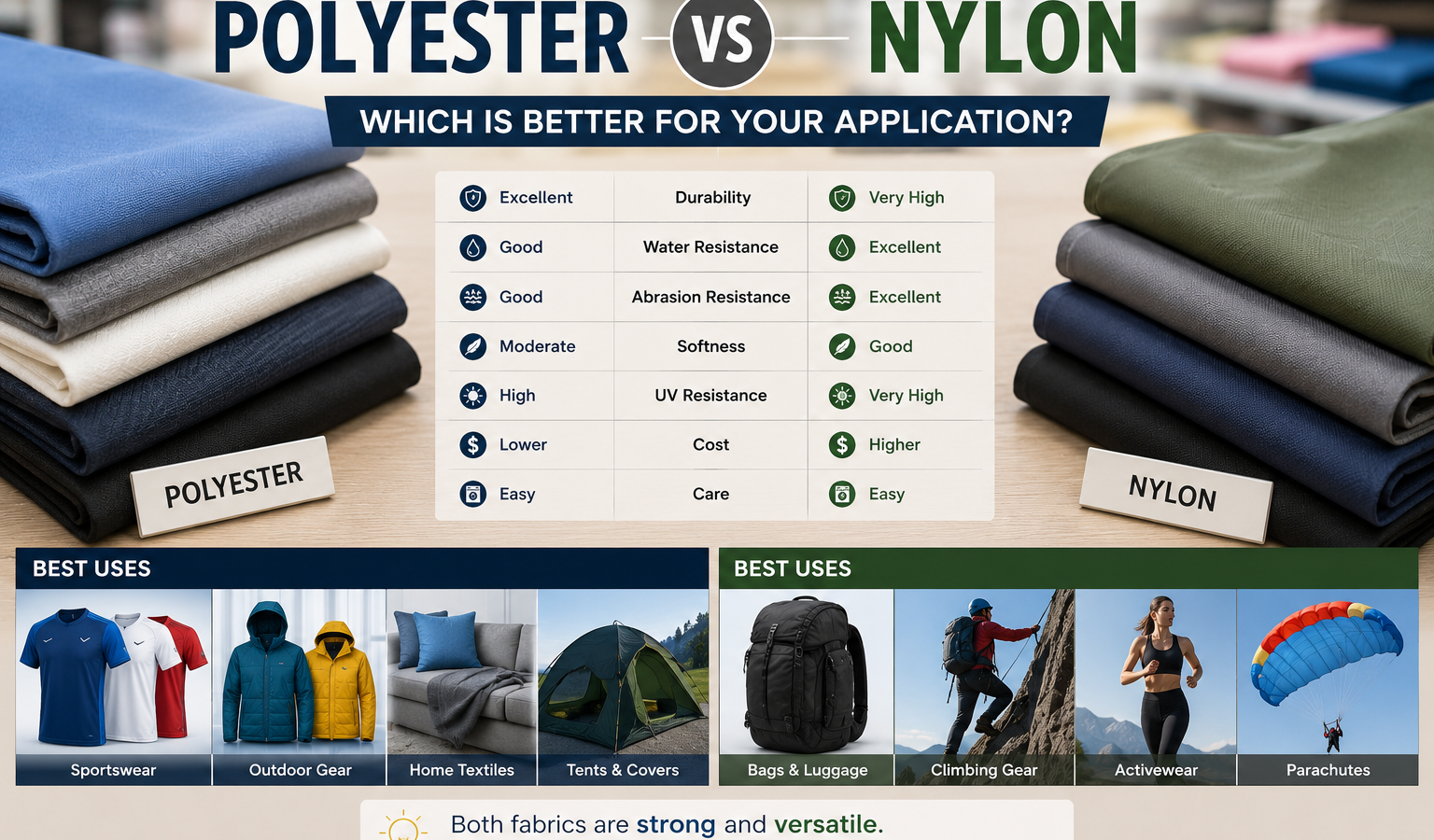
Short answer: There is no universal winner. Polyester is cheaper, dries faster, holds colour better, and resists UV. Nylon is stronger, softer, stretchier, and more abrasion-resistant. The right choice depends entirely on what the fabric needs to do. This guide breaks down every key property side by side and tells you exactly which one to choose for activewear, swimwear, bags, outdoor gear, workwear, fashion, and more.
If you’ve ever specified fabric for a garment or product and hit the polyester-vs-nylon question, you know how quickly it gets complicated. Both are synthetic, both come from petroleum, both look vaguely similar on a spec sheet. And yet they perform quite differently in practice — sometimes so differently that picking the wrong one means your product fails in the field, pills after ten washes, smells by the third wear, or costs you 30% more than it needed to.
I’ve spent years helping garment manufacturers, activewear brands, and bag makers in India navigate this exact question. The answer is almost never “one is better.” It’s almost always “one is better for this specific application.” And figuring out which one requires understanding the real differences — not just the marketing version.
This guide gives you the full picture.
First: What Are These Fabrics, Actually?
Polyester — The World’s Most Produced Fibre
Polyester is made from polyethylene terephthalate (PET) — the same polymer family used in plastic bottles. It’s produced by melting PET pellets and extruding them through tiny holes (spinnerets) to create continuous filament fibres, which are then wound, drawn, and processed into yarn.
Polyester now accounts for around 52% of global fibre production — more than all natural fibres combined. It’s everywhere: in your T-shirts, your curtains, your fleece jacket, your carpet, and increasingly, your performance sportswear. In India, polyester is also the dominant material in suiting fabric, georgette sarees, and the massive synthetic textile market centred in Surat.
Nylon — The Original Synthetic Silk
Nylon (also called polyamide in Europe and on many Indian export spec sheets) was the world’s first commercially successful synthetic fibre, developed in the 1930s as a direct substitute for silk. It’s made through a chemical reaction that creates a polyamide polymer — chains of molecules linked by amide bonds — which is then melt-spun into fibres.
Nylon accounts for about 11% of global synthetic fibre production — far less than polyester, which is part of why it costs more. It’s used where performance requirements are highest: military gear, technical outdoor equipment, climbing ropes, parachutes, hosiery, and premium activewear.
Direct property comparison — polyester leads on UV resistance, quick drying, and cost; nylon leads on abrasion resistance, softness, and stretch.
The Key Differences, One by One
Strength and Abrasion Resistance
Nylon wins here, and it’s not subtle. Independent abrasion testing (Martindale method) consistently shows nylon outperforming polyester by 30–50% in abrasion cycles before fibre breakdown. Military and outdoor gear specifications frequently mandate nylon for exactly this reason — the US and EU defence contracts cited earlier in 2024–25 specify Nylon 66 ballistic weaves, accepting the 30–40% price premium because the durability difference is real and documented.
For everyday apparel — T-shirts, casual jackets, everyday bags — the difference in abrasion resistance between polyester and nylon is largely academic. Both will outlast the style. But for backpacks that get scraped on rock faces, working gear that sees daily mechanical stress, or anything else that genuinely needs to resist wear, nylon’s structural advantage is worth paying for.
Moisture Management
This is where polyester has a meaningful edge for most activewear applications. Polyester absorbs almost no water (approximately 0.4% of its weight), which means sweat stays on the fabric surface and evaporates rather than soaking into the fibre. The result: polyester dries faster and feels drier during high-intensity activity.
Nylon absorbs more moisture — around 2.5–4% — which means it gets wetter and takes longer to dry. In very hot, high-sweat conditions like a long run or a cricket match in Indian summer, that difference is felt. However, nylon’s slight moisture absorption means it can pull sweat slightly away from the skin by capillary action, which has some comfort benefits at lower intensity.
The practical rule: polyester is better for tops and high-sweat applications where drying speed matters. Nylon is better for close-fitting bottoms (leggings, compression shorts) where softness and stretch matter more than maximum drying speed.
Softness and Comfort Against Skin
Nylon was originally designed to replicate silk. That heritage shows — nylon genuinely feels softer, smoother, and more silky against skin than polyester. This is why nylon dominates in underwear, hosiery, lingerie, yoga leggings, and swimwear. When something is worn very close to skin for extended periods, the tactile difference is real.
Modern polyester has improved enormously through processing and fibre engineering — today’s microfibre polyester can feel surprisingly soft — but at equivalent price points, nylon still tends to feel better. That’s part of what justifies nylon’s price premium in premium activewear.
UV Resistance
Polyester has a significant structural advantage in UV resistance. The ester bonds in the polyester molecular chain are more stable under UV radiation than the amide bonds in nylon. This means nylon loses tensile strength and colour faster when exposed to prolonged sunlight without UV treatment.
For outdoor applications — outdoor furniture fabric, awnings, car covers, tents left in sun — polyester is strongly preferred. A 2024 European study cited in industry data found polyester outdoor jackets maintained coating integrity longer under UV exposure than nylon equivalents. For garments worn outdoors regularly without UV-protective finishing, polyester holds up better over time.
“The question isn’t which fabric is stronger in the lab. It’s which failure mode your product needs to survive in the real world. Pick the fabric by the way it will fail, not by which spec sheet looks better.”
Colour and Dyeing
Polyester takes colour more consistently and holds it better. Disperse dyes used on polyester bond deeply with the fibre under high heat, giving excellent wash-fastness and light-fastness. Colours in polyester fabric look vibrant even after repeated washing and sun exposure.
Nylon is dyed with acid dyes, which can be less wash-fast and can shift slightly when exposed to UV. The colour depth achievable on nylon is very good — especially deep blacks and rich jewel tones — but colour retention over time is not as strong as polyester unless care is taken with dye selection and fixation.
For printed fabrics — anything with a logo, pattern, or photographic print — polyester is the clear choice. Sublimation printing only works reliably on polyester; it doesn’t transfer properly to nylon.
Odour Retention
This is polyester’s worst-known weakness. Polyester’s hydrophobic surface allows oils and bacteria from sweat to adhere to the fibre surface rather than being absorbed and released easily. The result: polyester sportswear smells noticeably after workout use, and the odour can persist even after washing. This is a well-documented consumer complaint about polyester activewear.
Nylon manages odour better. Its slightly more moisture-absorbing structure means body oils and bacteria don’t adhere to the surface as aggressively, and it generally washes cleaner. This is a real quality-of-life advantage in garments worn during physical activity.
For polyester sportswear, the fix is silver-ion antimicrobial finishing — a post-processing treatment that neutralises odour-causing bacteria on the fibre surface. It’s effective but adds cost.
Cost
Polyester is consistently 20–30% cheaper than nylon at comparable specifications. The raw material (PET precursors) is more abundant and cheaper than nylon’s caprolactam. The manufacturing process is simpler and runs at higher volumes globally, driving further cost efficiencies through scale.
In India, basic polyester fabric wholesale runs around ₹80–200 per metre depending on construction. Comparable nylon fabric runs ₹150–350 per metre. For a large production run, this difference compounds significantly. Brands working on cost-sensitive products — basic school uniforms, entry-level sportswear, promotional bags — usually choose polyester for this reason alone.
Application-by-application decision guide. Neither fibre dominates — context determines the correct choice every time.
Nylon vs Polyester for Specific Use Cases
Activewear and Sportswear
This is where the category split is clearest, and also where most confusion happens. The Indian activewear and sportswear market is growing at 12–15% CAGR and is projected to reach ₹1.2 lakh crore by 2028, so getting this right matters for anyone sourcing or manufacturing in this space.
The industry standard that has emerged: polyester for tops, nylon for bottoms. Polyester’s faster drying and better moisture wicking makes it the right call for T-shirts, tanks, and training tops where sweat volume is high and you want the fabric to manage it quickly. Nylon’s softness, natural stretch, and better recovery from repeated stretching makes it the right call for leggings, shorts, and compression wear that need to move with the body and maintain shape over time.
Premium activewear brands — at the level where performance is genuinely the selling point — often use 80% nylon / 20% spandex for bottoms because this combination delivers the best combination of softness, stretch, shape retention, and opacity (the “squat-proof” standard buyers in yoga and gym wear expect).
Swimwear
Nylon is the clear winner for swimwear, and not by a small margin. Chlorine is a polyester killer — repeated pool use degrades polyester structure and colour relatively quickly. Nylon resists chlorine significantly better, maintains its elasticity after chlorine exposure, dries faster from true wetting (nylon gets wet but doesn’t absorb as deeply as cotton), and feels softer against wet skin. The 80/20 nylon-spandex blend is essentially the industry standard for performance swimwear globally.
Bags, Luggage and Technical Gear
For anything that takes physical abuse — a backpack scraped on pavement, a bag thrown in an overhead bin, hiking gear rubbing against rock — nylon’s superior abrasion resistance is the defining factor. The long-term cost comparison even works in nylon’s favour here: a nylon bag that lasts five years replaces two polyester bags, and total cost of ownership can actually be lower despite nylon’s higher upfront price.
For low-use bags — trade show totes, promotional merchandise, simple grocery bags — polyester is perfectly adequate and significantly cheaper.
Outdoor and Sun-Exposed Applications
Polyester holds its structural integrity and colour far better under UV exposure. For sun umbrellas, outdoor furniture covers, awnings, garden flags, marine covers, and any product that will spend extended time in direct sunlight, choose polyester. Nylon will fade and weaken meaningfully faster without UV-protective finishing — and UV-protective finishing on nylon narrows the price gap while adding process complexity.
Sustainability: Recycled Options for Both
Both polyester and nylon have recycled versions available, and both matter for brands sourcing for EU and US markets where sustainability credentials are increasingly scrutinised by buyers.
Recycled polyester (rPET) is the more established of the two. India’s recycled polyester industry is significant — companies like Reliance Industries process millions of PET bottles daily into recycled polyester staple fibre. Recycled polyester is widely available, GRS-certifiable, and typically costs only a modest premium over virgin polyester (15–25% more). Brands like Patagonia and The North Face use it extensively in shells and fleece.
Recycled nylon (most commonly sold under the ECONYL brand, derived from fishing nets and other nylon waste) is less common and costs significantly more — 25–35% above virgin nylon. But it’s increasingly mandated by EU outdoor retailers for new collections, and for premium brands targeting environmentally conscious markets it’s becoming a sourcing requirement, not an option.
Complete 12-property comparison. Blue arrows (↑) indicate an advantage for polyester; orange arrows indicate an advantage for nylon.
Care and Maintenance: Basically the Same
One area where both fabrics are nearly equal is ease of care. Both polyester and nylon are machine washable, resistant to shrinking, don’t need ironing in most applications, and dry quickly by air. Neither should be dry-cleaned, and both should avoid high heat — whether in washing or tumble drying — because heat can damage the synthetic fibre structure.
If the garment has moisture-wicking or DWR (Durable Water Repellent) finishes, avoid fabric softener, which coats the fibre surface and blocks the finish from working. This applies equally to polyester and nylon performance fabrics.
Frequently Asked Questions
- Is nylon or polyester better for activewear?
- Both, for different garments. Polyester is better for tops, T-shirts, and tanks — it wicks moisture faster and dries quicker, which matters most in high-sweat activity. Nylon is better for leggings, compression shorts, and fitted bottoms — it’s softer, stretchier, and maintains shape better through repeated wear and stretching.
- Which is stronger — polyester or nylon?
- Nylon is stronger in abrasion resistance by 30–50% in controlled testing, and also has higher tensile strength. For products where durability under friction or repeated stress is the primary requirement — backpacks, gear, ropes — nylon is the better choice. For most garment applications, both are more than strong enough.
- Which fabric is better for swimwear — nylon or polyester?
- Nylon is significantly better for swimwear. It resists chlorine degradation far better than polyester, maintains elasticity after repeated pool exposure, and feels softer against wet skin. The dominant swimwear blend globally is 80% nylon / 20% spandex (elastane).
- Does nylon or polyester dry faster?
- Polyester dries faster. It absorbs almost no water (approximately 0.4% by weight) compared to nylon (2.5–4%), so moisture stays on the fibre surface and evaporates more quickly. This is why polyester is preferred for high-sweat activewear and rain gear where quick drying is a primary performance requirement.
- Which fabric resists UV better?
- Polyester resists UV significantly better. The ester bonds in polyester’s molecular structure are more stable under prolonged UV exposure than nylon’s amide bonds. For outdoor applications — awnings, outdoor furniture, car covers, any fabric that will see extended direct sunlight — polyester maintains its strength and colour substantially longer than nylon.
- Is nylon or polyester more expensive in India?
- Nylon is consistently 20–30% more expensive than comparable polyester at wholesale. Nylon’s raw material (caprolactam) costs more than PET precursors, and nylon’s production volume is far lower than polyester globally, so it doesn’t benefit from the same economies of scale. In India, basic polyester fabric runs ₹80–200/metre; comparable nylon runs ₹150–350/metre.
- Which is better for the environment — polyester or nylon?
- Both are synthetic petroleum-derived fibres with meaningful environmental footprints. Recycled polyester (rPET from plastic bottles) has a more established supply chain and is more widely available in India. Recycled nylon (ECONYL) is more expensive and less common but increasingly required by EU retailers. Neither is biodegradable. Both can microplastics-shed during washing. For brands targeting sustainability-conscious markets, third-party GRS or RCS certification is the credible way to substantiate recycled fibre claims.
Final Thoughts
Polyester and nylon are not interchangeable, and neither one is simply “better.” They have genuinely different strengths — polyester leads on UV resistance, drying speed, colour retention, print compatibility, and cost; nylon leads on abrasion resistance, softness, stretch, odour resistance, and chlorine resistance.
The only meaningful question is: what does your product actually need to do? Match the fibre to the application requirement, not to a brand preference or a spec sheet that sounds impressive. A backpack that lasts eight years instead of four because you chose nylon over polyester is a better product. A T-shirt that wicks moisture 30% faster because you chose polyester over nylon is a better product. Neither choice is universally right.
For Indian manufacturers and brands entering the sportswear and performance textile market, the practical starting point is almost always polyester — it’s widely available, domestically sourced, cost-effective, and technically excellent for most garment applications. Then bring in nylon selectively for the applications where its specific strengths — swimwear, premium leggings, technical bags, close-to-skin performance products — justify the additional cost.
Leave a Reply