The global textile industry has changed significantly over the past decade. Today, buyers are not only interested in attractive fabrics and competitive prices but also in product safety and environmental responsibility. International brands now expect suppliers to prove that their textiles are free from harmful substances and manufactured according to globally accepted standards.
This is where OEKO-TEX Certification plays an important role.
For textile manufacturers and exporters in India, obtaining OEKO-TEX certification is more than just a quality label. It demonstrates a commitment to consumer safety, compliance, and responsible manufacturing practices. Many international buyers prefer sourcing products from suppliers with recognized certifications because it reduces risk and increases customer confidence.
Whether you manufacture yarn, fabric, garments, home textiles, or accessories, understanding the OEKO-TEX certification process can help your business access new markets and strengthen your brand reputation.
What is OEKO-TEX Certification?
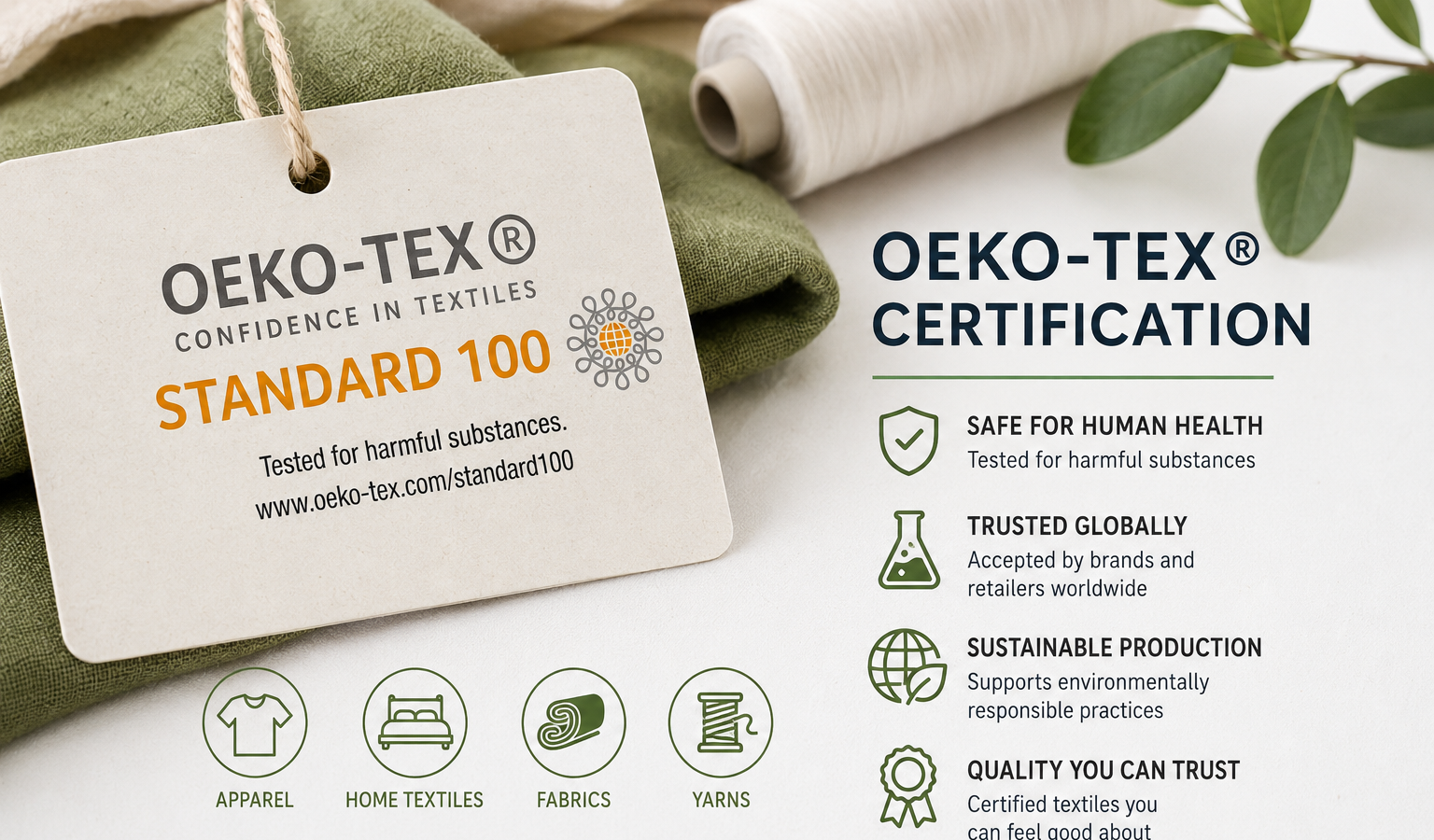
OEKO-TEX is an internationally recognized certification system that tests textile products for harmful substances. It was established in 1992 by independent textile research and testing institutes to promote safer textile production worldwide.
The most widely recognized certification is STANDARD 100 by OEKO-TEX, which verifies that every tested component of a textile product meets strict safety requirements.
The certification covers:
- Yarn
- Fabrics
- Sewing threads
- Buttons
- Zippers
- Labels
- Prints
- Finished garments
- Home textiles
If every component passes laboratory testing, the finished product can carry the OEKO-TEX label.
Why is OEKO-TEX Certification Important in India?
India is one of the world’s largest textile exporters. Buyers from Europe, the United States, Japan, and Australia increasingly demand products that comply with international safety standards.
OEKO-TEX certification helps Indian manufacturers:
- Build trust with international buyers
- Increase export opportunities
- Demonstrate compliance with chemical safety regulations
- Improve product quality
- Enhance brand reputation
- Reduce the risk of rejected shipments
Many global retailers include OEKO-TEX certification as part of their supplier qualification process.
Types of OEKO-TEX Certifications
OEKO-TEX offers several certification programs designed for different parts of the textile supply chain.
1. STANDARD 100 by OEKO-TEX
The most popular certification.
It verifies that textile products are free from harmful chemicals and safe for human use.
2. MADE IN GREEN by OEKO-TEX
This certification combines product safety with environmentally friendly manufacturing and socially responsible production.
3. LEATHER STANDARD
Designed specifically for leather products and accessories.
4. ECO PASSPORT
Certifies chemicals, dyes, auxiliaries, and textile processing chemicals.
5. STeP by OEKO-TEX
Focuses on sustainable textile production by evaluating environmental performance, chemical management, occupational safety, and social responsibility.
Who Needs OEKO-TEX Certification?
Almost every textile business can benefit from certification.
Examples include:
- Yarn manufacturers
- Fabric manufacturers
- Garment exporters
- Home textile producers
- Dyeing units
- Printing units
- Knitting mills
- Weaving mills
- Textile processing houses
- Fashion brands
- Buying houses
Even small manufacturers supplying export companies can benefit from becoming certified.
OEKO-TEX Certification Process in India
Although the process may vary slightly depending on the product, the overall steps remain similar.
Step 1: Select the Appropriate Certification
Choose the certification that matches your product and business operations.
For most textile manufacturers, STANDARD 100 is the starting point.
Step 2: Submit an Application
Prepare information about:
- Product details
- Raw materials
- Manufacturing process
- Chemical usage
- Supplier information
Step 3: Laboratory Testing
Samples are sent to an authorized OEKO-TEX laboratory.
The laboratory tests for hundreds of restricted substances, including:
- Formaldehyde
- Heavy metals
- Azo dyes
- Pesticides
- Phthalates
- PFAS (where applicable)
- Chlorinated phenols
- Nickel release
- Harmful solvents
Only products that meet the specified limits qualify for certification.
Step 4: Factory Assessment
Depending on the certification type, auditors may inspect the manufacturing facility.
The inspection typically covers:
- Production process
- Chemical storage
- Quality control
- Worker safety
- Environmental practices
- Documentation
Step 5: Certification Approval
If all requirements are met, the certification body issues the OEKO-TEX certificate.
Manufacturers can then use the OEKO-TEX label according to licensing rules.
Documents Required
Typical documents include:
- Company registration
- GST details
- Product specifications
- Material Safety Data Sheets (MSDS)
- Chemical inventory
- Supplier declarations
- Quality management documents
- Test reports (if available)
- Manufacturing flow chart
Maintaining organized records helps speed up the certification process.
Benefits of OEKO-TEX Certification
Better Export Opportunities
International buyers often prefer certified suppliers because it reduces compliance risks.
Higher Customer Confidence
Consumers increasingly look for safe and sustainable textile products.
Stronger Brand Image
Certification shows that your business values quality and consumer safety.
Reduced Product Recalls
Testing helps identify restricted substances before products reach the market.
Competitive Advantage
Certification can differentiate your products from competitors in both domestic and international markets.
Cost of OEKO-TEX Certification in India
There is no fixed certification fee because costs depend on factors such as:
- Product type
- Number of products
- Complexity of testing
- Certification scope
- Factory size
- Required laboratory analysis
Small manufacturers generally spend less than large integrated textile mills with multiple product categories.
It is advisable to request quotations from authorized OEKO-TEX institutes based on your specific product range.
How Long Does Certification Take?
The timeline depends on product complexity and laboratory workload.
A typical certification process may take 4 to 8 weeks, provided all documentation is complete and product samples comply with the testing requirements.
If corrective actions or additional testing are required, the process may take longer.
Common Reasons for Certification Failure
Manufacturers occasionally fail because of avoidable mistakes.
Common issues include:
- Use of restricted chemicals
- Incomplete documentation
- Poor supplier traceability
- Incorrect chemical management
- Non-compliant dyes
- Excess formaldehyde
- Heavy metal contamination
- Poor quality control
Regular internal audits can significantly reduce these risks.
Real-Life Example
Consider a textile manufacturer in Tiruppur producing organic cotton T-shirts for European retailers.
Initially, the company struggled to secure large export orders because buyers requested internationally recognized safety certifications.
After obtaining OEKO-TEX STANDARD 100 certification, the manufacturer demonstrated that its garments met strict chemical safety requirements. Within a year, it expanded exports to multiple European countries and established relationships with larger retail brands.
While certification alone does not guarantee business growth, it often strengthens buyer confidence and simplifies supplier approval processes.
Tips for Indian Textile Manufacturers
If you plan to apply for OEKO-TEX certification, consider these best practices:
- Source chemicals from reputable suppliers.
- Maintain complete supplier documentation.
- Test raw materials before production.
- Train employees on chemical handling.
- Keep production records updated.
- Conduct regular internal quality audits.
- Review restricted substance lists periodically.
- Work closely with accredited testing laboratories.
These practices improve both compliance and overall product quality.
Frequently Asked Questions
Is OEKO-TEX certification mandatory?
No. It is voluntary but highly valued by international buyers and retailers.
Who can apply?
Any textile manufacturer, processor, garment exporter, fabric producer, or brand can apply.
Does the certificate expire?
Yes. Certificates generally require renewal to ensure continued compliance with current standards.
Can small textile businesses apply?
Yes. Small and medium enterprises can also obtain certification if they meet the required standards.
Does OEKO-TEX certify organic textiles?
Not necessarily. OEKO-TEX focuses on testing for harmful substances, while certifications such as GOTS focus on organic fiber content and processing requirements.
Conclusion
OEKO-TEX certification has become one of the most respected textile safety certifications in the global apparel industry. For Indian textile manufacturers, it offers an opportunity to strengthen quality assurance, improve buyer confidence, and expand into international markets.
Although the certification process requires careful documentation, laboratory testing, and compliance with strict chemical safety standards, the long-term benefits often outweigh the investment. Companies that consistently follow good manufacturing practices and maintain strong quality control systems are better positioned to achieve certification and build lasting relationships with global buyers.
As sustainability and consumer safety continue to shape the future of the textile industry, OEKO-TEX certification can be an important step toward creating safer products and building a more competitive textile business.
Leave a Reply