Introduction
Modern textiles would look completely different without manufactured fibers. While natural fibers such as cotton, wool, silk, and linen continue to play an important role in the textile industry, manufactured fibers have transformed the way fabrics are produced and used across the world.
Today, manufactured fibers can be found almost everywhere. From sportswear and outdoor clothing to automotive interiors, medical textiles, home furnishings, carpets, industrial fabrics, and high-performance protective garments, these fibers have become an essential part of everyday life.
One of the biggest advantages of manufactured fibers is that their properties can be controlled during production. Unlike natural fibers that depend largely on climate, soil conditions, and biological factors, manufactured fibers are engineered to provide specific performance characteristics. Manufacturers can improve strength, durability, moisture management, flame resistance, UV protection, softness, elasticity, and many other properties during the fiber manufacturing process.
The production of manufactured fibers involves converting a polymer into a liquid form and forcing it through tiny holes called spinnerets. As the liquid emerges from the spinneret, it solidifies into long continuous fibers that can later be processed into yarns and fabrics.
This ability to engineer fiber characteristics has made manufactured fibers one of the most important innovations in textile history.
In this guide, we will explore how manufactured fibers are made, the additives used during production, major spinning methods, and the role these fibers play in modern textile applications.
What Are Manufactured Fibers?
Manufactured fibers are fibers that are produced through chemical and industrial processes rather than being harvested directly from plants or animals.
These fibers are generally divided into two major categories:
Regenerated Fibers
Regenerated fibers are made from natural raw materials that are chemically processed and reformed into fibers.
Examples include:
- Rayon
- Viscose
- Modal
- Lyocell
Synthetic Fibers
Synthetic fibers are produced entirely from chemical compounds derived from petroleum-based materials.
Examples include:
- Polyester
- Nylon
- Acrylic
- Olefin
- Spandex
Both categories use similar fiber-forming techniques despite differences in raw materials.
Why Manufactured Fibers Are Important
Manufactured fibers have gained enormous popularity because they offer advantages that natural fibers cannot always provide.
Some key benefits include:
- Consistent quality
- Higher durability
- Better wrinkle resistance
- Lower production costs
- Enhanced performance properties
- Greater design flexibility
- Improved chemical resistance
- Specialized functionality
Manufacturers can create fibers specifically designed for sportswear, industrial fabrics, outdoor applications, protective clothing, and technical textiles.
Basic Principle of Fiber Manufacturing
The manufacturing of fibers begins with a polymer.
A polymer is a large molecule made up of repeating chemical units.
Examples include:
- Polyester polymer
- Nylon polymer
- Acrylic polymer
The polymer must first be converted into a liquid form before fibers can be produced.
This liquid can be created by:
- Melting the polymer
- Dissolving the polymer in a solvent
The liquid polymer is then pumped through a spinneret.
A spinneret functions similarly to a showerhead but contains extremely small holes.
As the polymer exits these holes, thin streams are formed which solidify into continuous fibers.
These fibers are later stretched, processed, and converted into textile products.
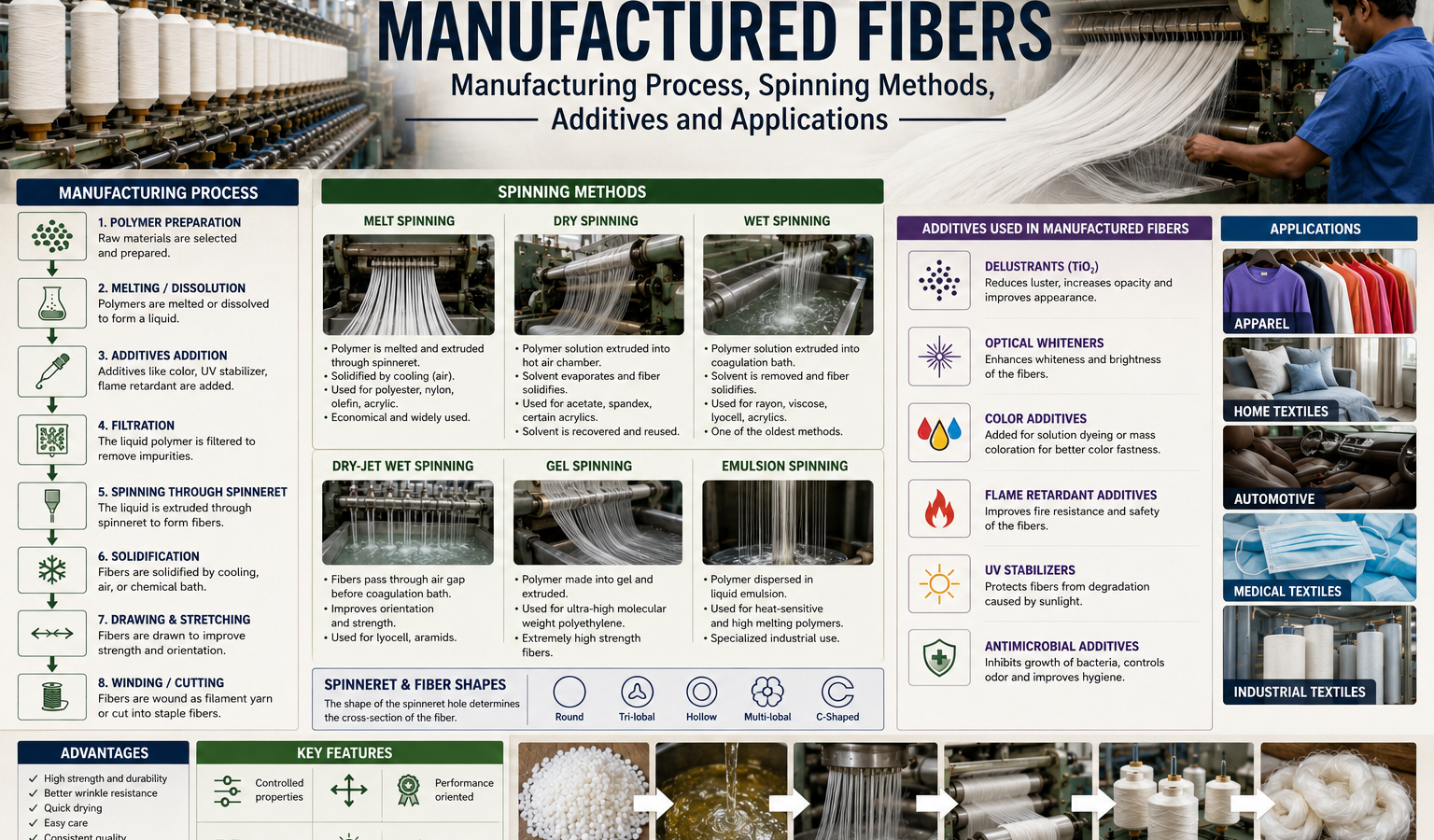
Flow Chart of Manufactured Fiber Production
The general manufacturing sequence includes:
- Polymer preparation
- Polymer melting or dissolution
- Addition of modifiers and additives
- Filtration
- Extrusion through spinneret
- Fiber solidification
- Drawing and stretching
- Crimping (if required)
- Cutting into staple fibers or winding into filament yarn
- Textile processing
Each stage influences the final fiber properties.
Additives Used in Manufactured Fibers
One of the greatest advantages of manufactured fibers is the ability to modify fiber characteristics before spinning.
During the liquid stage, various additives can be mixed directly into the polymer.
Delustrants
Many synthetic fibers naturally possess a bright and shiny appearance.
In some applications this high luster is undesirable.
To reduce shine, manufacturers add delustrants.
The most commonly used delustrant is:
Titanium Dioxide (TiO₂)
Benefits include:
- Reduced luster
- Improved opacity
- Better appearance
- More natural fabric look
Depending on the amount used, fibers may be classified as:
- Bright
- Semi-dull
- Dull
Most commercial polyester contains titanium dioxide.
Optical Whiteners
Optical whiteners are used to improve fiber whiteness.
These chemicals absorb ultraviolet light and emit visible blue light.
Benefits include:
- Brighter appearance
- Cleaner white shades
- Enhanced fabric aesthetics
They are widely used in apparel and home textile products.
Color Additives
Color can be incorporated directly into the polymer before spinning.
This process is known as:
Solution Dyeing
Other terms include:
- Dope dyeing
- Mass coloration
- Mass pigmentation
Advantages include:
- Superior color fastness
- Reduced water usage
- Lower environmental impact
- Improved UV stability
Solution-dyed fibers are common in outdoor textiles and automotive fabrics.
Flame Retardant Additives
Certain textile applications require enhanced fire safety.
Flame retardant chemicals can be incorporated directly into the polymer.
Benefits include:
- Reduced flammability
- Improved safety
- Long-lasting protection
Common applications include:
- Aircraft interiors
- Hotel furnishings
- Protective clothing
- Public transportation fabrics
UV Stabilizers
Ultraviolet radiation can damage fibers over time.
UV stabilizers help prevent degradation.
Benefits include:
- Extended outdoor durability
- Improved weather resistance
- Reduced color fading
Applications include:
- Outdoor furniture
- Carpets
- Awnings
- Marine fabrics
Antimicrobial Additives
Antimicrobial agents inhibit bacterial growth.
Benefits include:
- Reduced odor
- Improved hygiene
- Enhanced freshness
Common uses include:
- Sportswear
- Medical textiles
- Hospital fabrics
- Socks and footwear
Fiber Spinning Methods
After additives are incorporated, the polymer is ready for spinning.
Spinning is the process of converting liquid polymer into solid fibers.
The three primary spinning methods are:
- Melt spinning
- Dry spinning
- Wet spinning
Each method is selected according to the chemical characteristics of the polymer.
Melt Spinning Process
Melt spinning is the most widely used and economical fiber production method.
Fibers commonly produced through melt spinning include:
- Polyester
- Nylon
- Olefin
How Melt Spinning Works
Solid polymer chips are fed into a melting chamber.
Heat converts the polymer into a thick liquid.
The molten polymer is pumped through a spinneret.
As the polymer exits the spinneret, cool air solidifies the fibers.
The fibers are then wound onto packages or further processed.
Advantages of Melt Spinning
- Fast production speed
- Lower manufacturing cost
- No solvent recovery required
- High efficiency
- Environmentally preferable
Because of these advantages, melt spinning dominates synthetic fiber production worldwide.
Dry Spinning Process
Some polymers cannot be melted safely.
Instead, they are dissolved in solvents.
Examples include:
- Acetate
- Spandex
- Certain acrylic fibers
How Dry Spinning Works
The polymer solution is pumped through a spinneret into a heated chamber called a spinning cell.
Hot air causes solvent evaporation.
As solvent evaporates:
- Fibers solidify
- Solvent is recovered
- Fibers are collected
The recovered solvent can be reused in production.
Advantages of Dry Spinning
- Suitable for heat-sensitive polymers
- Produces high-quality fibers
- Efficient solvent recovery
Wet Spinning Process
Wet spinning is one of the oldest manufactured fiber production methods.
Common wet-spun fibers include:
- Rayon
- Viscose
- Certain acrylic fibers
How Wet Spinning Works
The polymer is dissolved in a suitable solvent.
The solution is extruded through a spinneret into a liquid coagulation bath.
The bath removes solvent and solidifies the fiber.
Fibers are then washed, stretched, and dried.
Advantages of Wet Spinning
- Suitable for non-meltable polymers
- Excellent fiber formation
- Useful for regenerated fibers
Dry-Jet Wet Spinning
An advanced variation of wet spinning is called dry-jet wet spinning.
This process is used for:
- Lyocell
- Para-aramid fibers
Unlike conventional wet spinning, fibers pass through a short air gap before entering the coagulation bath.
This improves:
- Molecular orientation
- Strength
- Crystallinity
The result is a stronger and higher-performance fiber.
Specialized Spinning Methods
Some advanced fibers require specialized manufacturing techniques.
Gel Spinning
Gel spinning is used for:
- Ultra-high molecular weight polyethylene fibers
Benefits include:
- Exceptional strength
- Lightweight performance
- High durability
Applications include:
- Ballistic protection
- Ropes
- Aerospace materials
Emulsion Spinning
Certain polymers possess extremely high melting temperatures.
These materials may require emulsion spinning.
The process involves:
- Polymer dispersion
- Alignment
- Coagulation
- Stretching
It is primarily used for specialized industrial fibers.
Spinnerets and Fiber Shapes
Spinnerets determine the shape of fibers.
Different hole designs create different cross-sections.
Examples include:
Round
Most common fiber shape.
Trilobal
Used for improved luster and soil hiding.
Hollow
Provides insulation and reduced weight.
Multilobal
Improves bulk and performance.
Fiber shape influences:
- Appearance
- Comfort
- Moisture transport
- Strength
- Thermal properties
Drawing and Orientation
Freshly spun fibers are generally weak.
Drawing stretches fibers after spinning.
Benefits include:
- Increased strength
- Better molecular alignment
- Improved durability
- Enhanced performance
Most manufactured fibers undergo drawing before final packaging.
Applications of Manufactured Fibers
Manufactured fibers are used across numerous industries.
Apparel
Examples include:
- Activewear
- Sportswear
- Fashion garments
- Uniforms
- Swimwear
Home Textiles
Applications include:
- Curtains
- Upholstery
- Carpets
- Bedding
Automotive Industry
Used in:
- Seat covers
- Headliners
- Carpets
- Safety systems
Medical Textiles
Applications include:
- Surgical gowns
- Wound dressings
- Protective equipment
Industrial Textiles
Examples include:
- Conveyor belts
- Geotextiles
- Filter fabrics
- Reinforcement materials
Sustainability in Manufactured Fibers
Modern manufacturers are focusing heavily on sustainability.
Key developments include:
- Recycled polyester
- Bio-based polymers
- Reduced water consumption
- Improved energy efficiency
- Closed-loop production systems
These innovations help reduce environmental impact while maintaining fiber performance.
Future of Manufactured Fibers
The future of textile fibers is increasingly focused on advanced functionality.
Emerging trends include:
- Smart fibers
- Conductive textiles
- Self-cleaning fabrics
- Biodegradable synthetics
- High-performance technical textiles
As technology advances, manufactured fibers will continue to play a critical role in modern textile innovation.
Conclusion
Manufactured fibers have transformed the global textile industry by providing consistent quality, enhanced performance, and remarkable versatility. Through sophisticated spinning technologies such as melt spinning, dry spinning, and wet spinning, manufacturers can produce fibers tailored for specific applications ranging from everyday clothing to advanced industrial products.
The ability to incorporate additives such as flame retardants, UV stabilizers, antimicrobial agents, and color pigments directly into the fiber structure gives manufactured fibers significant advantages over many natural materials. Combined with ongoing sustainability initiatives and technological innovation, these fibers are expected to remain at the center of textile development for decades to come.
Understanding how manufactured fibers are produced provides valuable insight into the science, engineering, and technology that shape the fabrics we use every day.
Leave a Reply