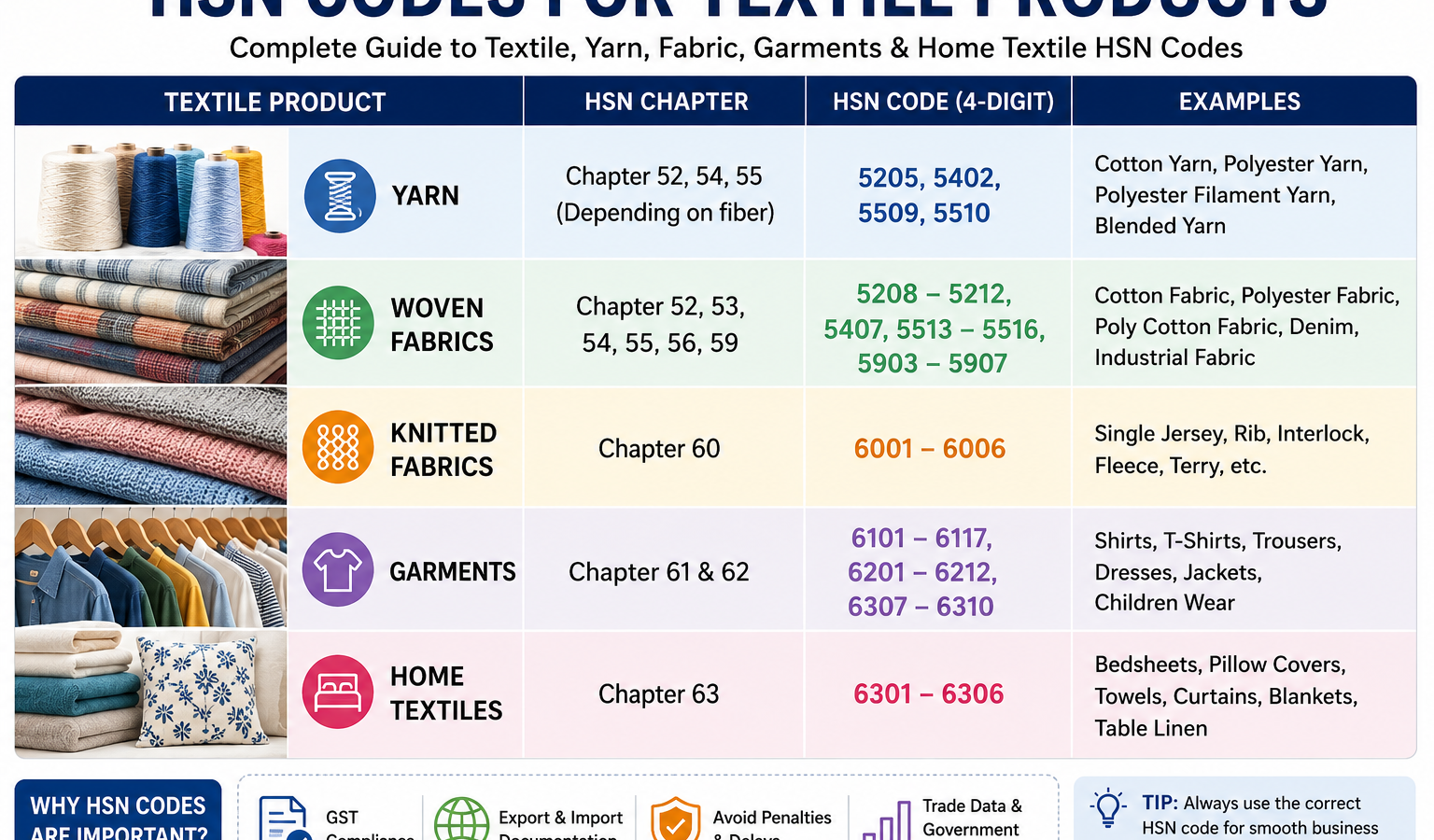
Introduction
If you are involved in the textile industry, whether as a fabric manufacturer, garment exporter, yarn trader, home textile supplier, or GST consultant, you’ve probably come across the term HSN Code countless times.
Yet many textile businesses still struggle with selecting the correct HSN code for their products.
A small mistake in classification can result in:
- GST compliance issues
- Incorrect tax payments
- Customs delays
- Export documentation problems
- Financial penalties
This is why understanding HSN Codes for textile products is crucial.
From cotton yarn and polyester fabrics to bedsheets, towels, garments, and technical textiles, every textile product falls under a specific HSN classification.
In this guide, we’ll explain textile HSN codes in simple language, explore major textile categories, discuss GST implications, provide practical examples, and help manufacturers and exporters avoid costly classification errors.
What Is an HSN Code?
HSN stands for Harmonized System of Nomenclature.
It is an internationally standardized system developed by the World Customs Organization (WCO) for classifying goods.
The system is used by over 200 countries worldwide.
Purpose of HSN Codes
HSN codes help governments:
- Identify products
- Determine tax rates
- Collect customs duties
- Monitor trade statistics
- Standardize international trade
Every textile product has a unique HSN code based on its material, construction, and end use.
Why HSN Codes Are Important for Textile Businesses
Many textile entrepreneurs think HSN codes are only for GST filings.
In reality, they affect multiple business operations.
GST Compliance
Correct HSN classification ensures proper GST payment.
Export Documentation
HSN codes appear on:
- Commercial invoices
- Shipping bills
- Bills of lading
- Export declarations
Import Clearance
Incorrect HSN codes can delay customs clearance.
Government Incentives
Export benefits and duty drawback calculations often depend on proper classification.
Trade Data Analysis
Many buyers use HSN-based trade data to identify suppliers and sourcing opportunities.
Structure of HSN Codes
The HSN system follows a hierarchical structure.
Example
HSN Code:
5208
Breakdown:
52 = Cotton
5208 = Woven cotton fabrics
Further digits create more detailed classifications.
HSN Format in India
- 2 digits = Chapter
- 4 digits = Heading
- 6 digits = Subheading
- 8 digits = Detailed classification
Most GST invoices use 4, 6, or 8-digit HSN codes depending on business requirements.
Textile Chapters Under HSN Classification
Most textile products fall within:
Chapter 50
Silk
Chapter 51
Wool
Chapter 52
Cotton
Chapter 53
Other vegetable textile fibers
Chapter 54
Man-made filament yarn
Chapter 55
Man-made staple fibers
Chapter 56
Wadding, felt, nonwoven fabrics
Chapter 57
Carpets and floor coverings
Chapter 58
Special woven fabrics
Chapter 59
Coated and industrial textiles
Chapter 60
Knitted fabrics
Chapters 61 & 62
Garments
Chapter 63
Home textiles and made-ups
These chapters cover the majority of textile products traded globally.
HSN Codes for Textile Fibers
Cotton Fiber
Chapter:
52
Used for:
- Raw cotton
- Ginned cotton
- Carded cotton
Polyester Fiber
Chapter:
55
Used for:
- Polyester staple fiber
- Synthetic fibers
Viscose Fiber
Chapter:
55
Used for:
- Viscose staple fiber
- Rayon fibers
Wool Fiber
Chapter:
51
Used for wool products and wool blends.
HSN Codes for Textile Yarn
Yarn classification depends on:
- Fiber composition
- Yarn count
- Packaging form
Cotton Yarn
Common Heading:
5205
Examples:
- 20s cotton yarn
- 30s cotton yarn
- 40s cotton yarn
Polyester Yarn
Common Heading:
5509
Used for polyester staple yarns.
Polyester Filament Yarn
Common Heading:
5402
Common in synthetic textile manufacturing.
Blended Yarn
Classification depends on dominant fiber content.
Examples:
- Poly cotton yarn
- Polyester viscose yarn
HSN Codes for Woven Fabrics
Fabric classification is one of the most complex areas in textiles.
Cotton Woven Fabric
Common HSN Range:
5208–5212
Classification depends on:
- Weight
- Fiber content
- Construction
Polyester Fabric
Common HSN:
5407
Examples:
- Suiting fabric
- Uniform fabric
- Technical polyester fabric
Poly Cotton Fabric
Classification depends on fiber percentage.
Typically falls under:
5513 to 5516
depending on composition and weight.
Denim Fabric
Common HSN:
5209
Used for cotton denim fabrics.
HSN Codes for Knitted Fabrics
Knitted fabrics generally fall under:
Chapter 60
Examples:
- Single jersey
- Rib fabric
- Interlock fabric
- Fleece fabric
Widely used in:
- T-shirts
- Polo shirts
- Sportswear
HSN Codes for Garments
Garment classification depends on:
- Gender
- Material
- Product type
Men’s Shirts
Common HSN:
6205
Women’s Garments
Common HSN:
6204
T-Shirts
Common HSN:
6109
Trousers
Common HSN:
6203
Children’s Wear
Various classifications under Chapters 61 and 62.
HSN Codes for Home Textile Products
Home textiles are among India’s largest export categories.
Bedsheets
Common HSN:
6304
or related headings depending on product structure.
Pillow Covers
Chapter:
63
Towels
Common HSN:
6302
Curtains
Common HSN:
6303
Blankets
Common HSN:
6301
HSN Codes for Technical Textiles
Technical textiles have become one of the fastest-growing sectors.
Examples:
Industrial Fabrics
Chapter:
59
Coated Fabrics
Chapter:
59
Geotextiles
Chapter:
56
Nonwoven Fabrics
Chapter:
56
These products often require careful classification due to specialized applications.
Real-Life Example: Fabric Manufacturer
Suppose a textile mill produces:
65% Polyester
35% Cotton
Twill Fabric
The manufacturer cannot automatically classify it under cotton fabric.
The correct HSN depends on:
- Fiber composition
- Weight
- Construction
This highlights why accurate classification requires technical understanding.
Real-Life Example: Bedsheet Exporter
An exporter ships:
100% Cotton Printed Bedsheets
Destination:
United States
Required documents include:
- Commercial Invoice
- Packing List
- Shipping Bill
The correct HSN code must appear consistently across all documents.
An incorrect code can create customs issues at both origin and destination.
Common HSN Classification Mistakes
Using Generic Codes
Many businesses repeatedly use one code for all products.
This creates compliance risks.
Ignoring Fiber Content
Fiber composition often determines classification.
Incorrect Product Description
Descriptions should match the HSN category.
Not Updating Classification
HSN schedules may change over time.
Always verify current classifications.
Best Practices for Textile Businesses
Maintain Product Master Data
Store:
- Product description
- GSM
- Fiber content
- Construction
- HSN code
in a centralized database.
Consult Tax Professionals
Complex classifications should be reviewed by experts.
Verify Before Export
Double-check HSN codes on:
- Invoices
- Shipping documents
- GST filings
Train Commercial Teams
Sales and export teams should understand basic HSN classification principles.
Frequently Asked Questions
What is an HSN code?
HSN stands for Harmonized System of Nomenclature and is used to classify goods for taxation and trade purposes.
Why are HSN codes important in textiles?
They determine GST treatment, customs classification, export documentation, and trade compliance.
Do all textile products have HSN codes?
Yes. Every textile product falls under a specific HSN classification.
Which chapter covers cotton textiles?
Chapter 52.
Which chapter covers garments?
Chapters 61 and 62.
Which chapter covers home textiles?
Chapter 63.
Can the wrong HSN code create GST problems?
Yes. Incorrect classification may result in compliance issues, tax mismatches, and penalties.
Conclusion
HSN codes are much more than numbers on an invoice. They form the foundation of taxation, customs compliance, export documentation, and international trade. For textile manufacturers, exporters, traders, and garment businesses, understanding product classification is essential for smooth operations and regulatory compliance.
From cotton yarn and woven fabrics to garments, towels, bedsheets, and technical textiles, each product must be classified accurately based on its characteristics and intended use.
By maintaining proper product records, reviewing classifications regularly, and ensuring consistency across business documents, textile companies can avoid costly errors and build stronger compliance systems.
As the textile industry becomes increasingly global and data-driven, mastering HSN codes is no longer optional—it’s a critical business skill.
Leave a Reply