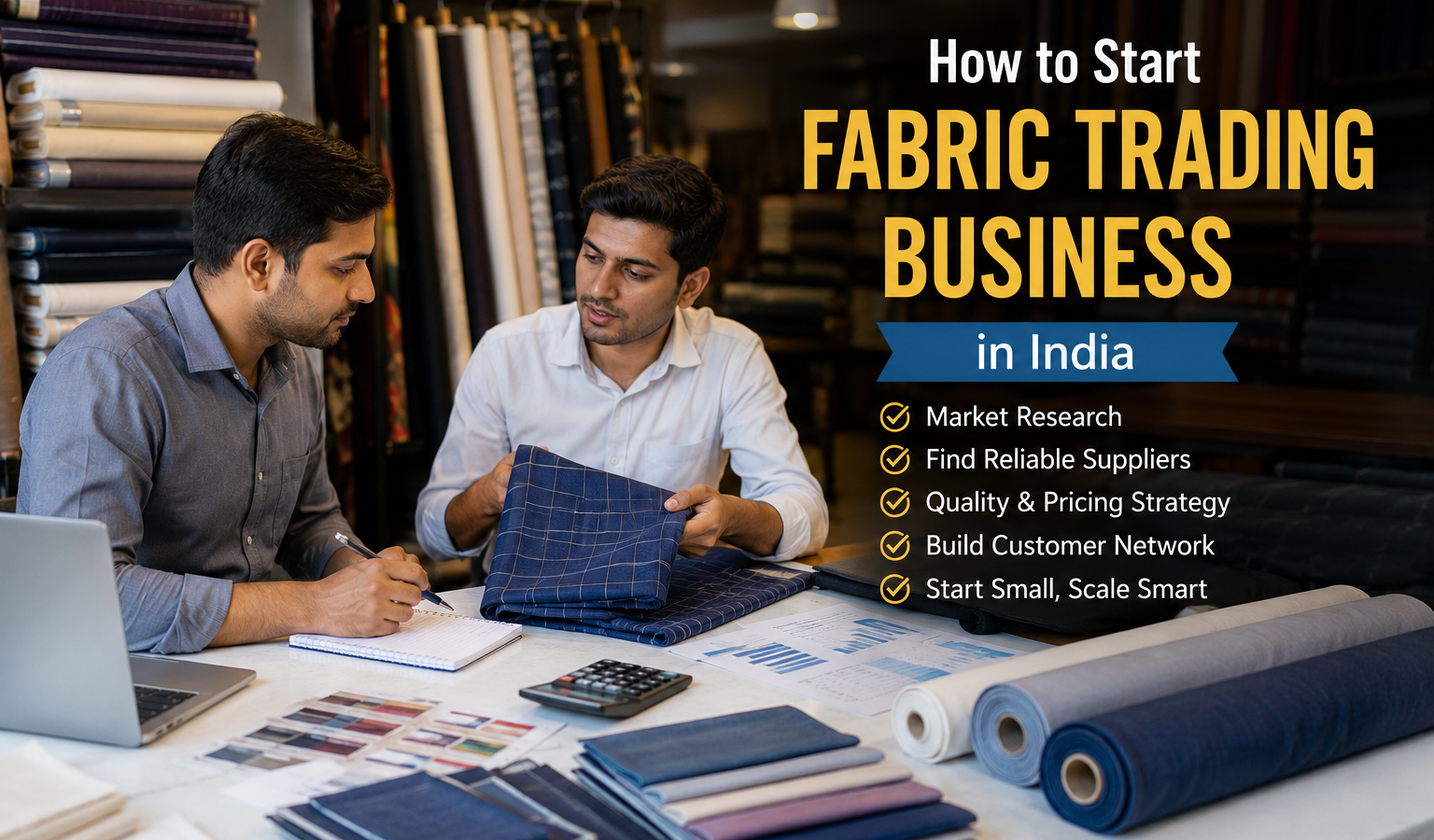
What this guide covers: Everything you need to start a fabric trading business in India from scratch — choosing your business structure, getting registered, finding suppliers in Surat and other markets, how much capital you need, realistic profit margins, how to find buyers, and the most common mistakes that sink new traders before they find their feet.
A friend of mine started a fabric trading business out of a rented 200 sq ft godown in Ahmedabad seven years ago. He had ₹4 lakh in savings, one contact at a mill in Surat, and zero prior experience in the textile trade. Today he runs a mid-size wholesale operation supplying to boutiques and garment manufacturers across three states with a team of six people.
I’ve also watched traders with significantly more capital and better connections shut up shop within two years because they got the fundamentals wrong — sourcing from the wrong level of the supply chain, carrying too much inventory, not building relationships, not tracking GST properly.
Fabric trading in India is genuinely one of the more accessible businesses to start. The barriers to entry are low, the demand is enormous, and the supply chain is well-established. But “accessible” doesn’t mean “easy.” This guide is an attempt to give you an honest picture of both sides.
What Is a Fabric Trading Business?
A fabric trader buys fabric in bulk — from mills, manufacturers, or larger wholesalers — and sells it in smaller quantities to garment makers, boutiques, retailers, tailors, exporters, and other businesses that need fabric but don’t buy in mill-scale quantities.
The value you add is not production. You’re not weaving or dyeing anything. Your value is aggregation, availability, credit terms, and variety. A garment unit that needs 500 metres of cotton voile and 200 metres of viscose challis can’t walk into a mill and place that order — minimum quantities don’t work that way. But they can come to you.
That’s the fundamental business model. Buy big, store smartly, sell in the quantities your buyers actually need, and make a margin on the difference.
The fabric trader’s position in the supply chain — bridging the gap between large mills and small-to-mid buyers who can’t meet mill MOQs directly.
Step 1: Choose Your Niche Before You Start
“Fabric trading” covers a massive range. Cotton shirting is a completely different business from polyester georgette, which is nothing like technical textile trading or handloom fabric supply. Each niche has different suppliers, different buyers, different pricing rhythms, and different seasonal patterns.
Don’t try to stock everything in your first year. Pick one or two fabric categories that you understand or have a connection to, and build depth there first. Here are the main options:
| Niche | Key Sourcing Hubs | Main Buyers | Min. Starting Capital |
|---|---|---|---|
| Cotton fabrics (shirting, dress material) | Erode, Coimbatore, Ahmedabad | Garment units, tailors, retailers | ₹5–10 lakh |
| Synthetic / polyester (georgette, chiffon) | Surat (primary hub) | Boutiques, ethnic wear brands, exporters | ₹5–15 lakh |
| Viscose & rayon | Surat, Bhiwandi | Kurti manufacturers, fashion brands | ₹5–12 lakh |
| Silk fabrics | Varanasi, Mysore, Dharmavaram | Saree traders, bridal wear units | ₹10–25 lakh |
| Denim | Ahmedabad, Surat | Jeans manufacturers, exporters | ₹15–30 lakh |
| Home textiles (bedsheet, curtain fabric) | Panipat, Karur | Retailers, interior firms, exporters | ₹8–20 lakh |
| Technical / industrial textiles | Ahmedabad, Chennai | Industrial buyers, govt contracts | ₹20–50 lakh |
If you’re starting with limited capital and no established relationships, the best first niche is usually synthetic or viscose fabric from Surat. Supply is abundant, variety is enormous, prices are competitive, and the ecosystem of small traders is large enough that you can learn quickly just by being in the market.
Step 2: Register Your Business
This is the step most new traders delay, usually because it feels administrative and slow compared to the excitement of picking fabrics. Don’t skip it. Trading without proper registration creates problems the moment you try to open a business bank account, claim ITC on purchases, or supply to any buyer who needs a proper GST invoice.
Choose a business structure
For most new fabric traders, the decision comes down to three options:
Sole Proprietorship — The simplest and cheapest to start. You are the business. No separate registration needed beyond GST and trade licence. The downside is unlimited personal liability — if the business owes money, your personal assets are at risk. Fine for starting out with low capital and low risk.
Partnership or LLP — If you’re starting with a partner (very common in textile trading where one person handles sourcing and the other handles sales), an LLP gives you the structure of a partnership with limited liability. More paperwork than a proprietorship but cleaner when multiple people are involved.
Private Limited Company — Best if you plan to grow significantly, take on investors, or have regular large-value transactions. More compliance requirements and annual costs, but gives the business its own legal identity and better credibility with larger buyers and banks.
Most fabric traders starting out go with sole proprietorship or LLP. Upgrade to a private limited company when turnover justifies the additional compliance burden.
Registrations you need
- GST Registration — Mandatory once your annual turnover crosses ₹40 lakh (₹20 lakh in special category states). But register from day one even if you’re below this threshold — without a GSTIN you can’t claim ITC on your fabric purchases, which means you’re leaving real money on the table every month.
- MSME / Udyam Registration — Free to do online at udyamregistration.gov.in. Qualifies you for government schemes, priority lending from banks, and certain market protections. Takes about 20 minutes.
- Shop and Establishment Licence — Required by most state governments for any commercial premises. Apply through your local municipal corporation. Usually straightforward.
- Trade Licence — Required in most states for any trading activity within municipal limits. Apply through the local municipal authority along with the shop licence.
- Current Account with a Bank — Open this in the business name before you start operations. All business transactions should flow through this account.
- IEC (Import Export Code) — Only if you plan to import fabrics directly or export. Apply online through DGFT (dgft.gov.in). Not needed for purely domestic trade.
Step 3: Arrange Your Capital
Fabric trading is a working capital business. You’re constantly buying inventory, holding it, and getting paid when it sells — sometimes 30, 60, or 90 days later if you’re offering credit to buyers. Most traders underestimate how much capital this cycle eats.
Here’s a realistic capital breakdown for a small fabric trading business starting from scratch:
| Expense Head | Estimated Amount | Notes |
|---|---|---|
| Opening stock (first inventory purchase) | ₹3–8 lakh | Your first sourcing trip to Surat or your chosen hub |
| Godown / storage rent (3 months advance) | ₹50,000–1.5 lakh | Depends heavily on city and size |
| Shelving, fabric rolls, basic equipment | ₹40,000–80,000 | Roll holders, cutting table, scale |
| Business registration and legal | ₹15,000–40,000 | Includes CA fees for GST setup |
| Transport for first stock | ₹20,000–50,000 | Freight from sourcing hub to your city |
| Website / visiting cards / basic branding | ₹15,000–30,000 | Non-negotiable in 2026 — buyers Google you |
| Working capital buffer (3 months) | ₹1–3 lakh | For restocking before payments come in |
Realistic minimum to start a small but functional fabric trading business: ₹6–12 lakh. You can start smaller, but you’ll feel the squeeze on inventory variety and working capital constantly.
If you don’t have full capital personally, look at: MSME loans from nationalised banks (Bank of Baroda, SBI, Canara Bank all have schemes), Mudra Yojana (collateral-free loans up to ₹10 lakh under the Tarun category), and SIDBI schemes for MSME textile businesses. Have your Udyam registration ready before applying — it significantly speeds up the process.
Step 4: Find the Right Suppliers
This is where fabric trading either works or it doesn’t. Buying from the wrong level of the supply chain — paying one or two intermediary margins before yours — is the single biggest reason traders fail to make sustainable profits.
The major sourcing hubs in India
India’s major fabric sourcing hubs and their specialties. Surat dominates synthetic fabrics; Erode and Ahmedabad anchor cotton supply.
How to actually find reliable suppliers
Go there in person. There’s no shortcut for this, especially early on. A trip to Surat’s Ring Road textile market or Chandni Chowk’s fabric lanes teaches you more in two days than weeks of reading online. You’ll see what fabrics are trending, what the real wholesale prices look like, and which traders are serious versus who’s just showing you samples from a catalogue.
Start with one trusted supplier, not ten mediocre ones. A common beginner mistake is spreading first orders across many suppliers to “diversify risk.” The opposite works better. Find one supplier whose quality and consistency you trust, build a relationship, and get better prices through loyalty and volume. Expand from there.
Understand the supply chain levels: In most markets there are mill agents, primary wholesalers, secondary wholesalers, and retailers. As a new trader, you’ll likely start buying from primary or secondary wholesalers. As your volumes grow and relationships develop, you can start buying directly from mills or their authorised agents — and that’s where margins really open up.
Verify before you trust: Ask for a GST invoice (not a kaccha bill). Check the supplier’s GSTIN on the government portal. Take a small trial order before committing to large quantities. A supplier who resists a small first order is worth being cautious about.
Step 5: Set Up Your Storage and Operations
Fabric needs proper storage or it loses value fast. Sunlight fades colour. Damp ruins fibre. Rats destroy rolls. A godown that seems cheap at ₹8,000 per month but has a leaking roof or inadequate ventilation will cost you far more in damaged stock.
The minimum requirements for a fabric godown: dry walls and floor, no direct sun on fabric rolls, clean and pest-free, proper shelving or rack system to store rolls vertically (not stacked flat — that creases fabric at the bottom of stacks), a decent lock and ideally a CCTV camera, and enough space to move around for picking and packing orders.
You’ll also need a basic cutting table and a fabric weighing scale. Most sales in the wholesale trade are by the metre, but having an accurate scale helps you verify supplier shipments and also allows you to sell by weight in some commodity fabric categories.
Step 6: Find Your First Buyers
Stock without sales is just a storage problem. Finding your first consistent buyers is the hardest part of starting any trading business, and fabric is no different.
Start local. Your city has garment manufacturers, boutiques, tailors, and retailers who currently buy fabric from someone else. Your job is to give them a reason to try you instead. Better prices, faster availability, credit terms, or simply being more reliable than their current supplier — any one of these can open a relationship.
Visit garment clusters in your city. Every Indian city of reasonable size has an area where garment manufacturers or tailors concentrate. In Ahmedabad it’s around Narol. In Jaipur it’s Sitapura. In Delhi it’s Okhla, Gandhi Nagar, or Sadar Bazaar. In Bengaluru it’s Peenya. Walk these areas with samples and a price list.
B2B online platforms. IndiaMART, TradeIndia, and Udaan are where a lot of fabric discovery now happens online. Listing your fabric inventory on IndiaMART with clear photographs and prices generates inbound enquiries even from buyers in other states. This is not an optional channel in 2026 — it’s where real money is being transacted.
Offer credit carefully. Fabric trading runs on credit. Most garment manufacturers will want 30–60 day payment terms. This is normal and manageable once you know your buyer — but giving credit to unknown buyers without checking references is how fabric traders get burned. Start with cash or PDC (post-dated cheque) with new accounts. Extend credit terms only after you’ve traded successfully with someone several times.
Step 7: Manage Your Numbers From Day One
Fabric trading looks simple — buy low, sell higher — but the actual numbers can be deceptive. Here’s what you need to track from the start:
Indicative monthly financials for a small fabric trading business in Year 1. Actual numbers depend on location, niche, and how aggressively you manage costs and credit.
The numbers above are indicative. What matters more than the specific figures is the discipline of tracking them. Every month, know your gross margin on each fabric category, how much stock you’re carrying, how much money you’re owed by buyers (receivables), and how much you owe suppliers. Fabric traders who don’t know these four numbers are running blind.
Use basic accounting software — Tally, Vyapar, or even a well-structured Excel sheet in the early days — and get a CA to file your GST returns and review your books quarterly. The cost is worth it.
Common Mistakes New Fabric Traders Make
Overstocking slow-moving fabric. Fabric has a fashion cycle. What was moving fast six months ago may be sitting dead today. Buy in smaller quantities initially, test which fabrics move in your market, and only stack up on proven sellers.
Giving too much credit too early. It feels generous and business-building to give 60-day credit to new buyers. What it actually does is tie up your working capital and expose you to default risk. Build credit terms gradually as you build trust with individual buyers.
Underpricing to win buyers. New traders often drop their margins to below sustainable levels to attract customers. This creates buyers who are loyal only to your price, not to you — and the moment anyone undercuts you, they leave. Compete on service, reliability, and quality, not just price.
Ignoring GST filing deadlines. Late GSTR-3B or GSTR-1 filings attract penalties and interest, and also block your buyers from claiming ITC on what they bought from you. This damages relationships. Set reminders, outsource to a CA if needed, but never miss your filing dates.
Skipping the market visit and buying only from catalogues. Fabric has to be touched, held up to the light, and draped to be evaluated properly. Buying based on photographs or samples alone leads to stock that doesn’t sell because the colour, hand-feel, or GSM is not what the market wants.
Government Schemes Worth Knowing
India’s Ministry of Textiles runs several schemes that benefit traders and MSMEs:
Udyam Registration gives you access to priority sector lending from banks, subsidised exhibition stalls at trade fairs, and protections under the MSME Delayed Payment Act (buyers legally have to pay MSMEs within 45 days — useful for enforcing credit terms).
PM MITRA Scheme sets up integrated textile parks across seven states — Telangana, Gujarat, Madhya Pradesh, Tamil Nadu, Karnataka, Uttar Pradesh, and Maharashtra — with plug-and-play infrastructure for textile businesses. If you’re planning a larger operation, these parks offer warehouse space, common services, and proximity to manufacturers.
ATUFS (Amended Technology Upgradation Fund Scheme) provides subsidies for machinery and technology upgrades — more relevant for manufacturers than traders, but worth knowing if you plan to add processing capabilities over time.
Frequently Asked Questions
- How much money do I need to start a fabric trading business in India?
- Realistically, ₹6–12 lakh to start a small but functional operation. This covers your first inventory purchase, godown setup, registration costs, and three months of working capital buffer. You can start with less (₹2–3 lakh) if you operate from home and do delivery-based trading without holding large stock, but growth will be slower.
- Is GST registration mandatory for fabric traders?
- Mandatory once your annual turnover exceeds ₹40 lakh (₹20 lakh in special category states). But strongly advisable from day one even below this threshold — without GST registration you can’t claim Input Tax Credit on your fabric purchases, which is a real cost disadvantage versus registered competitors.
- Which is the best city in India to source fabric for trading?
- Surat, Gujarat is the most important hub for synthetic, polyester, viscose, and printed fabrics. Ahmedabad is best for cotton. Varanasi for silk. Erode and Tiruppur for cotton knitwear. Panipat for home textiles. For most new traders starting in the ethnic or fashion fabric space, Surat is the logical first destination.
- What is the typical profit margin in fabric trading?
- Gross margins typically run 15–35% depending on fabric type and where in the supply chain you’re buying from. Specialty and printed fabrics carry higher margins than commodity cotton or grey cloth. Net profit after all operating expenses is typically 8–15% for a well-managed fabric trading business.
- Can I start a fabric trading business from home?
- Yes, in the early stages. Some traders start by taking orders and sourcing to order without holding stock, using their home or a small room as an office. However, once you’re buying in any real volume, you’ll need proper storage — fabric stored improperly loses value quickly from moisture, light, and pests.
- Do I need any specific licence to trade fabrics in India?
- No industry-specific licence is required purely for fabric trading — it’s a general commercial activity. You need GST registration, a Shop and Establishment licence, and a Trade Licence from your local municipal authority. If you import fabrics directly, you’ll also need an Import Export Code (IEC) from DGFT.
Final Word
Fabric trading is one of those businesses where the fundamentals are genuinely simple: know your product, know your market, buy smart, sell reliably, and manage your cash carefully. None of that is secret knowledge.
What separates successful traders from the ones who struggle is execution — actually doing the market visits, actually maintaining relationships with suppliers, actually following up on receivables before they become bad debts, and actually tracking which fabrics make money and which ones don’t.
India’s textile market is enormous, and it’s growing. The domestic fashion industry, the export garment sector, and the home textiles segment all need fabric — reliably, in the right quantities, at fair prices. If you can be that reliable supplier for a defined set of buyers, you have a business.
Start small, learn fast, and build relationships before you build volume.
If you’re calculating costing for your fabric business, try our Fabric Cost Calculator and Profit Margin Calculator — both built specifically for textile traders and manufacturers.
Leave a Reply