Introduction
In the textile industry, quality is everything. A fabric may have the perfect GSM, excellent color, and competitive price, but if defects are present, the entire shipment can be rejected by the buyer.
This is why fabric inspection is one of the most critical stages in textile manufacturing and garment production.
Among the various fabric quality inspection methods used worldwide, the 4 Point System is the most widely accepted and recognized fabric inspection standard. It helps manufacturers, exporters, garment factories, fabric suppliers, and quality controllers evaluate fabric quality consistently and objectively.
Whether you manufacture cotton fabrics, polyester blends, denim, pocketing fabric, shirting material, home textiles, or technical textiles, understanding the Fabric Inspection 4 Point System is essential for maintaining quality standards and reducing costly claims.
In this guide, we’ll explain the 4 Point System in detail, including scoring rules, defect classification, inspection procedures, calculation methods, acceptance criteria, practical examples, and best practices used by textile professionals.
What Is the Fabric Inspection 4 Point System?
The Fabric Inspection 4 Point System is a standardized fabric quality evaluation method used to assess defects in woven and knitted fabrics.
Each defect identified during inspection is assigned points based on its size and severity.
The total points accumulated during inspection determine whether the fabric lot passes or fails quality requirements.
Purpose of the 4 Point System
The system helps:
- Maintain fabric quality consistency
- Reduce customer complaints
- Standardize inspection procedures
- Support garment manufacturing quality
- Improve buyer confidence
- Minimize shipment rejections
Because of its simplicity and effectiveness, the 4 Point System has become the preferred method for textile quality control globally.
Why Fabric Inspection Is Important
Fabric accounts for a significant portion of garment manufacturing costs.
In many cases:
- Fabric contributes 50% to 70% of garment cost
A defective fabric can lead to:
- Garment defects
- Production delays
- Increased rejection rates
- Customer dissatisfaction
- Financial losses
Detecting defects before cutting and sewing saves time, labor, and money.
History of the 4 Point Fabric Inspection System
The 4 Point System was originally developed by the American textile industry to create a uniform method of evaluating fabric quality.
Before standardized inspection methods, different manufacturers used their own quality standards, creating confusion between buyers and suppliers.
The 4 Point System solved this problem by introducing a simple scoring mechanism that could be applied across different fabric types.
Today it is widely accepted by:
- Apparel brands
- Textile mills
- Buying houses
- Exporters
- Quality inspection agencies
How the 4 Point System Works
The system assigns points based on the length of the defect.
The larger the defect, the higher the penalty.
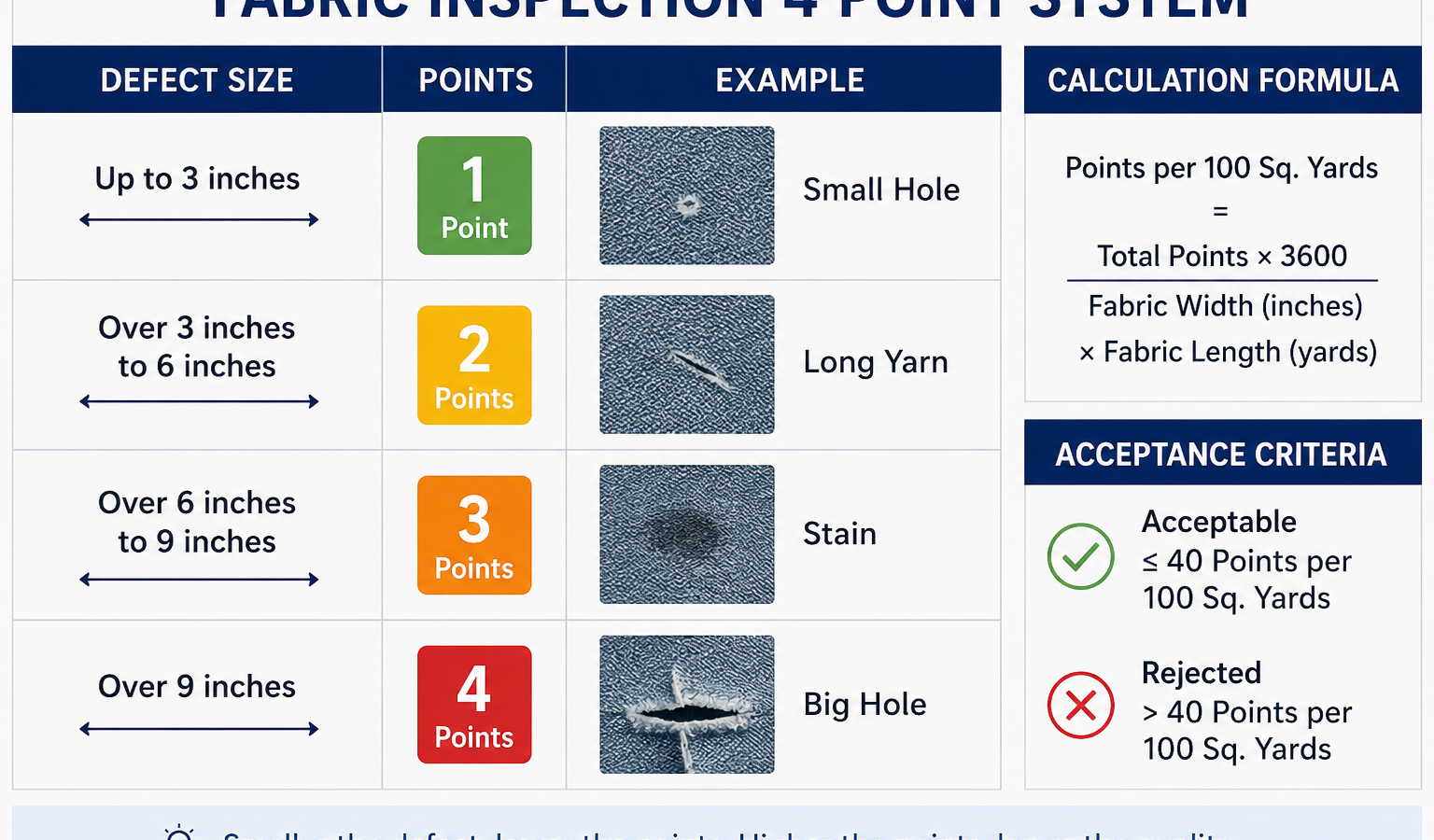
Standard Point Allocation
| Defect Size | Points Assigned |
|---|---|
| Up to 3 inches | 1 Point |
| Over 3 inches to 6 inches | 2 Points |
| Over 6 inches to 9 inches | 3 Points |
| Over 9 inches | 4 Points |
Maximum points for a single defect:
4 Points
Even if a defect exceeds 20 inches, it cannot receive more than 4 points.
Types of Fabric Defects Evaluated
During inspection, quality controllers check for a wide range of defects.
Weaving Defects
Examples include:
- Broken ends
- Broken picks
- Missing yarn
- Double ends
- Float marks
- Reed marks
- Tight ends
Dyeing Defects
Examples include:
- Shade variation
- Uneven dyeing
- Stains
- Oil marks
- Water spots
Printing Defects
Examples include:
- Misprint
- Color mismatch
- Smudging
- Registration issues
Finishing Defects
Examples include:
- Creases
- Bowing
- Skewness
- Finish marks
All visible defects are evaluated according to the 4 Point System rules.
Fabric Inspection Procedure
Step 1: Fabric Preparation
The fabric roll is mounted on an inspection machine.
Inspection is usually conducted under:
- Standard lighting conditions
- Controlled environment
Step 2: Visual Examination
Inspectors examine fabric continuously.
Typical inspection speed:
15–20 meters per minute.
Step 3: Defect Identification
Every visible defect is identified and recorded.
Examples:
- Hole
- Slub
- Oil stain
- Yarn contamination
Step 4: Point Assignment
Points are assigned according to defect size.
Step 5: Calculation
Total points are calculated per 100 square yards of fabric.
This determines acceptance or rejection.
Formula for Calculating Fabric Inspection Points
The standard formula is:
Points per 100 Square Yards=frac{Total Pointstimes3600}{Fabric Width (inches)times Fabric Length (yards)}
This formula standardizes inspection results across different fabric widths and roll lengths.
Practical Example
Suppose:
Fabric Width = 60 inches
Fabric Length = 100 yards
Total Defect Points = 28
Calculation:
Points per 100 square yards:
= (28 × 3600) ÷ (60 × 100)
= 16.8 points
Result:
16.8 points per 100 square yards
This roll would typically pass most buyer quality standards.
Acceptance Criteria
Different buyers may use different acceptance levels.
However, the most common industry standard is:
Acceptable Fabric
Less than:
40 points per 100 square yards
Rejected Fabric
More than:
40 points per 100 square yards
Many premium brands use stricter standards such as:
- 20 points
- 25 points
- 30 points
depending on product category.
Common Fabric Defects and Point Assignment Examples
Example 1
Oil stain:
2 inches
Assigned:
1 Point
Example 2
Weaving defect:
5 inches
Assigned:
2 Points
Example 3
Shade mark:
8 inches
Assigned:
3 Points
Example 4
Hole:
12 inches
Assigned:
4 Points
These examples help inspectors maintain consistency.
Major vs Minor Defects
Not all defects are equal.
Major Defects
Can affect:
- Appearance
- Performance
- Customer satisfaction
Examples:
- Holes
- Large stains
- Severe shade variation
Minor Defects
Less noticeable.
Examples:
- Small slubs
- Tiny spots
- Minor yarn irregularities
Both types are recorded, but major defects often receive more attention during evaluation.
Benefits of Using the 4 Point System
Standardized Quality Assessment
Everyone follows the same rules.
Improved Buyer Confidence
Buyers know quality standards are being followed.
Reduced Disputes
Objective scoring reduces arguments regarding fabric quality.
Better Production Planning
Defective rolls can be identified before cutting.
Cost Savings
Early detection prevents downstream manufacturing losses.
Real-Life Example: Garment Factory Inspection
A garment factory receives:
20,000 meters of cotton fabric.
Before cutting begins, quality inspectors examine each roll using the 4 Point System.
Results:
- 92% of rolls pass
- 8% exceed buyer limits
Those defective rolls are isolated and reported to the supplier.
Without inspection, defective fabric would have entered production, increasing rejection rates and manufacturing costs.
Best Practices for Fabric Inspection
Train Inspectors Properly
Human skill remains critical.
Experienced inspectors identify defects more accurately.
Use Standard Lighting
Poor lighting can hide defects.
Recommended:
D65 daylight conditions whenever possible.
Calibrate Inspection Machines
Proper machine setup ensures accurate inspection.
Inspect Early
Inspect fabric before cutting.
Late detection is costly.
Maintain Inspection Records
Document:
- Roll numbers
- Defect types
- Points assigned
- Final decisions
These records help resolve future disputes.
Challenges of the 4 Point System
Although widely used, the system is not perfect.
Subjectivity
Different inspectors may score defects differently.
Visual Dependence
Inspection depends heavily on human observation.
Limited Severity Evaluation
Some severe defects may receive the same maximum 4-point score as less severe defects.
Despite these limitations, the system remains highly effective for routine fabric quality control.
Future of Fabric Inspection
Technology is transforming textile quality control.
Automated Fabric Inspection Systems
Modern systems use:
- Artificial Intelligence
- Machine Vision
- Cameras
- Real-time defect detection
Benefits include:
- Higher accuracy
- Faster inspection
- Reduced human error
However, the 4 Point System still serves as the foundation for quality evaluation.
Frequently Asked Questions (FAQs)
What is the 4 Point System in fabric inspection?
It is a standardized method of assigning penalty points to fabric defects based on defect size.
What is the maximum point for a single defect?
4 Points.
What is the typical acceptance limit?
Most buyers use:
40 points per 100 square yards.
Can the 4 Point System be used for knitted fabrics?
Yes.
It is commonly used for both woven and knitted fabrics.
Why is fabric inspection important?
It helps prevent defective fabric from reaching garment production or customers.
What equipment is used for fabric inspection?
Typically:
- Fabric inspection machine
- Standard lighting system
- Measuring tools
- Quality inspection forms
Conclusion
The Fabric Inspection 4 Point System remains one of the most effective and widely accepted methods for evaluating textile quality. By assigning standardized penalty points to fabric defects, it provides a simple yet powerful framework for maintaining consistency across textile manufacturing, garment production, and export operations.
Whether you’re a textile mill, garment factory, exporter, sourcing agent, or quality controller, implementing the 4 Point System can significantly reduce defects, improve buyer satisfaction, and strengthen your quality management processes.
In an industry where quality directly impacts profitability and reputation, fabric inspection is not just a quality control activity—it’s a business necessity.
SEO Meta Title
Fabric Inspection 4 Point System: Complete Guide for Textile Quality Control
Leave a Reply