Introduction
If you work in textiles, garments, sourcing, fabric manufacturing, or even online clothing retail, you’ve probably heard the term GSM countless times. Yet many people still struggle to understand what GSM actually means and why it plays such a critical role in fabric quality.
Imagine buying two cotton T-shirts that look almost identical. After touching them, one feels lightweight and breathable, while the other feels thicker and more premium. The difference often comes down to GSM.
Fabric GSM is one of the most important measurements used throughout the textile industry. It influences fabric weight, comfort, durability, drape, cost, and end-use applications. Whether you’re manufacturing garments, purchasing fabric, exporting textiles, or simply trying to understand fabric specifications, knowing how GSM works can help you make better decisions.
In this comprehensive guide, you’ll learn:
- What GSM means in textiles
- Why GSM matters
- GSM formula and calculation methods
- How to measure GSM accurately
- GSM calculator concepts
- GSM ranges for different fabrics
- Common mistakes to avoid
- Industry applications and practical examples
Let’s begin with the basics.
What Is Fabric GSM?
GSM stands for Grams per Square Meter.
It is the standard unit used to measure the weight of fabric.
In simple terms, GSM tells us how much one square meter of fabric weighs in grams.
A higher GSM generally indicates a heavier fabric, while a lower GSM indicates a lighter fabric.
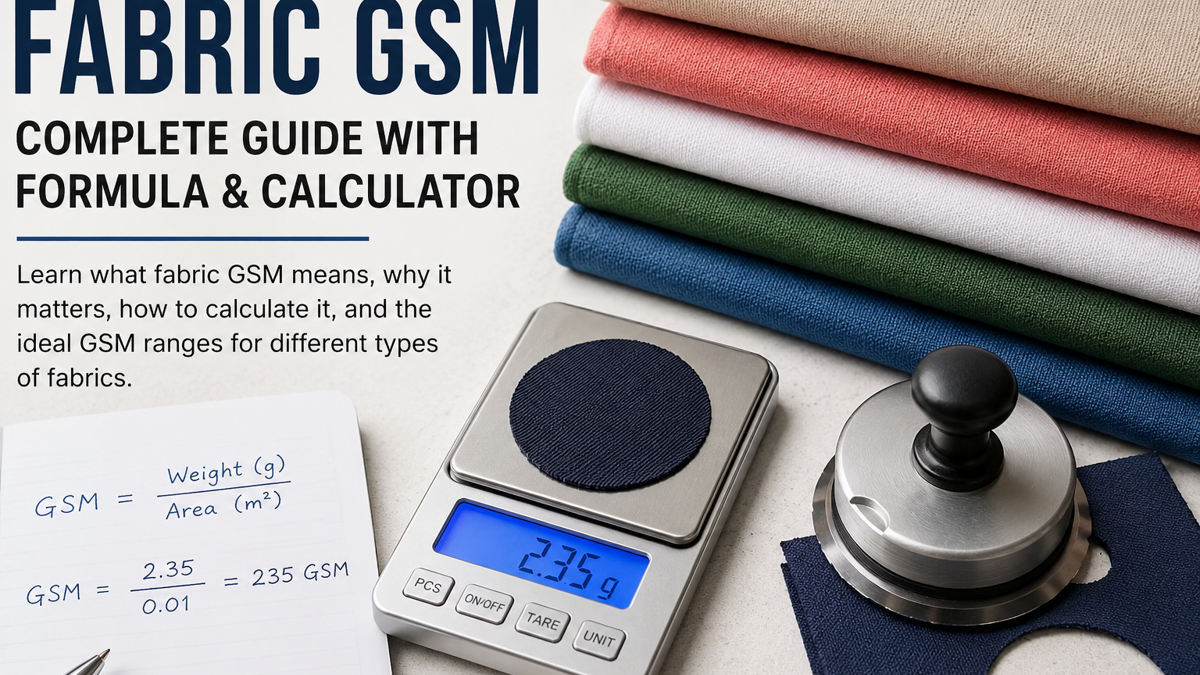
Fabric GSM Formula
GSM=frac{Fabric Weight (grams)}{Fabric Area (m^2)}
For example:
If one square meter of fabric weighs 180 grams, the fabric GSM is 180.
This means:
- 120 GSM = lightweight fabric
- 180 GSM = medium-weight fabric
- 300 GSM = heavyweight fabric
Why Is GSM Important?
Many buyers focus on color, design, or price. Textile professionals know that GSM often determines the actual quality and performance of a fabric.
1. Determines Fabric Thickness
Although GSM is technically a weight measurement, it often correlates with thickness.
Higher GSM fabrics usually feel:
- Thicker
- Denser
- More durable
Lower GSM fabrics feel:
- Lightweight
- Airy
- More breathable
2. Impacts Fabric Durability
A fabric with higher GSM typically contains more fiber material per unit area.
As a result, it often offers:
- Better strength
- Improved abrasion resistance
- Longer service life
This is one reason why workwear fabrics usually have much higher GSM than fashion garments.
3. Affects Garment Comfort
Climate plays a huge role in fabric selection.
For hot climates:
- 120–160 GSM cotton is preferred
For moderate climates:
- 160–220 GSM fabrics work well
For winter applications:
- 250 GSM and above is common
The wrong GSM can make a garment uncomfortable regardless of how attractive it looks.
4. Influences Fabric Cost
More material means higher raw material consumption.
Generally:
Higher GSM = Higher Fabric Cost
However, this is not always true because yarn quality, weave structure, fiber type, and finishing processes also affect pricing.
Understanding Fabric Weight Categories
Lightweight Fabrics
Usually below 150 GSM.
Examples include:
- Summer shirts
- Linings
- Scarves
- Lightweight dresses
Benefits:
- Excellent breathability
- Soft feel
- Comfortable in hot weather
Medium Weight Fabrics
Usually between 150 and 250 GSM.
Examples:
- Polo T-shirts
- Casual shirts
- Kurtis
- Uniform fabrics
Benefits:
- Balanced comfort
- Good durability
- Suitable for all seasons
Heavyweight Fabrics
Typically above 250 GSM.
Examples:
- Hoodies
- Sweatshirts
- Jackets
- Industrial uniforms
Benefits:
- Enhanced durability
- Better insulation
- Premium feel
How To Calculate Fabric GSM
The most common method uses a GSM cutter and weighing scale.
Step 1: Cut Fabric Sample
A GSM cutter typically cuts a circular sample.
The area is generally:
100 cm²
Step 2: Weigh Sample
Place the sample on a digital weighing balance.
Example:
Sample weight = 1.85 grams
Step 3: Apply GSM Formula
Since the sample area is 100 cm², multiply the weight by 100.
GSM=Sample Weighttimes100
Example:
1.85 × 100 = 185 GSM
Therefore:
Fabric GSM = 185
GSM Calculation Without GSM Cutter
Sometimes factories or buyers don’t have access to a GSM cutter.
You can still calculate GSM manually.
Manual Formula
GSM=frac{Weight (g)times10000}{Length (cm)times Width (cm)}
Example:
Fabric Length = 20 cm
Fabric Width = 20 cm
Fabric Weight = 8 grams
Calculation:
GSM = (8 × 10000) ÷ (20 × 20)
GSM = 200
Thus, fabric GSM is 200.
GSM Calculator Explained
A GSM calculator helps textile professionals instantly determine fabric weight.
Most GSM calculators require:
- Fabric sample weight
- Sample dimensions
The calculator automatically computes GSM using standard formulas.
Many textile mills now integrate GSM calculators into ERP systems to improve production accuracy and reduce manual errors.
Relationship Between GSM and Fabric Quality
One common misconception is that higher GSM automatically means better quality.
This is not always true.
Consider these examples:
Example 1
Fabric A:
- GSM: 200
- Poor yarn quality
Fabric B:
- GSM: 180
- Premium combed cotton yarn
Fabric B may actually perform better despite having lower GSM.
Quality depends on multiple factors:
- Fiber quality
- Yarn count
- Construction
- Finishing
- Dyeing process
- GSM
GSM is important, but it is only one piece of the puzzle.
Typical GSM Range For Different Fabrics
Cotton T-Shirts
- 120–180 GSM
Lightweight fashion tees often use:
- 140 GSM
- 160 GSM
Premium T-shirts commonly use:
- 180 GSM
- 220 GSM
Polo T-Shirts
Usually:
- 180–250 GSM
The heavier structure helps maintain shape and durability.
Formal Shirting Fabric
Typically:
- 90–150 GSM
This provides comfort and breathability for daily wear.
Denim Fabric
Generally:
- 250–450 GSM
Heavy-duty denim may exceed 500 GSM.
Sweatshirts
Usually:
- 280–400 GSM
Higher GSM provides warmth and structure.
Bed Sheets
Commonly:
- 100–180 GSM
Hotel-quality sheets often balance GSM with thread count for maximum comfort.
Towels
Generally:
- 300–700 GSM
Luxury bath towels often range between:
- 500–700 GSM
Higher GSM towels feel thicker and absorb more water.
GSM vs Thread Count
Many people confuse GSM and thread count.
They measure different characteristics.
GSM Measures
- Fabric weight
Thread Count Measures
- Number of threads per square inch
A fabric can have:
- High thread count
- Low GSM
Or:
- Low thread count
- High GSM
Both parameters should be evaluated together when assessing fabric quality.GSM vs Ounces (OZ): Understanding International Fabric Weight Measurements
In global textile trade, especially when dealing with denim and industrial fabrics, buyers often use ounces (oz) instead of GSM.
The relationship between GSM and ounces is straightforward:
1 oz/yd^2approx33.91 GSM
Quick Conversion Examples
| Ounces | Approx. GSM |
|---|---|
| 4 oz | 136 GSM |
| 6 oz | 203 GSM |
| 8 oz | 271 GSM |
| 10 oz | 339 GSM |
| 12 oz | 407 GSM |
| 14 oz | 475 GSM |
Practical Example
If an overseas buyer requests a 12 oz denim fabric, the supplier should understand that the target GSM is approximately 407 GSM.
Many export-related misunderstandings happen because buyers and suppliers use different weight units. Understanding both systems helps avoid costly mistakes.
GSM vs Yarn Count
Another common confusion in the textile industry is between GSM and yarn count.
These measurements are connected but represent completely different characteristics.
GSM Measures
- Fabric weight
- Mass per square meter
Yarn Count Measures
- Yarn fineness
- Thickness of yarn
For example:
A fabric made from:
- 20s cotton yarn
will generally be heavier than fabric made from:
- 40s cotton yarn
However, weave density also affects the final GSM.
This means two fabrics made from the same yarn count can have different GSM values if their construction differs.
Example
Fabric A:
- 40s x 40s
- 110 x 90 construction
Fabric B:
- 40s x 40s
- 133 x 72 construction
Even though yarn counts are identical, GSM will vary due to thread density differences.
GSM in Knitted Fabrics vs Woven Fabrics
GSM behaves differently in knitted and woven fabrics.
Woven Fabrics
Examples:
- Shirting
- Suiting
- Pocketing
- Bedsheets
- Uniform fabrics
Characteristics:
- Stable structure
- Less stretch
- GSM remains relatively consistent
Knitted Fabrics
Examples:
- T-shirts
- Polo shirts
- Sweatshirts
- Leggings
Characteristics:
- Stretchable structure
- Loop formation
- GSM may fluctuate depending on relaxation conditions
For knitted fabrics, GSM should ideally be measured after relaxation and finishing because stretching can significantly affect results.
How Textile Mills Control GSM During Production
Maintaining GSM consistency is one of the biggest challenges in textile manufacturing.
Even a small variation can lead to:
- Buyer complaints
- Rejected shipments
- Quality issues
- Cost overruns
Key Factors Affecting GSM
1. Yarn Count
Coarser yarn increases GSM.
Finer yarn reduces GSM.
2. Ends and Picks
Higher thread density increases fabric weight.
Lower thread density reduces fabric weight.
3. Fabric Width
Changes in width can indirectly influence GSM.
4. Finishing Processes
Processes such as:
- Sanforizing
- Compacting
- Shrinkage control
- Brushing
can alter GSM significantly.
5. Moisture Content
Fabric moisture affects weight.
For accurate testing, GSM should be measured under standard atmospheric conditions.
Real-Life Example: Why GSM Matters
A garment exporter receives an order for 50,000 cotton T-shirts.
The buyer specification:
- 180 GSM
- 100% Cotton
The supplier produces fabric at:
- 165 GSM
Difference:
15 GSM
At first glance, this seems minor.
However, when multiplied across 50,000 garments, the buyer notices:
- Different hand feel
- Reduced durability
- Different drape
- Perceived lower quality
The shipment may face claims or price deductions.
This example shows why GSM control is critical in large-scale manufacturing.
Common GSM Ranges Used in the Textile Industry
Fashion T-Shirts
- 140–180 GSM
Premium T-Shirts
- 180–240 GSM
Polo Shirts
- 200–260 GSM
School Uniform Fabrics
- 120–220 GSM
Industrial Uniform Fabrics
- 180–350 GSM
Shirting Fabrics
- 90–150 GSM
Bedsheet Fabrics
- 100–180 GSM
Towels
- 300–700 GSM
Denim Fabrics
- 250–500 GSM
Hoodies and Sweatshirts
- 280–450 GSM
Common Mistakes When Measuring GSM
Many textile professionals unknowingly make errors during GSM testing.
Using Uneven Fabric Samples
The sample should be free from:
- Creases
- Folds
- Distortions
Incorrect Weighing Scale
Low-quality scales often create inaccurate readings.
Use a calibrated digital balance.
Measuring Before Relaxation
Especially important for knitted fabrics.
Fabric should relax before testing.
Ignoring Moisture Content
Wet or humid fabric will show higher GSM.
Always test under standard conditions.
Measuring Near Fabric Edges
Selvedge areas may distort results.
Always take samples from representative sections.
How Buyers Use GSM During Fabric Sourcing
Professional buyers rarely purchase fabric without checking GSM.
During sourcing, GSM helps buyers evaluate:
Cost Control
Higher GSM often increases raw material consumption.
Performance Expectations
A workwear buyer may require:
- 220 GSM twill fabric
while a fashion brand may prefer:
- 140 GSM lightweight fabric
Supplier Consistency
Reliable suppliers maintain GSM within acceptable tolerance levels.
Typical tolerance:
±5%
Depending on customer requirements.
Expert Tips for Selecting the Right GSM
For Summer Clothing
Choose:
- 100–160 GSM
Benefits:
- Breathability
- Comfort
- Lightweight feel
For Everyday Casual Wear
Choose:
- 160–220 GSM
Provides a balance between durability and comfort.
For Workwear
Choose:
- 180–350 GSM
Improved lifespan and performance.
For Winter Garments
Choose:
- 250 GSM and above
Better insulation and warmth.
Frequently Asked Questions (FAQs)
What does GSM stand for in fabric?
GSM stands for Grams per Square Meter. It measures fabric weight.
Is higher GSM always better?
No.
Higher GSM only indicates heavier fabric. Quality also depends on fiber, yarn, construction, and finishing.
Which GSM is best for T-shirts?
Most premium T-shirts use:
- 180 GSM
- 200 GSM
- 220 GSM
depending on the desired feel.
How is GSM measured?
Using a GSM cutter and precision weighing scale or through manual fabric weight calculations.
Does GSM affect fabric price?
Yes.
Generally, higher GSM fabrics require more raw material and therefore cost more.
What GSM is suitable for bedsheets?
Most bedsheets range from:
100 GSM to 180 GSM
depending on construction and intended use.
Can GSM change after washing?
Yes.
Shrinkage and finishing effects can slightly alter GSM values after laundering.
Key Takeaways
If you remember only a few points from this guide, remember these:
✔ GSM means Grams per Square Meter.
✔ GSM measures fabric weight, not necessarily quality.
✔ Higher GSM usually means heavier fabric.
✔ GSM impacts comfort, durability, appearance, and cost.
✔ Both buyers and manufacturers rely on GSM for quality control.
✔ GSM should always be evaluated alongside yarn count, construction, fiber type, and finishing.
✔ Consistent GSM is critical for successful textile production and exports.
Conclusion
Fabric GSM is one of the most fundamental measurements in the textile industry. From garment manufacturers and fabric exporters to sourcing managers and fashion brands, everyone relies on GSM to evaluate fabric performance and quality.
Understanding GSM helps you choose the right fabric for the right application, estimate costs more accurately, maintain quality standards, and communicate effectively with suppliers and buyers.
Whether you’re purchasing cotton shirting, manufacturing industrial uniforms, producing premium T-shirts, or exporting bed linens, GSM provides a reliable benchmark for comparing fabrics and ensuring consistency.
The next time you review a fabric specification sheet, don’t just look at the color or design. Pay close attention to the GSM. It often tells the real story behind the fabric’s performance, durability, and value.
SEO Meta Description
Learn everything about Fabric GSM, including definition, formula, calculation methods, GSM calculator, conversion charts, industry standards, and expert tips. Complete beginner-to-advanced guide for textile professionals.
Leave a Reply