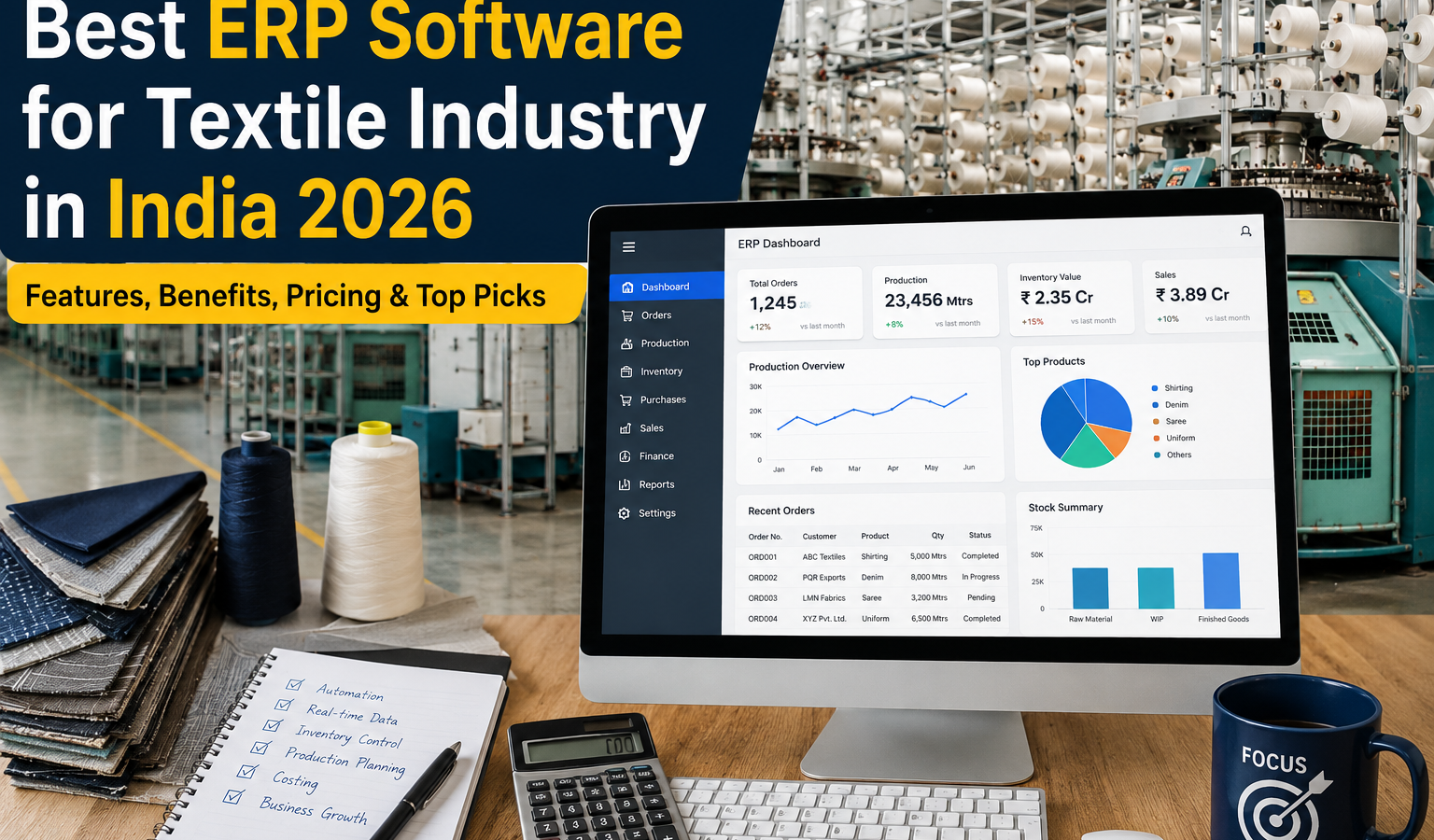
We tested and compared 8 leading textile ERP platforms used by Indian mills, fabric traders, and garment manufacturers — so you don’t have to spend months figuring it out yourself.
⚡ Quick Picks — Best Textile ERP by Category
Why Textile Manufacturing Needs a Specialised ERP
Let’s be honest — most generic ERP systems weren’t built with a weaving mill in mind. They don’t understand GSM, they can’t plan loom capacity, and they have no idea what a jobwork challan is. That’s why textile manufacturers across India — from spinning mills in Coimbatore to fabric traders in Surat — keep running into the same frustrations when they try to fit generic software into their workflow.
A textile-specific ERP solves this from the ground up. It speaks your language: yarn count, warp-weft ratio, pocketing fabric, dyeing batch, grey fabric inventory, cuts and wastage. It connects your production floor to your accounts, your store to your sales team, and your buyers to your dispatch team — all in real time.
And in 2026, the stakes are even higher. Buyers in Europe and the USA increasingly demand traceability data — which fibres, which dyes, which mill, which batch. OEKO-TEX, GOTS, and GRS certifications require documentation that manual systems can’t reliably produce. A proper ERP isn’t just an operational upgrade — it’s a competitive requirement.
According to industry estimates, textile manufacturers who implement a specialised ERP typically see 18–25% improvement in production planning accuracy and a 12–18% reduction in raw material wastage within the first year of implementation.
How We Evaluated These ERP Systems
Our team spent three months researching, demoing, and speaking to actual users of each platform. We focused on Indian textile businesses — mills, traders, exporters, and garment manufacturers — and evaluated each ERP on these criteria:
- Textile-specific modules: Does it handle yarn management, fabric GSM, loom planning, jobwork, dyeing, and finishing natively?
- India compliance: GST billing, e-way bills, TDS, statutory reports — without add-ons?
- Ease of implementation: How long does it take to go live? What’s the learning curve?
- Scalability: Can it grow with your business from 20 users to 200?
- Support quality: Local implementation partners, Hindi-language support, response time?
- Total cost of ownership: License + implementation + annual maintenance + hidden costs?
- Integration: With e-commerce, fabric exchanges, tally, or third-party tools?
Top 8 ERP Software for Textile Industry in India — Reviewed
Aptean Apparel ERP (formerly Lawson/CGS) is one of the most complete textile and apparel ERP systems available in India today. Originally built for the global fashion and textile supply chain, it’s been adapted for the Indian market with full GST compliance, multi-currency support, and a network of local implementation partners.
What sets Aptean apart is its depth in product lifecycle management (PLM) — from initial design and sampling, through fabric procurement and production planning, to delivery and financial settlement. For manufacturers who also export, the LC management and shipping documentation modules are genuinely excellent.
The downside? It’s not a small-business tool. Implementation takes time, costs money, and needs a dedicated team. But for a mid-sized mill with 50+ employees and complex production workflows, it’s hard to beat.
- Full PLM + production + finance in one system
- Excellent yarn & fabric inventory tracking
- Strong India GST and statutory compliance
- Good export documentation support
- Trusted by major Indian textile groups
- High implementation cost
- UI feels dated in some modules
- Requires dedicated IT team for on-premise
- Steep learning curve for shop floor users
No ERP list is complete without SAP, and for India’s largest textile groups — names like Vardhman, Welspun, Raymond, and Arvind — SAP S/4HANA is the backbone of their operations. The textile industry solution built on SAP covers everything from raw material procurement to spinning, weaving, dyeing, finishing, trading, and exports.
SAP’s real strength is data integration at scale. When you have multiple plants, thousands of SKUs, dozens of buyers, and complex intercompany transactions, SAP is the only platform that handles it all without duct-taping different software together. The analytics and reporting capabilities are unmatched.
That said, SAP is genuinely overkill for anyone below ₹100 crore in revenue. The implementation cost, time, and change management effort are significant. You’ll need a specialised SAP implementation partner with textile experience — and those aren’t cheap.
- Unmatched scalability and enterprise depth
- Powerful real-time analytics (SAP Analytics Cloud)
- Global standard — accepted by all large buyers
- Full multi-plant, multi-currency, multi-entity support
- Very high cost — licenses + implementation
- Long implementation timeline
- Requires expensive SAP-certified consultants
- Not suitable for businesses under ₹100Cr revenue
Focus Garment+ is one of the most widely used ERP systems among small and mid-sized Indian textile businesses — and for good reason. It was designed specifically for the Indian garment and fabric trade, with modules covering fabric procurement, job work management, cutting and production, packing, and GST-compliant billing.
The biggest advantage is speed of implementation. Most businesses go live in 4–8 weeks, which means minimal disruption and faster return on investment. The software is available in Hindi and regional languages, and support is available in local languages — a genuine differentiator for businesses in tier-2 textile clusters.
It doesn’t have the depth of SAP or Aptean, but for a fabric trader with 5–50 staff, or a small weaving unit that needs basic production tracking with solid accounts and GST billing, Focus Garment+ is an excellent starting point.
- Fast, affordable implementation
- Strong GST & e-way bill compliance
- Good job work (jobwork challan) module
- Available in Hindi and regional languages
- Wide dealer network across India
- Limited advanced production planning
- UI needs modernisation
- Not suitable for complex multi-plant operations
- Reporting customisation can be limited
Unisoft Infotech is a Surat-based ERP company that has built its entire business around the Indian textile trade — particularly fabric traders, power loom owners, and grey fabric processors. If your business uses terms like taka, thaan, grey fabric, and jobwork challan every day, Unisoft will feel like home from day one.
The software handles the full trading cycle — purchase from mill, job work to dyeing/printing, quality checking, finishing, and sale to buyer — with GST billing, broker commission management, and fabric stock in metres. It’s purpose-built for how Indian textile traders actually work, not how a Western ERP vendor imagines they work.
- Lowest cost of any option on this list
- Designed for Indian textile trade workflows
- Fabric stock in metres/kg/thaan
- Strong broker/agent management
- Excellent Surat cluster support
- Limited mobile/cloud capabilities
- Basic reporting — no dashboards
- Support mainly in Gujarat region
- Not suitable for export-heavy operations
Almost every textile business in India already uses Tally for accounting. So it makes sense that many want to add textile-specific functionality to it rather than switching systems entirely. That’s where Tally Prime with a textile add-on comes in — typically from third-party developers like Prabal Solutions, DataCraft, or local Tally partners.
These add-ons bring fabric inventory management, job work tracking, and production entries directly into Tally. The advantage is a zero learning curve for your accounts team and continuity with your existing data. The limitation is that Tally was never designed for production planning — and the add-ons, while useful, can feel like workarounds rather than real solutions.
- Extremely low cost
- Zero learning curve if already on Tally
- Perfect GST and India compliance
- Familiar interface for accounts team
- Not a true ERP — limited production depth
- Add-on quality varies by vendor
- No real-time production floor visibility
- Will outgrow quickly if business scales
Denim ERP by Texbase is a cloud-based platform built specifically for fabric manufacturers who export. Its strongest modules are in export documentation and compliance — LC management, shipping bill tracking, forex remittance, buyer-wise price lists, and certificate of origin generation. For any textile business with significant export volumes, these features alone save hours every week.
The production module handles yarn consumption, warp beam planning, weaving efficiency tracking, and fabric inspection records — all stored digitally and traceable by batch. This makes it an ideal fit for manufacturers supplying to buyers who demand traceability documentation.
- Best export documentation module in this list
- Strong LC and forex management
- Good fabric traceability for compliance buyers
- Cloud-native — access from anywhere
- Weaker domestic trading features
- Smaller support network outside metro cities
- Limited HR/payroll module
Microsoft Dynamics 365, when paired with a textile industry vertical add-on (from partners like To-Increase or Yotta), becomes a capable mid-enterprise ERP for Indian textile manufacturers. Its biggest advantages are its integration with Microsoft 365 (Excel, Teams, Power BI) — tools that many textile businesses already use — and its cloud-native architecture.
Power BI integration is particularly valuable: production managers can build live dashboards showing loom efficiency, fabric output, yarn consumption, and pending orders — all without needing an IT team to run reports. The mobile app is also one of the best in class.
- Seamless Microsoft 365 integration
- Excellent Power BI reporting
- Strong mobile app
- Regular feature updates via cloud
- Textile modules need third-party add-ons
- Higher ongoing subscription costs
- Implementation partners with textile expertise are limited
Infor CloudSuite Fashion is a global-grade cloud ERP designed specifically for the apparel and textile industry. It covers everything from design and product development through supply chain, production, and retail — with strong sustainability and traceability features that are increasingly important for Indian exporters supplying to European and US brands.
In India, Infor is used primarily by larger fashion and textile brands with international operations. Its AI-driven demand forecasting and supply chain visibility modules are genuinely advanced, but they come at enterprise pricing that puts it out of reach for most SME manufacturers.
- Industry-built for fashion & textile
- Strong sustainability & traceability tools
- AI demand forecasting
- Global supply chain visibility
- Very high total cost of ownership
- Limited local India support partners
- Overkill for domestic-only manufacturers
Side-by-Side Comparison of Top Textile ERPs
Here’s a quick reference table to compare the key specs of all 8 ERP platforms reviewed in this guide:
| ERP Software | Best For | Setup Cost | GST Ready | Yarn/Fabric Mgmt | Export Module | Cloud |
|---|---|---|---|---|---|---|
| Aptean Apparel ERP | Mid-large mills | ₹8–25L | ✔ | ✔ | ✔ | ✔ |
| SAP S/4HANA | Large groups | ₹40L–2Cr | ✔ | ✔ | ✔ | ✔ |
| Focus Garment+ | SME manufacturers | ₹2–8L | ✔ | ~ | ~ | ✔ |
| Unisoft Infotech | Fabric traders | ₹1.5–6L | ✔ | ✔ | ✗ | ✗ |
| Tally + Add-on | Very small biz | ₹30K–1.5L | ✔ | ~ | ✗ | ✗ |
| Denim ERP | Exporters | ₹4–12L | ✔ | ✔ | ✔ | ✔ |
| MS Dynamics 365 | Tech-forward teams | ₹10–40L | ✔ | ~ | ~ | ✔ |
| Infor CloudSuite | Large exporters | ₹20–80L | ✔ | ✔ | ✔ | ✔ |
✔ = Full native support | ~ = Partial/add-on required | ✗ = Not available
How to Choose the Right Textile ERP for Your Business
With so many options, the real question isn’t which ERP is the best — it’s which one is best for you. Here are four key factors to think through before shortlisting vendors:
Most textile businesses underestimate implementation costs by 40–60%. Get a detailed scope-of-work quote — not just a software licence price — before comparing options.
ERP Implementation Tips for Textile Manufacturers
Buying an ERP is the easy part. Making it work for your team is where most implementations fail. Here are the lessons learned from manufacturers who have gone through this process:
- Appoint an internal ERP champion. This person owns the implementation from your side — tracks progress, resolves issues, and drives adoption. Without one, projects drift.
- Clean your data before going live. Your yarn stock, fabric inventory, pending orders, and supplier ledgers should be reconciled and cleaned before migration. Garbage in = garbage out.
- Don’t go live during peak season. If you’re shipping heavily during October–November (Diwali rush), don’t plan your ERP go-live then. Choose a slow period for transition.
- Train your accounts team first. GST filing, purchase entries, and sales invoicing must be smooth from day one — accounting errors are visible and costly. Train this team thoroughly before production staff.
- Resist customisation temptation. Every customisation adds cost and makes future upgrades harder. Adapt your processes to the software first — only customise what’s genuinely critical.
- Negotiate AMC terms carefully. Annual maintenance contracts can cost 15–20% of the licence fee every year. Make sure the scope includes software updates, bug fixes, and a defined number of support hours.
Textile ERP Cost Breakdown — What You’ll Actually Pay
ERP pricing in India is rarely transparent, and vendors rarely publish list prices. Based on real implementation data from Indian textile businesses, here’s what you should budget for:
| Cost Component | Small Business (₹1–10Cr) | Mid-Size (₹10–100Cr) | Large (₹100Cr+) |
|---|---|---|---|
| Software licence (one-time) | ₹50K – ₹2L | ₹3L – ₹20L | ₹25L – ₹1Cr+ |
| Implementation & training | ₹50K – ₹3L | ₹5L – ₹40L | ₹50L – ₹2Cr |
| Annual maintenance (AMC) | ₹20K – ₹50K/yr | ₹1–4L/yr | ₹8–20L/yr |
| Cloud hosting (if SaaS) | ₹2–5K/user/month | ₹3–8K/user/month | Negotiated |
| Hardware (if on-premise) | ₹50K – ₹1.5L | ₹2–10L | ₹20L+ |
| Internal IT & change mgmt | Minimal | ₹2–8L one-time | ₹15–50L one-time |
For a mid-sized Indian textile manufacturer (₹20–50Cr revenue), budget ₹8–20 lakh for the complete ERP project — including software, implementation, training, and first year of support. Anything significantly below this is either under-scoped or too good to be true.
Frequently Asked Questions
Which is the best ERP for a small textile business in India?
For businesses with revenue under ₹10 crore and fewer than 20 staff, Focus Garment+ or Unisoft Infotech ERP are the most practical choices. They’re affordable, fast to implement, and designed around how Indian textile businesses work. Tally Prime with a textile add-on is also worth considering if you’re already deep into Tally.
Is SAP suitable for a mid-sized textile mill in India?
Honestly, for most mid-sized mills (below ₹100 crore revenue), SAP is overkill. The implementation cost, timeline, and ongoing maintenance overhead outweigh the benefits. Look at Aptean Apparel ERP or Denim ERP instead — they give you 80% of SAP’s capability at 20% of the cost, and they’re actually built for textile.
How long does textile ERP implementation take?
It varies widely. A simple Tally add-on can go live in 2–3 weeks. Focus Garment+ typically takes 4–8 weeks. Aptean or Dynamics 365 implementations run 3–6 months. SAP can take 9–18 months. Timelines also depend heavily on your team’s readiness and how clean your existing data is.
Can ERP software help with GST and e-way bill compliance?
All the ERPs on this list support GST billing, GSTR-1/2A/3B reconciliation, and e-way bill generation natively. This is no longer a differentiator — it’s a baseline requirement. What varies is how smoothly it’s integrated and whether you need to export data to a separate GST filing tool.
What modules should a textile ERP have?
At minimum, look for: yarn/fabric inventory management (in metres and kg), purchase and job work management, production planning (loom-wise or machine-wise), quality inspection, GST billing and compliance, and financial accounting. For exporters, add: LC management, shipping documentation, and forex management.
Leave a Reply