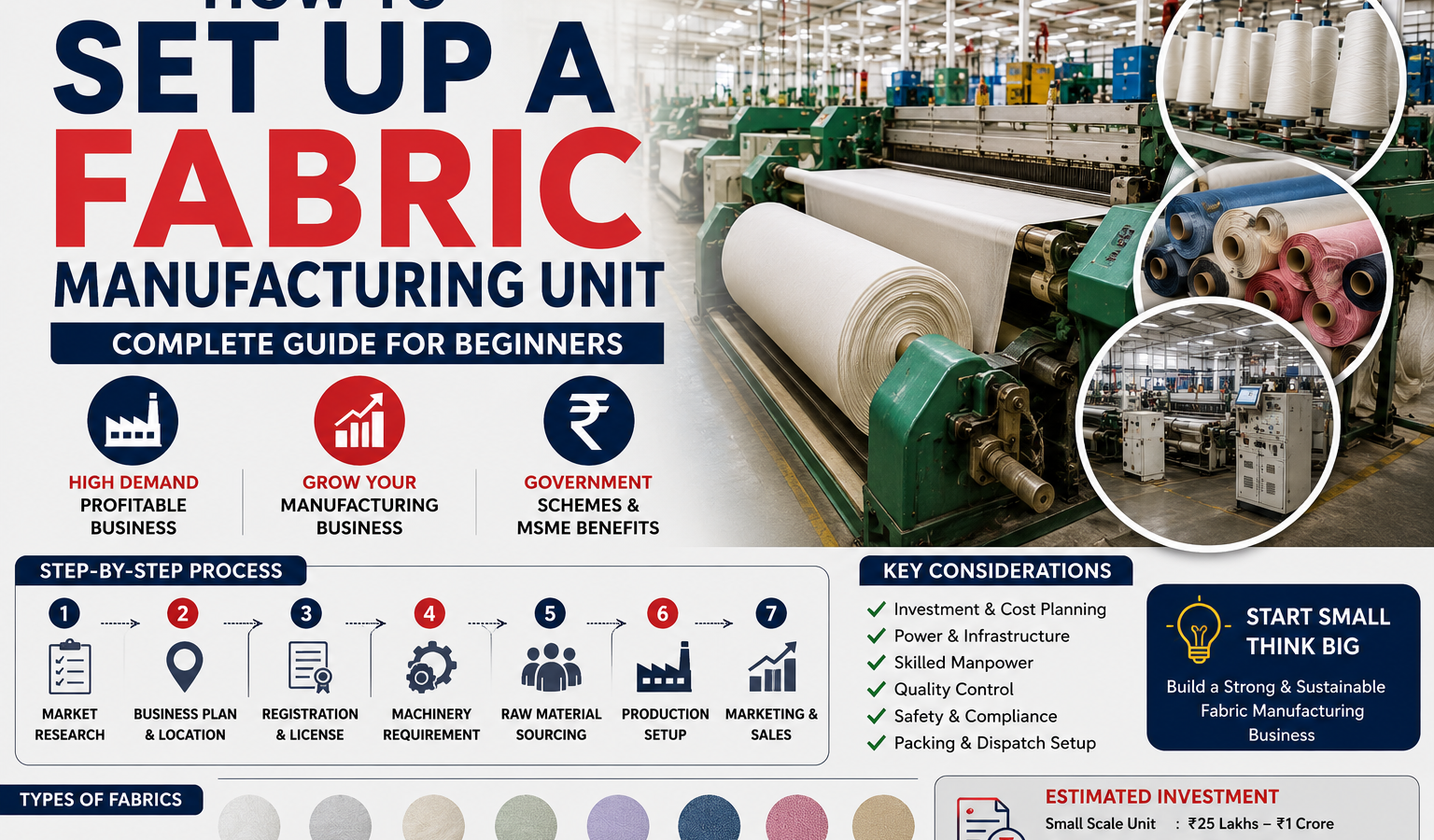
How to Set Up a Fabric Manufacturing Unit in India
Investment needed, machines to buy, licences to get, staff to hire — everything a first-time textile entrepreneur or expanding mill owner needs to plan their unit properly.
Why Start a Fabric Manufacturing Unit?
India is the second-largest textile producer in the world, and domestic fabric consumption grows every year. Weddings, fashion cycles, home textiles, garment exports, industrial fabric — the demand for fabric in India is massive, consistent, and comes from multiple sectors simultaneously. This makes fabric manufacturing one of the few industries where demand isn’t a problem — execution is.
More importantly, the Government of India has made textile manufacturing one of its priority sectors. Between the PLI Scheme for Textiles, the Technology Upgradation Fund Scheme (TUFS), PMEGP subsidies, and dedicated industrial clusters like Amravati Textile Park, there has never been a better-supported time to set up a fabric unit in India.
That said, it’s not a business to enter casually. Fabric manufacturing is capital-intensive, requires technical knowledge, and operates on thin margins that only improve with scale and quality. But done right — with the right location, right machinery, right buyers, and right financial planning — a fabric manufacturing unit is a durable, generational business.
Types of Fabric Manufacturing Units You Can Set Up
Fabric manufacturing isn’t one thing — it’s a spectrum of processes, and you don’t have to do all of them. You can enter at any stage of the value chain. Here’s how to think about it:
| Unit Type | What You Make | Min. Investment | Key Input | Difficulty |
|---|---|---|---|---|
| Weaving Unit (Grey Fabric) | Unfinished grey fabric from yarn | ₹15–50L | Yarn | Medium |
| Knitting Unit | Knitted fabric for garments / hosiery | ₹10–40L | Yarn / Thread | Medium |
| Dyeing & Processing Unit | Coloured / finished fabric from grey | ₹25–1Cr+ | Grey Fabric, Dyes | High (pollution norms) |
| Integrated Weaving + Dyeing | Finished woven fabric end-to-end | ₹75L–3Cr | Yarn, Dyes, Chemicals | High |
| Embroidery / Printing Unit | Decorated fabric for fashion / retail | ₹8–30L | Grey / Dyed Fabric | Low–Medium |
| Technical Fabric Unit | Industrial / medical / geotextiles | ₹50L–5Cr | Specialty Yarn | High (B2B sales) |
| Non-Woven Fabric Unit | Bonded fabric for hygiene / packaging | ₹30L–2Cr | Fibre / Polymer | Medium |
For most first-time entrepreneurs, starting with a weaving unit producing grey fabric is the most practical entry point. The technology is proven, the market is established, raw material sourcing is straightforward, and you can sell grey fabric to dyeing units or traders without needing finishing infrastructure. Many of India’s largest integrated mills started as small grey fabric weaving units.
Choosing the Right Location for Your Fabric Unit
Location is one of the most consequential decisions you’ll make — and one that’s very hard to change later. The right location gives you access to trained labour, yarn suppliers, fabric traders, and logistics infrastructure. The wrong one means fighting for every input and every sale.
Established Textile Clusters — The Smart Starting Point
India has a well-developed ecosystem of textile clusters, each specialising in particular fabric types. Starting inside a cluster gives you access to a ready ecosystem — yarn merchants, job workers, traders, transporters, and banks with textile expertise — that would take years to build from scratch in an isolated location.
Key Location Factors Beyond the Cluster
- Power availability: Looms are power-hungry. Check the state’s industrial power tariff, reliability of 3-phase supply, and availability of dedicated industrial feeders. Gujarat and Tamil Nadu typically have better industrial power infrastructure than some other states.
- Water availability: Critical for dyeing units. A grey fabric weaving unit needs minimal water, but any finishing or dyeing process needs a reliable, quality water source — and an ETP (effluent treatment plant) to manage discharge.
- Industrial zone vs residential area: Setting up a loom unit in a residential area invites noise complaints, municipal action, and eventual shutdown. Always set up in a designated industrial area or MIDC / GIDC estate from the start.
- Labour catchment: Weaving requires skilled operators. Check whether the location has a trained textile workforce — or whether you’d need to bring in workers from outside (adds to cost and housing requirements).
Factory / Shed Requirements
Your shed is your foundation — and one of the early decisions that will either constrain or enable your growth. Here’s what to plan for:
| Unit Size | No. of Looms | Shed Area Required | Power Requirement | Approx. Shed Cost (Rental) |
|---|---|---|---|---|
| Micro Unit | 4–6 looms | 500–1,000 sq ft | 10–20 kVA | ₹8,000–25,000/month |
| Small Unit | 8–16 looms | 1,500–3,000 sq ft | 25–60 kVA | ₹20,000–60,000/month |
| Mid Unit | 20–40 looms | 4,000–8,000 sq ft | 80–150 kVA | ₹60,000–1.5L/month |
| Large Unit | 50–100 looms | 10,000–25,000 sq ft | 200–500 kVA | ₹1.5L–4L/month or own shed |
For a first-time entrepreneur, renting a shed in an industrial estate is strongly recommended over construction. It preserves capital, gives you flexibility to relocate, and avoids the time and headache of building approvals. Many industrial estates in textile clusters have pre-built sheds with power connections ready to use.
Key shed requirements to check before signing a lease: clear ceiling height of at least 14–16 feet (for large loom machinery), 3-phase industrial power connection with sufficient sanctioned load, a well-maintained floor (vibration from looms can crack weak floors), ventilation and adequate lighting, and proximity to yarn market or transport connectivity.
Machinery — What You Need and What It Costs
Your machinery is your production engine — and your biggest capital outlay. Here’s a breakdown of the key machines for a woven fabric unit, with realistic 2026 price ranges for both new and refurbished equipment:
The modern standard for quality woven fabric. Uses compressed air to propel the weft yarn across the warp. Produces fabric at 600–900 RPM. Ideal for cotton, polyester, and blended fabrics. Brands: Toyota, Tsudakoma, Picanol, Dornier.
Versatile loom suitable for a wider range of yarn types including fancy yarns and heavier fabrics. Slower than air-jet but more flexible for variety fabrics. Good for denim, suiting, and dobby weaves. Brands: Smit, Picanol, Somet.
Winds yarn from cones onto a large beam for weaving. Every weaving unit needs one — or access to a job-work warping facility. Sectional or direct warping machines available. Brands: Karl Mayer, Suzuki, local manufacturers.
Applies starch or size to warp yarn to strengthen it for weaving. Usually shared or done through job-work in early stages. Required for higher speed air-jet weaving. Brands: Sucker-Müller, Tsudakoma, local variants.
Attached to the loom to produce patterned weaves — dobby for geometric patterns, jacquard for complex figured designs. Significantly increases fabric value. Optional for plain weave units but opens premium markets.
Mandatory for air-jet looms — provides the compressed air that propels the weft yarn. Sized based on number of looms. Atlas Copco, Elgi, and Ingersoll Rand are popular brands for textile applications.
Total Investment Breakdown
Here’s a realistic investment breakdown for three different scales of woven fabric manufacturing unit in India in 2026. These are complete first-year figures — not just machinery costs:
Investment Tiers — First Year
| Cost Head | Micro (4–6 Looms) | Small (10–16 Looms) | Mid (24–40 Looms) |
|---|---|---|---|
| Machinery (Looms) | ₹8–18L | ₹20–50L | ₹55–1.5Cr |
| Auxiliary Machines (warping, compressor, dobby) | ₹2–5L | ₹5–15L | ₹15–40L |
| Shed (Deposit + 3 months rent) | ₹50K–1.5L | ₹1–4L | ₹3–10L |
| Power Connection & Wiring | ₹50K–1.5L | ₹1–3L | ₹3–8L |
| Initial Raw Material (Yarn) | ₹1.5–4L | ₹4–10L | ₹10–25L |
| Licences & Registrations | ₹20–60K | ₹40K–1.5L | ₹1–3L |
| Working Capital (3 months ops) | ₹1–4L | ₹5–12L | ₹15–35L |
| Misc. (tools, spares, setup) | ₹50K–1L | ₹1–3L | ₹3–8L |
| Total First-Year Investment | ₹14–35L | ₹37–98L | ₹1.05–2.69Cr |
Licences & Registrations Required
This is the part most entrepreneurs underestimate in terms of time. Getting all registrations in order before you start production saves you from legal headaches, tax penalties, and loan complications later. Here’s every registration a fabric manufacturing unit needs:
Raw Material Sourcing — Yarn Procurement Strategy
Yarn is your biggest raw material cost — typically 55–70% of your total production cost. Getting your yarn procurement right is not just about finding the cheapest supplier; it’s about quality consistency, payment terms, and supply reliability.
Where to Source Yarn in India
- Local Yarn Markets: Every major textile cluster has a yarn market or yarn agent ecosystem. In Ichalkaranji, the yarn market on Miraj Road has 100+ traders. In Surat, the Ring Road yarn market is the heartbeat of the synthetic fabric trade. Starting with local traders gives you credit terms and immediate supply.
- Spinning Mills (Direct): Buying directly from spinning mills (Vardhman, RSWM, Indo Count, Nahar) gives you better prices and consistent quality — but requires higher minimum order quantities (typically 500–1000 kg per count) and upfront or short-term credit.
- Yarn Wholesalers and Agents: For smaller quantities and variety, yarn wholesalers and commission agents are your most practical option early on. They stock multiple counts and blends and typically offer 30–45 day credit to established buyers.
- e-Procurement Platforms: IndiaMART, TradeIndia, and dedicated textile B2B platforms like Fibre2Fashion are useful for price benchmarking and finding new suppliers — but physical inspection before bulk ordering is essential.
Key Yarn Buying Tips
- Always test new yarn batches before weaving bulk orders — count, tenacity, evenness, and twist can vary between lots even from the same mill.
- Maintain at least 15–20 days of yarn inventory to buffer against supply disruptions and price spikes.
- Track yarn prices weekly — cotton yarn prices move with commodity cycles and government MSP changes. Buying at peaks destroys margins.
- Negotiate credit terms aggressively — as your relationship with suppliers grows, push for 45–60 day credit rather than upfront payment.
Staffing Your Fabric Manufacturing Unit
A fabric weaving unit runs on skilled technical labour — and finding, retaining, and managing this workforce is one of the trickiest operational challenges. Here’s the standard staffing structure for a small-to-mid sized weaving unit:
| Role | No. Required (10-Loom Unit) | Key Responsibility | Monthly Salary (2026) |
|---|---|---|---|
| Unit Manager / Supervisor | 1 | Overall production supervision, quality, output targets | ₹18,000–35,000 |
| Loom Operator / Weaver | 4–6 | Operating and monitoring looms, weft change, basic troubleshooting | ₹10,000–18,000 |
| Loom Fitter / Mechanic | 1–2 | Loom maintenance, repairs, cam/dobby setting, reed denting | ₹14,000–25,000 |
| Warp / Beam Handler | 1 | Warping, beam loading, warp changing on looms | ₹10,000–16,000 |
| Quality Inspector | 1 | Fabric inspection, defect marking, roll measurement | ₹10,000–18,000 |
| Stores / Yarn In-Charge | 1 | Yarn receipt, inventory, issue to looms | ₹10,000–16,000 |
| Accounts / Admin | 1 | Billing, GST returns, payroll, bank coordination | ₹12,000–22,000 |
| Helper / Trainee | 2–3 | General assistance, cleaning, carrying, learning | ₹7,000–10,000 |
| Total Monthly Payroll (10-Loom Unit, approx.) | ₹1.2L–2.2L/month | ||
Selling Your Fabric — Finding Buyers
Production is only half the job. The other half is moving your fabric to buyers consistently, at a good price. Here are the main channels for selling fabric from a manufacturing unit:
Fabric Traders and Commission Agents
The fastest way to start selling — and how most new units begin. Fabric traders in textile clusters buy grey fabric from mills and sell it to dyeing units, garment manufacturers, or retail chains. They take a small margin but handle payment risk, logistics, and market intelligence. Work with 3–5 agents initially to spread risk and learn the market.
Direct to Dyeing Units
Grey fabric weaving units can sell directly to dyeing and processing units who buy in bulk and add colour before resale. This cuts out the trader margin but requires you to build relationships with dyeing unit owners — which takes time but is well worth it for pricing power.
Direct to Garment Manufacturers
If you’re producing finished fabric (dyed or printed), selling directly to garment exporters and manufacturers is the highest-margin channel. Requires consistent quality, timely delivery, and often the ability to produce small trial orders before large commitments.
Export — Fabric as an Export Product
Grey and finished fabric is one of India’s major export categories. With an IEC code and RCMC membership, you can sell directly to garment manufacturers in Bangladesh, Sri Lanka, UAE, or Europe. Export margins are often better than domestic — but payment cycles are longer and quality standards are stricter.
Online B2B Platforms
Platforms like IndiaMART, Fibre2Fashion, and ExportersIndia let you list your fabric for buyers across India and abroad. Useful for discovery and inquiries — less useful as a primary sales channel without follow-up systems in place.
Month-by-Month Setup Roadmap
Here’s a realistic timeline for setting up a small woven fabric unit (8–12 looms) from decision to first production:
Mistakes That Sink New Fabric Units — Avoid These
Frequently Asked Questions
How much does it cost to set up a small fabric weaving unit in India?
A small weaving unit with 8–12 air-jet looms requires a total first-year investment of approximately ₹40–90 lakh, including machinery, shed deposit, power connection, initial yarn stock, licences, and 3 months of working capital. A micro unit with 4–6 refurbished looms can be set up for ₹15–35 lakh. Costs vary significantly by location, loom type (new vs refurbished), and whether you rent or own the shed.
Is a government licence required to start a fabric manufacturing unit?
Yes — several licences are mandatory. At minimum, you need GST registration, Udyam registration, Shops & Establishment registration, Pollution Control Board consent (green category for weaving), and a Factory Licence if you employ 10 or more workers. The power connection from the state electricity board is also formally a licensed sanction. Getting these in order before starting production protects you from shutdowns, fines, and loan complications.
Can I start a fabric unit with just ₹10–15 lakh?
Yes — a very small micro unit with 2–4 refurbished power looms (shuttle looms or basic rapier) and a rented shed is achievable in this budget, especially in established clusters where shed rents are lower and job-work facilities (warping, sizing) are readily available. However, the economics of very small units are tight — you’d need to be owner-operated with minimal staff and extremely lean working capital management. Consider this a starting point, not a sustainable scale.
What is the profit margin in fabric manufacturing?
Gross margins in fabric manufacturing typically range from 15–30%, depending on fabric type, yarn cost, efficiency, and whether you sell grey or finished fabric. Net profit margins (after all overheads, interest, and depreciation) for a well-run small unit are typically 6–14%. Finished fabric (dyed, printed) commands higher margins than grey fabric. Units that sell directly to garment manufacturers or exporters — bypassing traders — earn significantly more per metre.
What is the best fabric to produce for maximum profit?
There’s no universal answer — profitability depends on your location, machinery, skill, and buyer access. That said, some categories that offer good margin potential in 2026: pocketing and lining fabrics (stable demand, less fashion risk), technical fabrics (industrial, medical — less competition, higher value), and organic/sustainable fabrics (GOTS, OEKO-TEX certified — premium buyers, growing demand). For beginners, starting with what’s produced in your local cluster — where raw material, job-work, and buyers are all nearby — is more important than chasing “maximum margin” categories.
Do I need to be a textile engineer to set up a fabric unit?
No — many of India’s most successful fabric unit owners started as traders, accountants, or even from completely different fields. What you do need is a willingness to learn the technical basics, a good production supervisor or partner who knows weaving, and patience to build market relationships. If you’re new to textiles, spend 3–6 months working in or visiting existing units before investing. That ground knowledge is worth more than any qualification.
Leave a Reply