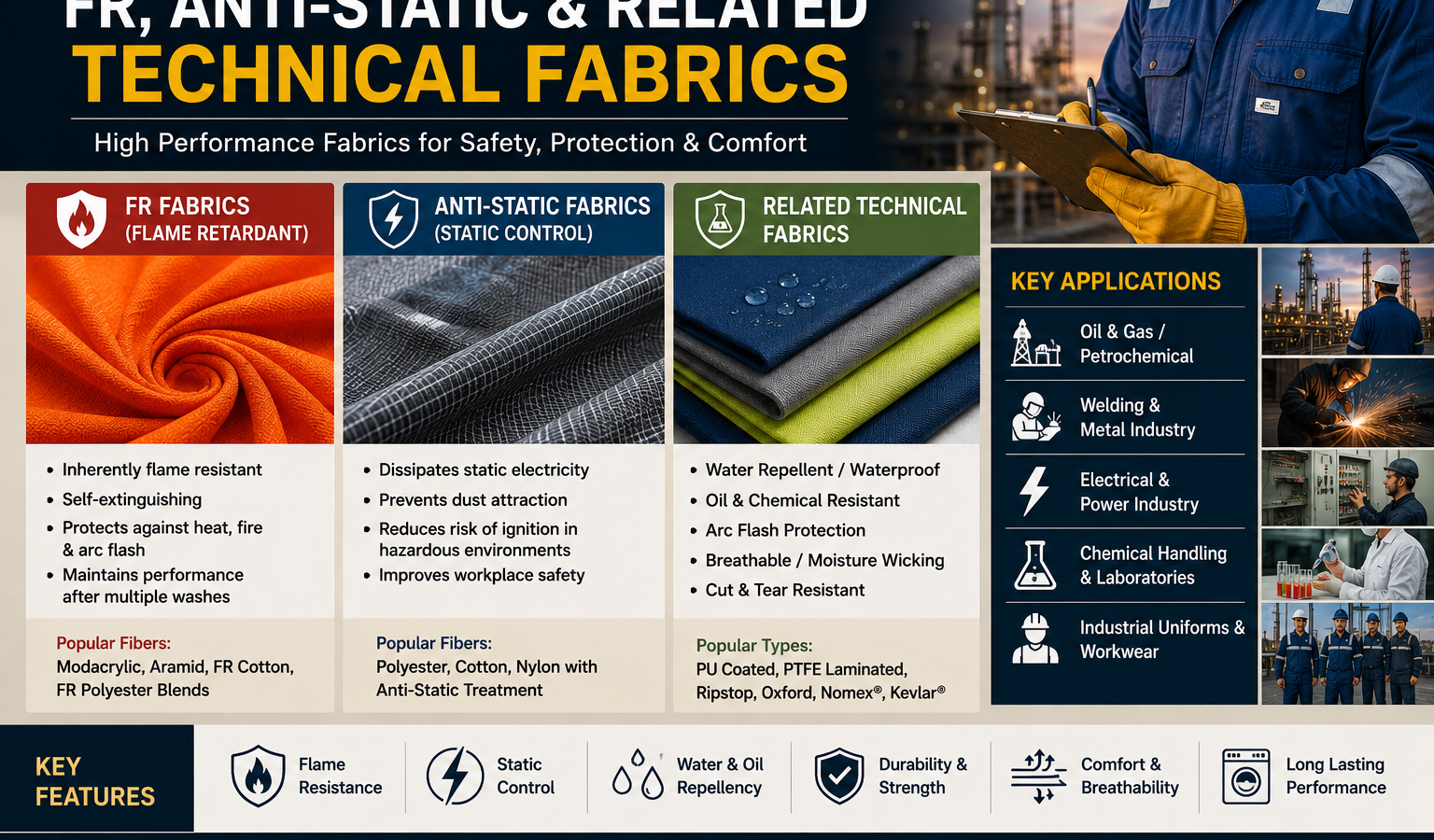
Fire Resistant & Anti-Static Fabric: The Complete Guide for Industrial Applications
What this covers: A complete, practical guide to fire resistant (FR) and anti-static (ESD) fabrics used in industrial workwear and technical applications — how each type works at the fibre level, the difference between inherent and treated FR, how anti-static conductive fibres function, which fabric suits which industry, the major international and Indian standards, care and maintenance requirements, and how to evaluate a supplier’s certification claims.
In 2005, a static spark from a worker’s synthetic coverall ignited hydrocarbon vapour at a Texas City refinery. The resulting explosion killed 15 people and injured 180 more. Investigation reports specifically cited inadequate protective clothing as a contributing factor.
In 2023, a fire at a chemicals facility in Rajasthan injured seven workers, three of whom were wearing non-flame-resistant synthetic workwear. Investigators noted that the synthetic fabric melted onto the skin — converting a survivable flash fire exposure into serious burns requiring extended hospitalisation.
These are not freak events. In industries where heat, flame, flash fire, arc flash, static discharge, or explosive atmospheres are present, the fabric a worker wears is a life-safety decision. Getting it right means understanding what these fabrics actually do, how they’re made, and what the standards actually require.
Part 1: Fire Resistant (FR) Fabric
What Does “Fire Resistant” Actually Mean?
The terms fire resistant, flame resistant, and flame retardant are often used interchangeably in the market, but they’re technically distinct — and the distinction matters when you’re writing a spec or evaluating a garment.
Flame resistant (FR) refers to a fabric’s ability to self-extinguish once the ignition source is removed. A properly certified FR fabric may catch fire, but it will stop burning when the flame is taken away. It will not continue to burn or smoulder, and critically, it will not melt or drip onto the skin (which synthetic fabrics like standard polyester or nylon do catastrophically). This is the key protection mechanism in a flash fire — the exposure lasts only seconds, and FR fabric buys the worker those seconds by not igniting or continuing to burn.
Fire resistant (with both words) implies a higher threshold — the fabric can withstand direct contact with flame for a defined period without igniting. Firefighter turnout gear and furnace proximity suits fall into this category.
Flame retardant is the most general term — used for both inherently FR fabrics and chemically treated fabrics that meet defined performance standards. Any fabric that passes the relevant standard tests is correctly described as flame retardant.
“The goal of FR workwear is not to make the worker fireproof. It is to give them enough time to get away. Every second of burn time prevented is a second of skin that isn’t damaged.”
FR fabric protects by charring rather than burning — buying critical seconds in a flash fire. Inherent FR protection lives in the fibre; treated FR protection is applied chemically and can degrade over time.
Inherent FR Fabrics: Built-In Protection
How Inherent FR Works
Inherent flame resistance means the FR property is part of the fibre’s molecular structure. It cannot be washed out, rubbed off, or depleted through repeated use, because it isn’t a coating — it’s the chemistry of the fibre itself. When an inherent FR fibre is exposed to flame, the molecular structure reacts to form a carbonaceous char rather than melting or continuing to burn. This char is itself an insulator, helping to slow heat transfer to the skin beneath.
The Main Inherent FR Fibres
Nomex® (Meta-Aramid by DuPont/Teijin) — The benchmark inherent FR fibre for most industrial applications. Nomex is lightweight, breathable, and provides excellent thermal insulation. It chars when exposed to flame and does not melt. It’s the standard for firefighter station wear, electrical utility workers, and petrochemical industry PPE globally. Nomex can be blended with cotton or other fibres for improved comfort without sacrificing FR performance.
Kevlar® (Para-Aramid by DuPont) — Known primarily for cut and ballistic resistance, Kevlar is inherently FR and is frequently blended with Nomex to give Nomex-Kevlar blends exceptional strength combined with thermal protection. Kevlar is the choice where both FR performance and mechanical durability are required — turnout gear for structural firefighting is the classic example.
Modacrylic — The most cost-effective inherent FR fibre. Modacrylic is a modified acrylic fibre with inherent flame resistance built into its polymer structure. It’s often blended with cotton (to add comfort and moisture management) or with aramids (to add strength). The result — modacrylic-cotton blends — is the workhorse of cost-effective, durable FR workwear in oil and gas, utilities, and chemical processing. Meets NFPA 2112 and EN ISO 11612 when properly blended and constructed.
FR Viscose (Birla SaFR) — India’s significant contribution to this space. Aditya Birla’s Birla Cellulose launched Birla SaFR in 2023 — a phosphate-based inherently flame-retardant sustainable cellulosic fibre developed domestically. It supports the Make in India initiative and is suitable for defence, oil and gas, and emergency response applications at a more competitive price point than aramids.
Treated FR Fabrics: Applied Protection
How Treated FR Works
Treated FR fabrics start with a standard base fabric — typically 100% cotton or a cotton-rich blend — and apply a flame-retardant chemical during the finishing process. The most widely used commercial treatments are Proban® (a phosphorus-based treatment developed by Solvay) and Pyrovatex® (also phosphorus-based). These chemicals bond to the cotton fibres and create a reaction layer that forms a char barrier when exposed to flame, preventing ignition.
The key limitation of treated FR fabric is durability. The FR chemical treatment is not permanent — it degrades with washing, especially with harsh detergents, bleach, or high-temperature laundering. Most treated FR garments have a rated protection life of 25–50 industrial wash cycles. After this point, the garment may still look functional but provide significantly reduced FR protection — which is a major safety hazard.
Part 2: Anti-Static (ESD) Fabric
The Problem: Static Electricity in Industrial Environments
Static electricity is an everyday nuisance when you touch a doorknob after walking across a carpet. In certain industrial environments, it’s a direct cause of explosions, fires, and expensive component destruction.
Static charge builds up on a person’s body and clothing through the triboelectric effect — friction between materials as they move. On a standard polyester or synthetic clothing surface, this charge accumulates because the fibre is electrically insulating. When the charged person then touches a grounded object or a sensitive component, all that accumulated charge discharges suddenly — an Electrostatic Discharge (ESD) event. The spark may be invisible and barely perceptible to the person but can:
Ignite a flammable vapour, dust, or gas cloud in a petrochemical facility, grain silo, paint spray booth, or mining environment. Instantly destroy a sensitive semiconductor component worth hundreds of dollars. Corrupt data in electronic storage. Cause an unintended trigger in electronic detonation systems.
ESD is estimated to cost the electronics industry approximately 5% of total annual sales through component damage alone — before counting fires, explosions, or downstream product failures.
Anti-static fabric uses conductive fibres woven at regular intervals to give accumulated static charge a controlled path to earth — preventing the dangerous sudden spark of an uncontrolled ESD event.
How Anti-Static Fabric Is Made
Anti-static and ESD fabrics achieve their charge-dissipating properties through one of two main approaches:
Conductive Fibre Integration (Most Common and Reliable)
The most widely used and durable method weaves electrically conductive fibres — typically carbon-core fibres, stainless steel fibres, or carbon-black treated fibres — into the fabric at regular intervals. The most common spacing standard is every 5mm in the warp direction, creating a grid of conductive pathways across the fabric surface.
When charge accumulates on the wearer, the conductive grid provides a low-resistance pathway for the charge to bleed off gradually — preventing the sudden spike of an uncontrolled ESD event. The fabric effectively turns the wearer into a grounded conductor, continuously dissipating charge as it builds rather than allowing it to accumulate.
The resistance of the conductive fibres determines the type of protection provided:
| Resistance Range | Classification | Behaviour | Typical Use |
|---|---|---|---|
| < 10⁵ Ω (100,000 Ω) | Conductive | Charge flows rapidly to ground | Explosive atmosphere workwear |
| 10⁵ – 10⁹ Ω | Static Dissipative (ESD) | Charge drains slowly and safely | Electronics manufacturing, cleanrooms |
| > 10⁹ Ω (1 GΩ) | Insulative / Anti-static finish only | Reduces charge build-up but doesn’t dissipate | Low-risk applications, general comfort |
The distinction between “anti-static” and “ESD/static dissipative” is important in procurement. Anti-static fabric reduces charge build-up — it doesn’t eliminate it. True ESD-protective fabric dissipates charge at a controlled rate through its resistance network. For electronics manufacturing and explosive environments, dissipative or conductive properties are required; anti-static alone is insufficient.
Chemical Anti-Static Finishing
Hygroscopic (moisture-attracting) chemicals applied to fibre surfaces make the fabric slightly conductive by attracting moisture from the air, which provides a surface conduction path for static charge. This approach is less reliable than conductive fibre integration because it depends on ambient humidity — in very dry conditions or air-conditioned environments, performance drops significantly. It also washes out over time. Chemical anti-static finishing is appropriate for general comfort garments but not for safety-critical ESD applications.
Part 3: Combined FR + Anti-Static Fabric — The Industrial Standard
Why You Almost Always Need Both Together
In oil and gas, mining, petrochemical, and chemical processing environments, workers face both hazards simultaneously: flammable or explosive atmospheres AND the risk of flash fire or arc flash. Using anti-static fabric without FR protection in these environments is dangerous — if a static spark does ignite a flash fire, the non-FR outer layer will make the burn injury dramatically worse. Using FR fabric without anti-static protection is equally dangerous — the FR properties protect after ignition, but the anti-static properties would have prevented ignition in the first place.
Modern industrial protective clothing for these environments combines both in a single fabric construction: an inherent FR base fibre (Nomex, modacrylic-cotton blend, or FR viscose) with conductive fibres woven in at regular intervals. The result is a garment that prevents static-induced ignition AND protects the worker in the event of a flash fire.
Other Technical Protective Fabrics Worth Knowing
High-Visibility (Hi-Vis) Fabric
Hi-vis fabric uses retro-reflective tape and fluorescent background material (typically fluorescent yellow-green or orange-red) to make workers visible in low-light conditions — at night, in dawn/dusk, or in dusty environments. In many applications, hi-vis and FR requirements are combined — road construction workers in dark conditions who also work near fuel lines, for example, require hi-vis FR fabric. The international standard is EN ISO 20471; India’s equivalent is IS 15809.
Arc Flash Protective Fabric
Arc flash is a different hazard from conventional flame: an electrical arc releases a sudden burst of energy as plasma — potentially 35,000°F — at radiant and convective heat levels far beyond what standard FR fabrics can handle. Arc flash protective garments are rated by ATPV (Arc Thermal Performance Value) in cal/cm² — the higher the number, the more arc energy the fabric can absorb before the wearer sustains a second-degree burn. Fabric like Nomex-Kevlar blends, PBI, and certain modacrylic-aramid blends are used specifically for arc flash categories 2–4 (which require 8–40 cal/cm² protection). Utility workers and industrial electricians who may be exposed to switchgear or live electrical panels need arc flash rated garments, not just standard FR.
Chemical Protective Fabric
Chemical splash protection is a separate category. Fabrics for chemical protection (like Tyvek, polyethylene-coated nonwovens, or laminated FR barriers) are evaluated for liquid splash resistance, vapour permeability, and chemical breakthrough time — not purely for flame or static properties. In environments where both chemical exposure AND flame risk exist (most petrochemical environments), the garment system typically layers an FR anti-static base layer with a chemical-resistant outer layer.
Welding Fabric
Welding work involves sustained exposure to UV radiation, sparks, and molten metal spatter — a different profile from the flash fire risk of oil and gas. Welding fabrics (typically heavy cotton treated with FR chemicals, or leather) need good spatter resistance — the ability to resist burning from droplets of molten metal — which is not the same as flash fire protection. Note: pure aramid fabrics (Nomex, Kevlar) are actually NOT recommended for welding because molten metal sticks to aramid and continues burning. FR cotton and leather are preferred for welding applications.
Protective fabric requirement matrix by industry. Oil, gas, and mining workforces typically require both inherent FR and anti-static in a single garment construction.
Key Standards and Certifications
International FR Standards
| Standard | Covers | Used In |
|---|---|---|
| EN ISO 11612 | Protective clothing against heat and flame (heat convection, contact heat, radiant heat, molten metal) | Europe, India (via BIS alignment) |
| NFPA 2112 | Flame-resistant garments for flash fire protection — must pass 35 wash cycles minimum | USA, widely referenced globally |
| NFPA 70E | Arc flash protection — defines arc thermal performance categories (CAT 1–4) by cal/cm² | USA electrical utilities |
| ISO 15025 | Surface flame spread test for protective clothing — pass/fail | Global reference |
| IS 15748:2022 | Indian standard for protective clothing for industrial heat exposure | India (mandatory for certain sectors) |
| IS 16890:2018 | Protective clothing for firefighters — India specific | India fire services |
Anti-Static / ESD Standards
| Standard | Covers | Used In |
|---|---|---|
| EN 1149-1 | Surface resistivity of protective clothing — measurement method | Europe |
| EN 1149-5 | Material performance and design requirements for anti-static protective clothing | Europe, increasingly referenced in India |
| IEC 61340-5-1 | General ESD requirements for protecting electronic devices | Global electronics industry |
| ASTM D257 | DC resistance measurement for ESD fabrics | USA |
Care and Maintenance of FR and Anti-Static Garments
Even the best protective fabric fails if it isn’t maintained correctly. Most FR garment failures in the field come from improper laundering, not from defective fabric.
For FR garments: Always use a pH-neutral industrial detergent — never bleach. Bleach degrades FR chemical treatments in treated FR fabric and can cause surface damage even in inherent FR fibres over time. Do not use fabric softener — it coats the fibre surface and can interfere with FR properties. Wash at the temperature specified on the garment care label (usually 60°C maximum). For treated FR garments, maintain a wash cycle log and retire garments at the supplier’s specified maximum wash count.
For anti-static garments: The conductive fibre grid must remain intact. Avoid washing in very high-alkalinity detergents. Inspect garments regularly for tears or repairs that may have bridged the conductive grid with non-conductive thread. After repair, re-test surface resistance before returning to service. Anti-static garments should be stored away from insulating plastic bags, which can trap charge.
For combined FR + anti-static: Follow the more restrictive of the two care regimes. If the FR treatment requires specific laundering conditions, prioritise those. Industrial laundries that specialise in PPE care are strongly recommended for large workforces — they have validated processes that maintain both FR and anti-static performance.
How to Choose the Right Protective Fabric
The selection process should follow a risk assessment hierarchy, not a budget discussion. Here is the practical decision path:
Step 1: Identify the hazard. Is the primary risk flame or flash fire? Arc flash? Explosive atmosphere? Static damage to electronics? Each hazard has a different fabric requirement. Oil and gas workers face multiple hazards simultaneously; electronics workers face primarily ESD risk.
Step 2: Determine the required standard. Match the hazard to its applicable standard — EN ISO 11612 for heat and flame, NFPA 2112 for flash fire, EN 1149-5 for anti-static, NFPA 70E for arc flash. The standard will specify both what the fabric must achieve and how it will be tested.
Step 3: Inherent vs treated FR. For high-risk, sustained-exposure environments (oil and gas drilling, electrical work, firefighting), inherent FR is the safer choice because protection doesn’t degrade. For lower-risk, lower-frequency exposure (welding, general industrial), treated FR may be adequate if the wash cycle regime is strictly managed.
Step 4: Verify the certification. Ask for the full third-party test report, not just the certificate. Check the test date — if the report is more than 5 years old, request updated testing. Verify that the test laboratory is accredited (NABL in India, UKAS in UK, A2LA in USA).
Step 5: Total cost of ownership. Inherent FR garments cost more upfront but maintain protection throughout their physical lifespan. A treated FR garment needs replacement every 25–50 wash cycles. Calculate the total cost over a 3-year period, not just the per-garment price. In most high-risk industrial applications, inherent FR is cost-competitive on a lifecycle basis.
Frequently Asked Questions
- What is the difference between FR and anti-static fabric?
- FR (flame resistant) fabric protects workers from fire, flame, and thermal hazards by self-extinguishing when ignition source is removed and not melting onto skin. Anti-static (ESD) fabric prevents static electricity from accumulating on the worker’s clothing by providing a controlled conductive path to dissipate charge safely. In many industrial environments — oil and gas, mining, petrochemical — both protections are required in a single garment.
- What is the difference between inherent FR and treated FR fabric?
- Inherent FR fabric is made from fibres (like Nomex, Kevlar, modacrylic, or FR viscose) whose flame resistance is part of their molecular structure and cannot wash out. Treated FR fabric starts as regular cotton or cotton-blend and has flame-retardant chemicals applied during finishing — this protection degrades with washing (typically lasting 25–50 industrial wash cycles). For high-risk environments, inherent FR is the safer long-term choice.
- What industries require anti-static workwear?
- Anti-static workwear is mandatory or strongly recommended in: electronics manufacturing and semiconductor fabrication (to protect sensitive components), oil and gas and petrochemical facilities (to prevent static sparks igniting flammable vapours), pharmaceutical and biotech cleanrooms (contamination control), mining (explosive dust environments), grain handling (explosive dust risk), and medical operating rooms (where flammable gases are present).
- Can you wash FR garments normally?
- No. FR garments require specific laundering with pH-neutral detergents at specified temperatures — typically no bleach, no fabric softener. For treated FR garments, incorrect washing can strip the FR chemical treatment. Even inherent FR garments can be surface-contaminated by softeners or oil residues that reduce protective performance. Industrial laundering services specialised in PPE care are strongly recommended for large workforces.
- What is Nomex fabric used for?
- Nomex is a meta-aramid inherent FR fibre by DuPont (now produced by multiple manufacturers under licence). It is used in firefighter station wear and proximity suits, electrical utility worker PPE, oil and gas industry workwear, military flight suits (it was the standard for Formula 1 driver suits for decades), motorsport safety wear, and industrial PPE requiring long-duration heat and flame protection. Nomex does not melt, drip, or continue to burn when the flame source is removed.
- Is standard polyester or nylon workwear acceptable in industrial environments?
- Standard polyester and nylon (non-FR) are specifically prohibited in many industrial safety standards for environments with flash fire, arc flash, or explosive atmosphere risk. Both fibres melt at relatively low temperatures and can cause severe burns by bonding to skin. Even if they don’t ignite immediately, they are dangerous in heat incidents. In oil and gas, mining, electrical utility, and petrochemical environments, synthetic non-FR fabrics should not be worn.
- What does BIS certification mean for FR fabric in India?
- The Bureau of Indian Standards (BIS) now requires BIS certification for protective textiles — including FR curtains, firefighter clothing (IS 16890:2018), and industrial heat protection clothing (IS 15748:2022) — when imported into India. This certification requires independent third-party testing against the relevant Indian Standard. Indian manufacturers of FR fabric also increasingly pursue BIS certification to access government and PSU procurement contracts.
Final Thoughts
Fire resistant and anti-static fabrics are not commodities. They are engineered life-safety systems, and the quality of the fabric, the integrity of the certification, and the discipline of the maintenance programme all affect whether a garment actually protects the worker or just looks like it does.
India’s industrial workforce — in oil refineries, thermal power plants, chemical factories, electronics assembly lines, and mines across the country — deserves the same level of protection that is standard in Europe, North America, and the Gulf. As Indian standards tighten (IS 15748:2022, mandatory BIS certification for imported FR workwear), and as the domestic market for technical protective textiles grows toward ₹522 crore by 2033, the knowledge gap between what is being used and what is needed is slowly closing.
For buyers, procurement managers, and safety officers evaluating protective textile suppliers: always ask for the third-party test report, understand whether you’re buying inherent or treated FR, know the wash cycle limit of your treated FR garments, and never accept a self-issued compliance declaration in place of an accredited lab report. The consequences of getting this wrong are permanent.
Leave a Reply