Introduction
For many years, Eastern Europe was viewed primarily as a cost-effective manufacturing destination for global fashion and textile brands. Countries across the region built strong reputations for skilled labor, established textile infrastructure, and competitive production costs. However, the landscape is changing rapidly.
Today, Eastern Europe is emerging as one of the most exciting regions for textile innovation. Driven by sustainability goals, digital transformation, changing consumer expectations, and new European Union regulations, manufacturers are investing heavily in advanced technologies that are reshaping how textiles are designed, produced, recycled, and distributed.
From artificial intelligence and smart factories to circular fashion systems and advanced recycling technologies, companies across Poland, Hungary, Romania, Czechia, Serbia, the Baltic states, and neighboring regions are embracing innovation at an unprecedented pace.
The transformation is not only helping manufacturers become more efficient and competitive, but it is also creating opportunities for brands seeking sustainable supply chains and consumers looking for more responsible fashion choices.
As environmental regulations become stricter and demand for transparency continues to grow, Eastern Europe is positioning itself as a key player in the future of global textile manufacturing.
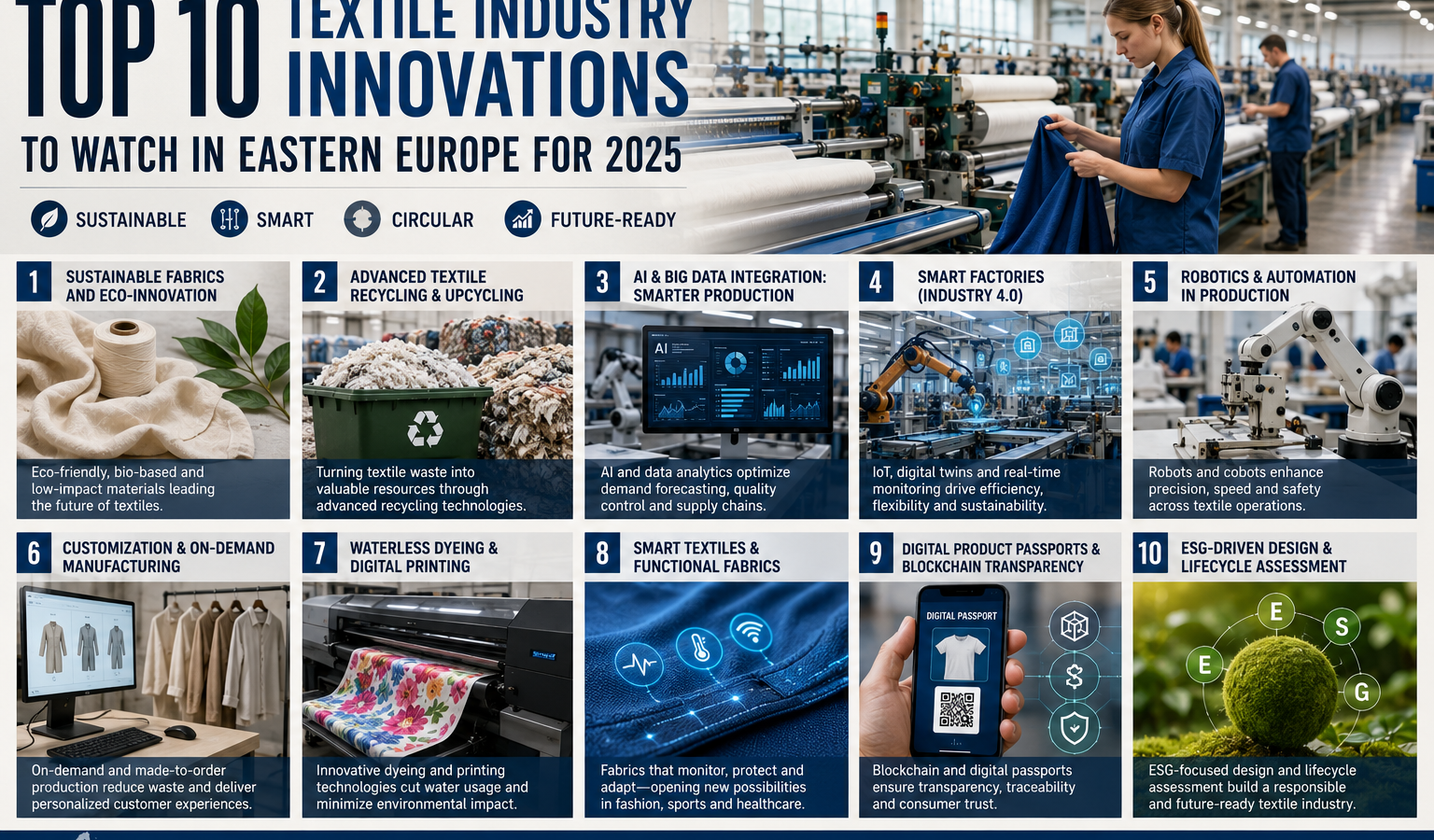
Here are ten of the most important textile innovations expected to shape Eastern Europe’s textile industry throughout 2025 and beyond.
1. Sustainable Fabrics Are Becoming the New Industry Standard
One of the biggest shifts taking place across Eastern Europe is the growing adoption of sustainable textile materials.
Manufacturers are increasingly moving away from traditional petroleum-based fibers and exploring alternatives that reduce environmental impact. Materials derived from renewable resources, recycled waste streams, agricultural by-products, and biodegradable sources are receiving significant attention from both producers and brands.
The transition is being accelerated by new European regulations that encourage companies to consider sustainability from the earliest stages of product development. Instead of focusing solely on performance and cost, manufacturers are now evaluating environmental impact, recyclability, carbon footprint, and end-of-life disposal options.
Innovative materials produced from wood pulp, agricultural residues, and recycled textile waste are becoming more common in both fashion and technical textile applications. These materials provide an opportunity to reduce dependence on virgin resources while meeting consumer demand for more environmentally responsible products.
For brands, sustainable fabric innovation is no longer simply a marketing strategy. It has become an essential business requirement that influences purchasing decisions, regulatory compliance, and long-term competitiveness.
2. Advanced Textile Recycling Is Creating a Circular Economy
Textile waste remains one of the biggest environmental challenges facing the fashion industry. Millions of tonnes of garments and fabric scraps are discarded every year, creating significant pressure on landfills and waste management systems.
Eastern European companies are responding by investing in advanced recycling technologies that can recover valuable fibers and materials from discarded textiles.
Traditional recycling methods often struggled with blended fabrics and mixed materials. New chemical recycling technologies can now separate and recover fibers more effectively, making it possible to transform textile waste into valuable raw materials for new products.
At the same time, improvements in mechanical recycling systems are helping manufacturers recover usable fibers from post-consumer garments and production waste.
Artificial intelligence is also playing an important role by improving the sorting and classification of textile waste. Automated systems can identify fiber compositions more accurately, allowing recycling facilities to process materials more efficiently.
These innovations support the broader goal of creating a circular textile economy where materials remain in use for as long as possible rather than being discarded after a single lifecycle.
3. Artificial Intelligence Is Making Textile Manufacturing Smarter
Artificial intelligence is rapidly becoming one of the most influential technologies in the textile sector.
Manufacturers throughout Eastern Europe are using AI-powered systems to improve planning, reduce waste, optimize production schedules, and predict market demand.
Traditionally, textile companies relied heavily on historical sales data and manual forecasting methods. These approaches often resulted in overproduction, excess inventory, and wasted resources.
Modern AI systems analyze enormous amounts of information, including consumer behavior, seasonal trends, retail sales data, and market conditions. This allows businesses to make more accurate decisions about production volumes and product development.
AI is also transforming quality control. Advanced computer vision systems can detect fabric defects, color inconsistencies, weaving problems, and finishing issues much faster than manual inspections.
As a result, manufacturers can improve product quality while reducing operational costs and minimizing material waste.
4. Smart Factories Are Redefining Production Efficiency
The concept of Industry 4.0 is becoming a reality across Eastern Europe’s textile manufacturing sector.
Smart factories use connected machines, sensors, automation systems, and real-time analytics to monitor and optimize production processes.
Instead of reacting to equipment failures after they occur, manufacturers can use predictive maintenance systems that identify potential problems before breakdowns happen. This reduces downtime and improves overall efficiency.
Digital twins, virtual replicas of physical production systems, allow factory managers to simulate processes and test improvements without disrupting actual production.
Real-time monitoring also helps companies reduce energy consumption, improve resource utilization, and achieve sustainability targets.
These technologies are creating more resilient, efficient, and competitive manufacturing operations capable of responding quickly to changing market conditions.
5. Robotics and Automation Are Transforming Textile Production
Automation is no longer limited to large automotive factories. Textile manufacturers across Eastern Europe are increasingly adopting robotic systems to improve productivity and consistency.
Robots are now assisting with fabric handling, cutting, sewing, packaging, quality inspection, and warehouse operations.
Unlike earlier automation technologies, modern collaborative robots can safely work alongside human operators. This allows companies to combine human expertise with robotic precision.
The result is faster production, fewer errors, lower operational costs, and improved product consistency.
Rather than replacing workers entirely, automation is helping employees focus on higher-value tasks that require creativity, decision-making, and technical expertise.
6. Customization and On-Demand Manufacturing Are Changing Fashion Production
For decades, the textile and apparel industry relied heavily on mass production. Manufacturers produced large quantities of garments based on forecasts, hoping consumer demand would match supply. While this system helped reduce production costs, it often resulted in significant waste, unsold inventory, and markdowns.
Eastern European textile manufacturers are increasingly adopting customization and on-demand production models that address these challenges.
Advances in digital manufacturing technologies now make it possible to produce smaller batches efficiently and economically. Instead of manufacturing thousands of garments before demand exists, companies can create products based on actual customer orders.
This approach offers several advantages.
First, it significantly reduces waste. Brands no longer need to overproduce products that may never sell.
Second, it improves inventory management. Companies can operate with lower stock levels while responding more quickly to changing consumer preferences.
Third, it creates opportunities for personalization. Consumers increasingly expect products tailored to their specific needs, whether that means custom sizing, unique color combinations, or personalized designs.
Digital design tools, automated cutting systems, and flexible manufacturing processes are making this level of customization possible without dramatically increasing production costs.
For consumers, the result is a better shopping experience. For manufacturers, it means higher efficiency and lower risk.
As sustainability becomes more important throughout the fashion industry, on-demand manufacturing is expected to play an increasingly important role in reducing overproduction and supporting responsible consumption.
7. Waterless Dyeing and Digital Printing Are Reducing Environmental Impact
Textile dyeing has traditionally been one of the most resource-intensive stages of fabric production.
Conventional dyeing processes consume enormous amounts of water, chemicals, and energy. In many parts of the world, textile wastewater has become a major environmental concern.
To address these challenges, manufacturers across Eastern Europe are investing in innovative dyeing and printing technologies that significantly reduce environmental impact.
One of the most promising developments is waterless dyeing technology.
Instead of using large volumes of water to transport dyes into fibers, advanced systems utilize alternative methods such as supercritical carbon dioxide. This process allows dye molecules to penetrate synthetic fibers without requiring water-based dye baths.
The environmental benefits are substantial.
Water consumption can be reduced by up to 90 percent compared to traditional methods. Chemical usage is also significantly lower, and wastewater generation is minimized.
Digital textile printing is another area experiencing rapid growth.
Unlike traditional screen printing methods, digital printing applies designs directly onto fabric using computer-controlled inkjet systems. This technology enables highly detailed designs while reducing water usage, setup costs, and material waste.
For fashion brands, digital printing offers greater design flexibility and shorter production cycles. Small production runs become economically viable, supporting both customization and sustainability goals.
As water scarcity becomes a growing global concern, these innovations are likely to become standard practice throughout the textile industry.
8. Smart Textiles and Functional Fabrics Are Creating New Possibilities
The future of textiles extends far beyond traditional clothing and furnishings.
One of the most exciting developments in Eastern Europe is the rapid growth of smart textiles and functional fabrics.
Unlike conventional materials, these advanced textiles are designed to interact with their environment or perform specific functions.
Researchers and manufacturers are developing fabrics capable of monitoring health conditions, regulating temperature, improving comfort, and even generating data.
Healthcare is one of the most promising application areas.
Textiles embedded with sensors can monitor heart rate, body temperature, respiration, and other physiological indicators. These innovations are creating new opportunities in patient care, elderly monitoring, and medical wearables.
Sportswear manufacturers are also investing heavily in smart textile technologies.
Performance fabrics capable of regulating temperature, managing moisture, and responding to environmental conditions help athletes maintain comfort and improve performance.
Automotive applications are expanding as well.
Advanced textile materials are being integrated into vehicle interiors, providing enhanced comfort, safety, and durability. Some materials can even adapt their properties based on passenger preferences or environmental conditions.
Many of these innovations are supported by collaborative research programs involving universities, technology institutes, and industrial partners throughout Eastern Europe.
As development continues, smart textiles are expected to become increasingly common across healthcare, sports, transportation, military, and consumer markets.
9. Digital Product Passports and Blockchain Are Improving Transparency
Consumers today want more information about the products they purchase.
Questions about material sourcing, environmental impact, labor practices, and product authenticity are becoming increasingly important.
To meet these expectations, Eastern European textile companies are adopting Digital Product Passports (DPPs) and blockchain-based traceability systems.
A Digital Product Passport acts as a digital identity card for a textile product.
By scanning a QR code or accessing a digital record, consumers can view detailed information about:
- Fiber composition
- Manufacturing location
- Supply chain history
- Environmental footprint
- Repair information
- Recycling instructions
These systems support upcoming European regulations that aim to improve transparency and encourage more sustainable consumption patterns.
Blockchain technology adds another layer of security and trust.
Because blockchain records cannot easily be altered, they provide a reliable method for verifying information throughout the supply chain.
This helps combat issues such as:
- Counterfeit products
- False sustainability claims
- Inaccurate sourcing information
For brands, transparency is becoming a competitive advantage.
Consumers increasingly reward companies that openly share information about their products and demonstrate genuine commitment to sustainability.
As regulatory requirements continue to evolve, Digital Product Passports and blockchain systems will likely become standard tools across the textile industry.
10. ESG-Driven Design Is Reshaping Textile Business Strategy
Environmental, Social, and Governance (ESG) principles are now influencing nearly every aspect of textile manufacturing.
What was once considered a corporate responsibility initiative has become a core business requirement.
Investors, regulators, customers, and supply chain partners increasingly expect companies to demonstrate measurable progress toward sustainability goals.
Throughout Eastern Europe, textile manufacturers are incorporating ESG principles into product design, material selection, manufacturing processes, and reporting practices.
One important tool driving this transformation is Lifecycle Assessment (LCA).
Lifecycle assessments evaluate the environmental impact of a product from raw material extraction through manufacturing, distribution, use, and disposal.
These analyses help companies identify opportunities to:
- Reduce carbon emissions
- Lower energy consumption
- Minimize waste
- Improve recyclability
- Enhance resource efficiency
European regulations such as the Corporate Sustainability Reporting Directive (CSRD) are further accelerating adoption.
Companies are now expected to provide more detailed and transparent sustainability disclosures than ever before.
This shift is encouraging manufacturers to embed sustainability considerations directly into product development rather than treating them as an afterthought.
The result is a more responsible and future-ready textile industry.
Businesses that successfully integrate ESG principles are likely to enjoy stronger customer trust, improved regulatory compliance, better investor relationships, and long-term competitive advantages.
Conclusion
Eastern Europe is rapidly evolving from a traditional manufacturing region into one of the world’s most dynamic centers for textile innovation.
From sustainable materials and advanced recycling technologies to artificial intelligence, smart factories, and blockchain-enabled transparency, the region is embracing solutions that address both environmental challenges and changing market demands.
These innovations are helping manufacturers improve efficiency, reduce waste, strengthen competitiveness, and create products that better meet consumer expectations.
As regulations become stricter and sustainability becomes a defining factor in business success, the importance of innovation will only continue to grow.
For textile manufacturers, brands, investors, and consumers, Eastern Europe’s transformation represents an exciting glimpse into the future of the global textile industry.
The companies leading these changes today are not simply adapting to industry trends. They are actively shaping the next generation of textile production, creating a more sustainable, transparent, and technologically advanced future for the entire sector.
Leave a Reply