Export & Trade · Updated 08 July 2026
Most articles on export incentive schemes read like a copy of the DGFT circular with better formatting. That’s not what you need when you’re pricing a shipment. What you need to know is: for your product, your input mix, and this month’s rate schedule, which scheme actually puts more money back in your account — and how much of that “4.3%” headline rate you’ll really see after the value cap eats into it.
I’ve filled out enough shipping bills over the years to know that the theory of RoDTEP, Duty Drawback and Advance Authorisation is easy to explain and hard to apply. Every consultant’s blog gives you the same three definitions. Almost none of them show you what happens when you actually run the numbers on a real order — and what happens to those numbers when the government changes the rates mid-year, which is exactly what happened between February and March 2026.
This piece is written from the costing desk, not from a law firm. I’ll walk through what each scheme actually does to your landed margin, when one beats the other for a fabric business specifically, and then run a full worked example on a pocketing fabric export order so you can see the arithmetic rather than just the definitions. By the end, you should be able to open your own costing sheet and redo this exercise for your own HS code in about fifteen minutes.
Why this got more complicated in 2026
For most of 2022 to 2025, RoDTEP was the kind of scheme you set up once in your costing template and forgot about. The rate for your HS code didn’t move much, so you’d just carry a fixed percentage in your quote and move on. That stability broke this year.
- 23 February 2026 — DGFT Notification No. 60/2025-26 cut RoDTEP rates and value caps by 50% across most HS codes (Chapters 1–24, mostly agri and food items, were spared)
- March 2026 — Notification No. 66/2025-26 reversed the cut, restoring rates and caps to their pre-February level for shipments between 23 February and 31 March 2026
- 31 March 2026 — Notification No. 74/2025-26 extended the scheme at the restored rates through 30 September 2026
If you quoted an export order in the first week of March using the rate you’d been using since January, and your shipment happened to clear customs in the last week of February, your RoDTEP credit would have landed at exactly half of what you’d priced in. That’s not a rounding error — on a mid-sized fabric order, that’s the difference between a healthy margin and a break-even shipment.
The lesson isn’t “RoDTEP is unreliable, ignore it.” The lesson is that RoDTEP now needs to sit in your costing sheet as a live variable you check per shipment, not a constant you set once a year. I’ll come back to how to build that habit near the end of this piece.
The three schemes, explained the way I actually think about them
RoDTEP — refunding taxes you can’t see on your invoice
RoDTEP doesn’t care what you imported. It exists to hand back taxes that are baked into your cost structure but never show up as a line item you can claim GST input credit on — mandi tax, electricity duty, fuel VAT on the diesel that ran your generator during a power cut, stamp duty on your factory’s various registrations. None of that is recoverable any other way, so the government estimates it as a percentage of your FOB value and refunds it as a transferable duty credit scrip through ICEGATE.
The part that trips people up is the value cap. Most textile HS codes carry both a percentage rate and a per-unit cap (per kilo for yarn, per square metre for woven fabric), and you get whichever number is lower. For high-value fabric, the cap usually bites before the percentage does — which means the headline rate you see quoted in every RoDTEP article is often not the rate you’ll actually receive. I’ll show you exactly how much difference this makes in the worked example below.
Duty Drawback — refunding duty you actually paid on imports
Duty Drawback is the older, more literal cousin. It refunds the customs duty you paid when importing an input that ended up, in some form, inside your exported product. If your pocketing fabric uses recycled PET chips imported from a supplier in Taiwan or a specialty finish chemical imported from Germany, the Basic Customs Duty you paid on that import is what Drawback is compensating for.
Two flavours exist: the All Industry Rate (AIR), a flat percentage published for your HS code regardless of what you individually paid, and the Brand Rate, which is calculated specifically for your factory based on your actual duty payments if the AIR doesn’t reflect your real cost. Most MSME exporters use AIR because Brand Rate applications require more documentation than most accounts teams have the bandwidth for — but if your imported-input share is unusually high, it’s worth the paperwork.
Advance Authorisation — skipping the duty instead of claiming it back later
Advance Authorisation (AA) sidesteps the refund conversation entirely by letting you import your inputs duty-free upfront, against a commitment to export a corresponding finished quantity within a set window (typically 18 months, extendable). No duty paid means nothing to claim back — which is exactly why AA-based exports are excluded from both RoDTEP and Duty Drawback. You’ve already received the benefit at the import stage.
AA makes the most sense when your import content is a large share of your total cost — think a pocketing fabric line built heavily around imported recycled polyester chips for a GRS-certified order, or a technical finish fabric that needs an imported chemical with no reliable domestic substitute. For a fabric that’s mostly grey cotton yarn sourced from an Indian spinning mill down the road, AA adds licensing overhead for very little upside.
Building the decision around your actual bill of materials
Every guide to this topic tells you to “compare your cost structure.” Almost none of them tell you how. Here’s the actual test I run for a fabric order before quoting:
- Pull the bill of materials and tag each input as domestic or imported. For a PC blend pocketing fabric, that’s usually: polyester staple/chips (sometimes imported, sometimes domestic depending on your supplier), cotton yarn (almost always domestic), dyes and auxiliary chemicals (a mix — reactive dyes are often imported, basic auxiliaries are usually domestic), and finishing chemicals for functional finishes like water repellency (frequently imported, since several speciality finishes have no strong Indian manufacturer).
- Estimate the customs duty actually embedded in the imported share. If your imported inputs make up less than roughly 8–10% of your FOB value, Duty Drawback’s AIR percentage will usually undershoot what RoDTEP would give you, because AIR percentages for textile inputs tend to be modest unless the import content is genuinely significant.
- Check whether your RoDTEP rate is cap-bound or rate-bound for your product. This changes your real percentage, sometimes by close to half, and it’s the step everyone skips.
- Only look at Advance Authorisation if imported inputs are a large, recurring share of a specific order — a one-off small shipment rarely justifies the licence, bond, and export-obligation tracking overhead that AA requires.
The worked example: 60,000 metres of PC blend pocketing fabric
Here’s a shipment close to what a mid-sized pocketing and lining fabric exporter would actually ship to a bottomwear brand’s sourcing office — say, a buyer in Bangladesh or Vietnam consolidating fabric for jeans and trouser production.
Now let’s put RoDTEP through its paces using an illustrative rate structure for woven PC blend fabric — a 4.3% FOB rate with a ₹3.4 per square metre cap, broadly in line with the rate levels historically notified for woven cotton-blend fabric under Appendix 4R. Always confirm your own HS code’s current rate on the DGFT portal before quoting — I’m using this figure to demonstrate the mechanism, not as a rate you should plug into your own quote.
Notice that already, before any rate cut, the cap has quietly reduced the “4.3%” headline down to an effective 2.43%. This is the single most common source of RoDTEP disappointment I see in exporters’ quarterly numbers — they price the headline rate into their quote and then wonder why the credit that shows up in ICEGATE is smaller.
Same order, same buyer, same fabric — a swing of ₹1.53 lakh depending purely on which five-week window your shipping bill happened to fall in. On a shipment where your net margin after all costs might be sitting around ₹4–5 lakh, that’s not a footnote — that’s a meaningful share of your profit riding on a notification you may not have been tracking closely.
Now compare it against Duty Drawback
Say this fabric uses roughly 18% recycled polyester chips imported from a Southeast Asian supplier (a common scenario if part of the order carries GRS certification), with the balance sourced domestically. If the applicable AIR for this HS code sits around 1.3% of FOB value — again, illustrative, confirm your own code — here’s how it stacks up:
| Scheme | Basis | Claim on this shipment |
|---|---|---|
| RoDTEP (restored rate) | Cap-bound, 2.43% effective | ₹3,06,000 |
| RoDTEP (during Feb–Mar cut) | Cap-bound, 1.21% effective | ₹1,53,000 |
| Duty Drawback (AIR) | 1.3% of FOB value | ₹1,63,800 |
At the restored RoDTEP rate, RoDTEP wins comfortably. But during the five-week window when RoDTEP was cut in half, Duty Drawback would actually have paid out slightly more — ₹1,63,800 versus ₹1,53,000. This is exactly the kind of shift that a fixed “we always claim RoDTEP” policy misses, and exactly why I’d argue every export order above a certain size deserves a two-minute comparison rather than a default.
Remember — you cannot claim both on the same shipping bill for the same duty component. You declare your choice at the time of filing, so this comparison needs to happen before you ship, not after.
Where Advance Authorisation would change the picture entirely
Now imagine the same order, but the recycled PET chip content is closer to 45% of the fabric’s cost rather than 18% — a scenario that’s increasingly common as more global bottomwear brands push GRS-certified recycled content minimums into their sourcing contracts. At that import share, the Basic Customs Duty you’d otherwise pay on importing those chips becomes large enough that importing them duty-free under an AA licence — against a committed export obligation — usually outperforms claiming either RoDTEP or Drawback after the fact. You lose eligibility for both refund schemes on that shipment, but you never paid the duty you’d have been refunding anyway.
The trade-off is administrative: AA requires an export obligation period (commonly 18 months), a bond or bank guarantee, and export obligation discharge documentation once you’ve shipped the corresponding finished goods. For a one-off order, that overhead usually isn’t worth it. For a recurring buyer relationship where you’re importing the same recycled input every quarter, it very often is.
Compliance mistakes I see most often on the shop floor
- HS code drift. A code that was correct for your fabric two seasons ago may have been reclassified since — India updates its ITC-HS schedule annually, and the WCO revises the global HS every five to six years. If your CHA is using a code from an old template, you may be claiming the wrong rate or missing the claim entirely.
- Ignoring the value cap when quoting. As shown above, this alone can overstate your expected RoDTEP benefit by close to half on higher-value fabrics.
- Double-claiming on AA-linked inputs. If part of your fabric used duty-free AA-imported chips, that portion of the shipment cannot also carry a RoDTEP or Drawback claim — this needs to be split cleanly in your documentation, not lumped into one blanket declaration.
- Letting RoDTEP e-scrips expire. Once generated on ICEGATE, a scrip is valid for exactly one year. Unused, unlisted scrips sitting in a ledger because nobody remembered to use them against an import or transfer them are money quietly evaporating.
- Treating the rate as static in your ERP or costing template. This is the one this article is really about — if your system has “RoDTEP 4.3%” hardcoded from a January setup and nobody revisits it, you’ll misprice every order placed during a rate revision window.
Building this into your costing workflow instead of your memory
The practical fix isn’t complicated, but it does require treating export incentive rates as a maintained data field rather than a one-time entry. Here’s the routine I’d recommend for a small-to-mid textile exporter, whether you’re running this in a spreadsheet, a costing calculator, or a full ERP:
- Maintain a single rate reference sheet with your top 8–10 export HS codes, their current RoDTEP rate and cap, current Duty Drawback AIR, and the notification number and date you last verified them against. Revisit it monthly, and immediately after any DGFT notification your industry association flags.
- Add both the percentage-based and cap-based RoDTEP figure to your quotation template, so whichever is lower is what actually gets built into your margin — not the headline number.
- Tag each fabric quality with its approximate imported-input share at the BOM level. This is the single most useful field for deciding, order by order, whether RoDTEP or Drawback deserves the comparison in the first place.
- Flag any order with imported-input share above roughly 30–35% of FOB value for an Advance Authorisation review before quoting, rather than after the order is confirmed.
- Reconcile your ICEGATE scrip ledger quarterly against your shipping bills, so nothing sits unused and unexpired without your knowledge.
A short checklist before your next shipping bill
- Confirmed the current HS code classification for this specific fabric quality, not last season’s
- Checked both the RoDTEP percentage and the per-unit cap, and used whichever is lower
- Compared the RoDTEP figure against the Duty Drawback AIR for the same HS code
- Reviewed whether any input on this order was imported duty-free under an existing AA licence, and excluded that portion from RoDTEP/Drawback accordingly
- Declared your chosen scheme correctly in the shipping bill at the time of filing — not something you can retrofit afterward
- Noted the notification number and date you last verified the rate against, for your own audit trail
Frequently asked questions
Can I claim both RoDTEP and Duty Drawback on the same shipment?
Not for the same duty component. Since both schemes are structured to cover different embedded costs, some notifications do allow both to be claimed on the same shipping bill as long as you’re not refunding the same tax twice — but the safer, cleaner practice for most MSME exporters is to declare one scheme per shipment and keep the documentation unambiguous.
Why did my RoDTEP credit drop so much for shipments in late February 2026?
DGFT Notification No. 60/2025-26, effective 23 February 2026, cut RoDTEP rates and value caps by 50% for most HS codes outside Chapters 1–24. This was reversed by Notification No. 66/2025-26 in March 2026, restoring the earlier rates for shipments made between 23 February and 31 March 2026.
Is RoDTEP available if I’ve already used Advance Authorisation for this order?
No. Exports where the inputs were imported duty-free under Advance Authorisation are excluded from RoDTEP, because the scheme considers the duty benefit already delivered at the import stage. Claiming RoDTEP on top would be a double benefit and can attract recovery action.
What is the value cap in RoDTEP and why does it matter so much?
Many textile HS codes carry a per-unit cap (per kilogram or per square metre) alongside the percentage rate, and you receive whichever figure is lower. For higher-value fabric, the cap frequently binds before the percentage does, meaning your actual RoDTEP benefit can be significantly lower than the advertised headline percentage.
Should a small exporter bother with Advance Authorisation?
Only if imported inputs make up a large, recurring share of your cost — commonly above 30–35% of FOB value. Below that, the licensing, bonding, and export-obligation tracking overhead usually outweighs the duty saved, and RoDTEP or Drawback on a post-export basis is simpler to manage.
How do I know which HS code applies to my fabric?
Your fabric’s classification depends on fibre composition, weave, and finish — a customs broker (CHA) or the Customs Tariff Schedule itself is the authoritative source. Cross-check the code your CHA uses against the current RoDTEP Appendix 4R/4RE entries each season, since misclassification is one of the most common reasons for rejected or reduced claims.
What’s the difference between the All Industry Rate and Brand Rate for Duty Drawback?
The All Industry Rate (AIR) is a flat, published percentage for your HS code, usable without extra paperwork. The Brand Rate is calculated specifically for your factory based on your actual documented duty payments, and is worth pursuing only if your real imported-input cost is meaningfully higher than what the AIR assumes.
How long are RoDTEP e-scrips valid, and what happens if they expire?
E-scrips are valid for one year from the date they’re generated on ICEGATE, not from the shipping bill date. If a scrip isn’t used to pay Basic Customs Duty on an import or transferred to another IEC holder within that window, it expires and cannot be revalidated.
Can RoDTEP e-scrips be used to pay IGST?
No. RoDTEP e-scrips can only be used to pay Basic Customs Duty on imports. They cannot be applied against IGST, anti-dumping duty, or safeguard duty.
Does RoDTEP apply to garments, or only to fabric and yarn?
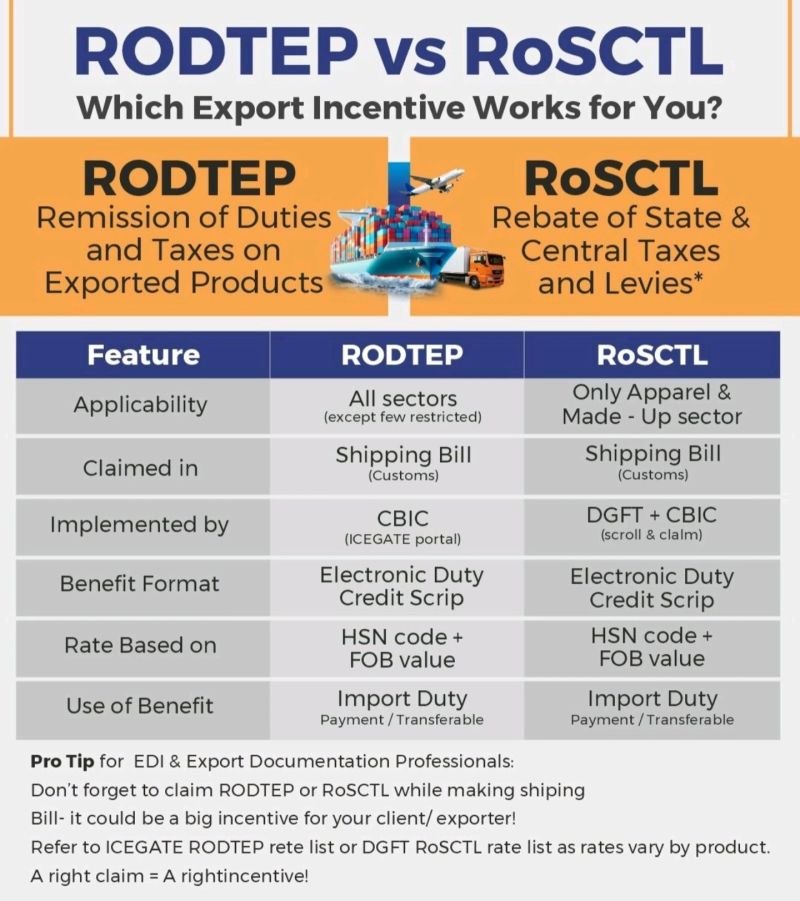
Apparel and made-ups are generally covered under a separate scheme, RoSCTL, which is often more favourable for finished garments than RoDTEP. Fabric and yarn exporters typically fall under RoDTEP proper. If your product range spans both fabric and finished garments, check which scheme applies to each HS code separately.
How often do RoDTEP rates actually change?
For a few years the rates were largely stable, but 2026 has shown they can move on short notice — the scheme saw a 50% cut and a full restoration within about five weeks. The current extension runs the restored rates through 30 September 2026, but exporters should treat any notified “until” date as a prompt to re-verify rather than an assumption of permanence.
What records should I keep to support a Duty Drawback or RoDTEP claim?
Keep your shipping bill, the declared HS code and scheme choice, the bill of entry for any relevant imported inputs, and your internal costing sheet showing the imported-versus-domestic input split for that order. These become essential if a claim is questioned or if you later pursue a Brand Rate application.
Can I switch between RoDTEP and Duty Drawback from one shipment to the next?
Yes — the choice is made per shipping bill, not fixed for your business as a whole. This is exactly why comparing both before filing each significant order, rather than defaulting to whichever one you used last time, is worth the few minutes it takes.
What this looks like over a full year, not just one shipment
One shipment is a useful way to see the mechanics, but the number that actually matters to your business is the annual one. Here’s where the habit pays off. Take a fabric exporter shipping roughly ₹12 crore of FOB value a year across pocketing, lining, and PC blend fabric — not an unusual size for a mid-tier Tirupur or Panipat-based manufacturer supplying two or three overseas buying offices.
| Approach | Effective RoDTEP/Drawback rate | Annual claim on ₹12 crore FOB |
|---|---|---|
| Headline rate applied blindly (4.3%) | 4.3% | ₹51,60,000 |
| Cap-adjusted RoDTEP, no per-order comparison | ~2.4% | ₹28,80,000 |
| Cap-adjusted, with per-order Drawback comparison | ~2.7% blended | ₹32,40,000 |
That gap between “headline rate applied blindly” and “cap-adjusted with per-order comparison” is money that exists whether or not you go looking for it. Most of it is sitting in the difference between what a costing sheet assumes and what the cap and scheme choice actually deliver. The ₹3.6 lakh gap between the second and third row, in this example, is purely the value of comparing RoDTEP against Drawback order by order rather than defaulting to one scheme for everything — roughly the cost of a junior costing executive’s annual salary, recovered from fifteen minutes of arithmetic per significant order.
None of this requires new software or a consultant retainer. It requires a rate reference sheet that someone actually updates, and a costing template that asks the cap-versus-percentage question by default instead of by exception.
A note on RoSCTL for made-ups and garment lines
If your export book includes finished made-ups — cushion covers, bags, or garment-adjacent products stitched from your own fabric — those lines usually sit outside RoDTEP altogether and fall under RoSCTL (Rebate of State and Central Taxes and Levies), a separate Ministry of Textiles scheme aimed specifically at apparel and made-ups. RoSCTL rates are generally structured more generously than the equivalent RoDTEP rate for the same fibre content, which is why most garment exporters use RoSCTL rather than RoDTEP wherever their product qualifies.
The practical implication for a composite fabric-and-stitching unit: don’t assume your whole export book runs on one scheme. Fabric shipped as fabric goes through RoDTEP or Drawback by the logic in this article; the same fabric stitched into a finished made-up before export needs to be checked against RoSCTL separately, because it’s a different HS chapter with a different rate table entirely. Lumping both product types under one blanket “we claim RoDTEP” policy is a common way MSME exporters leave RoSCTL money unclaimed on their made-ups line.
Why exporters default to one scheme instead of comparing
In fairness to the accounts teams who end up hard-coding “RoDTEP 4.3%” into a template and never revisiting it — the comparison genuinely used to matter less. Rates were stable for years, margins in the fabric business have always been thin enough that a 1-2% swing felt like noise rather than signal, and most MSME exporters don’t have a dedicated trade compliance person whose job is to track DGFT notifications. The habit of defaulting to one scheme isn’t laziness; it’s a rational response to a system that used to be quiet.
What changed in 2026 is that the system stopped being quiet. A 50% cut and full restoration inside five weeks is the kind of volatility that turns “set it once a year” into “check it every shipment,” at least for as long as the scheme remains this actively managed. Whether that volatility continues past the September 2026 extension is genuinely unclear — but the cost of building the fifteen-minute habit is low enough that it’s worth keeping regardless of how calm the next notification cycle turns out to be.
Who should actually own this inside a small export house
In most MSME textile exporters I’ve worked with, this responsibility falls into a gap between three people who each assume someone else is watching it. The merchandiser is focused on getting the order confirmed and the buyer happy. The accounts team processes whatever scheme code the shipping bill already carries, without necessarily having the authority — or the fabric-costing context — to question whether it’s the optimal one. The CHA files what they’re told to file, and their incentive is to get the shipping bill cleared quickly, not to spend twenty minutes comparing two schemes for a client who hasn’t asked them to.
The fix isn’t hiring a dedicated trade compliance officer — most MSME exporters don’t have the volume to justify that. It’s assigning explicit, named ownership of the rate reference sheet to one person, usually whoever already owns costing, and giving them a standing instruction: for any order above a threshold you set (say, ₹15–20 lakh FOB value, or whatever feels material for your business), the scheme comparison happens before the quote goes out, not after the shipping bill is filed. Below that threshold, a default scheme is fine — the arithmetic in this article matters most where the rupee amounts are large enough to move your quarterly numbers.
If you’re already running any kind of ERP or structured costing system, this is a five-minute addition: a mandatory field on the sales order or costing sheet for “export incentive scheme used” and “rate verified on [date],” so at minimum you have an audit trail showing the decision was made deliberately rather than inherited from whatever the last shipment happened to use. That single field, more than any consultant or software purchase, is usually what separates exporters who catch a rate change within days from those who find out about it three months later when the ICEGATE credit lands lower than expected.
The honest bottom line
None of these three schemes is “the best one.” They’re each solving a different cost problem, and the only way to know which applies to you is to actually look at your bill of materials and your current rate schedule side by side — not once a year, but per significant order, especially in a year where the rates themselves have proven this volatile. If you take one thing from this piece, let it be the habit: before you file the shipping bill, run the percentage-versus-cap comparison, check it against the Drawback AIR for the same code, and only then decide.
It takes about the same amount of time as writing the covering email to your buyer. It’s usually worth a lot more.
Leave a Reply