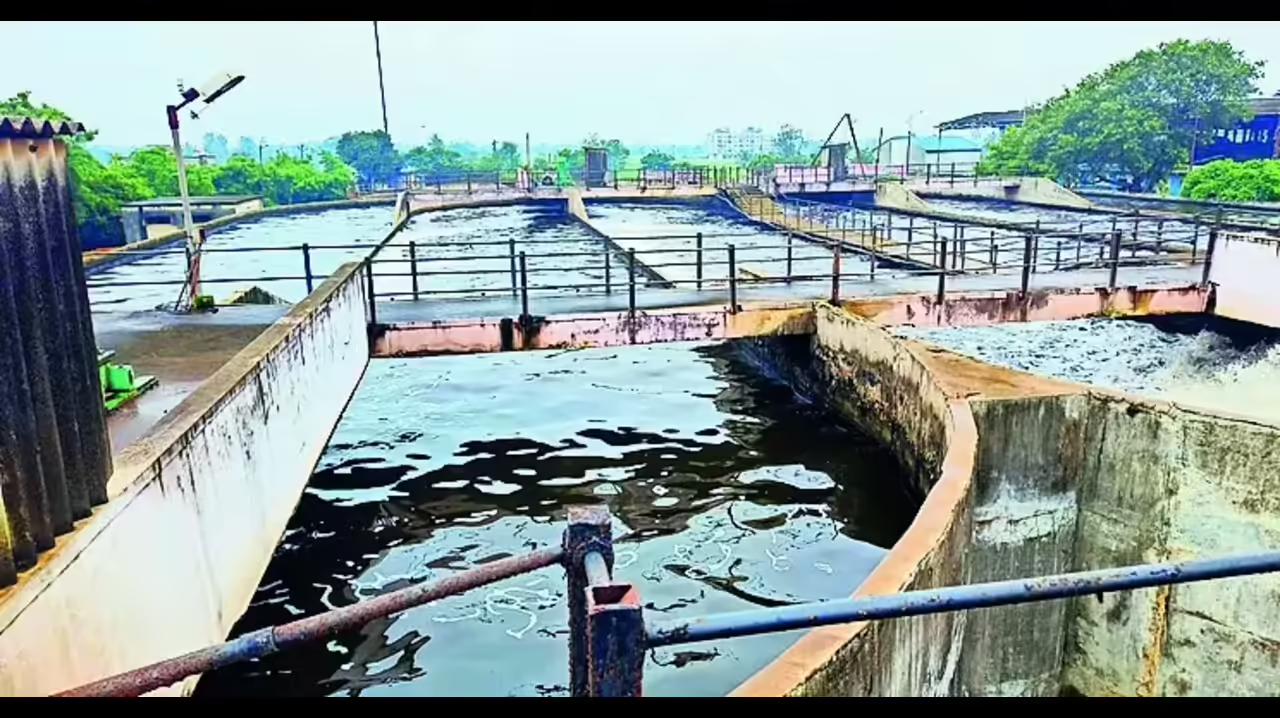
Four clusters, one connected supply chain, and a Supreme Court case active right now that’s already changed how cloth moves between them. Here’s the current, verifiable status — and what it means if you manufacture, trade, or process fabric in any of these regions.
This article summarizes publicly reported regulatory actions, court proceedings, and published water-quality studies. It is not legal advice, and litigation referenced here (particularly the Supreme Court’s ongoing Jojari River matter) is active and evolving — verify current orders and compliance deadlines with your pollution control board or legal counsel before making business decisions based on this content.
Why these four cities, together
One supply chain, four pollution crises
These four textile clusters aren’t just four separate case studies — they’re physically connected by the same cloth. Ichalkaranji’s powerlooms weave roughly one crore metres of grey (unprocessed) cloth a day, and a meaningful share of it — historically 30 to 40% — is sent to Balotra, Bhiwandi, and Ahmedabad for dyeing, printing, and finishing, since each processing hub gives the fabric a different character depending on its water, chemistry, and finishing technique.
That interdependence became very visible in 2025 and 2026. When Balotra’s processing units were shut down over pollution violations, Ichalkaranji’s weavers had nowhere to send their cloth and had to cut production by roughly 30%. If you manufacture in one of these clusters, what happens to water regulation in another cluster is not somebody else’s problem — it can directly determine whether your looms keep running.
This guide walks through the current situation in each city, what’s driving it, what regulators and courts are actually doing about it in 2026, and — since this is the part most pollution articles skip — what manufacturers and traders in these clusters should be doing right now to avoid getting caught in the next round of closures.
Ichalkaranji sits on the left bank of the Panchganga River, and the river has been under sustained pressure for decades from a combination of textile processing effluent, sugar industry discharge, and domestic sewage from Kolhapur and Ichalkaranji municipal areas. A 2023 water quality index study sampling the river from Ichalkaranji to Shirol found the stretch ranged from moderately to highly polluted at every monitoring station, with sections downstream of the city rated unfit for drinking without treatment. Researchers documented water hyacinth overgrowth and repeated fish kills along the Ichalkaranji-to-Shirol stretch — both classic indicators of oxygen depletion from organic and chemical loading.
What’s actually driving it
Unlike Balotra or Ahmedabad, Ichalkaranji’s core industry is weaving, not wet-processing — the city’s 1.25 lakh powerlooms produce grey cloth, which is comparatively low-pollution. The pollution load instead comes from the smaller number of processing and dyeing units embedded in and around the city (co-operative dyeing and bleaching mills, yarn processors, and a handful of dedicated textile processors), combined with a municipal sewage treatment capacity that hasn’t kept pace with the city’s population growth — the 20 MLD STP capacity is well short of the roughly 35 MLD of domestic effluent the city generates.
The Maharashtra Pollution Control Board maintains an active list of textile processing units under scrutiny along the Panchganga, including cooperative processors, yarn processing mills, and bleaching and dyeing works across the Ichalkaranji Industrial Estate, Khanjire Industrial Estate, and neighbouring Shirol taluka. This isn’t a hypothetical watch list — MPCB closure notices have historically covered exactly this class of unit when effluent standards aren’t met.
Direct impact you should know about
The Balotra shutdown hit Ichalkaranji hard
In May, the NGT’s Jodhpur circuit bench ordered the closure of 739 textile processing units in Balotra. Because a large share of Ichalkaranji’s grey cloth output is routed to Balotra specifically for its processing style, the closure left 30–40% of Ichalkaranji’s daily production with no buyer. The Ichalkaranji Powerloom Weavers’ Association had to formally petition local political representatives for intervention, and production was cut by roughly 30% while the shutdown lasted.
The practical lesson for Ichalkaranji-based manufacturers: your business risk isn’t limited to your own compliance status. A regulatory action against your processing partners hundreds of kilometres away can stall your production line just as effectively as a closure notice on your own gate.
This is the most serious, and currently most legally active, situation of the four. Balotra, along with Pali, Jasol, and Bithuja, has been a dyeing and printing hub for decades, and the Luni and Bandi rivers that run through the region have been receiving industrial effluent since the 1980s — India’s first Common Effluent Treatment Plant was actually built in Pali in 1982 specifically to address it. Despite more than four decades of CETP infrastructure, the underlying problem hasn’t gone away: too many units, too much effluent volume, and treatment plants that were undersized or poorly maintained relative to the load.
The scale of the problem, in numbers
Of roughly 800 textile units historically operating in Pali alone, around 600 fall under the Central Pollution Control Board’s “red category” — the classification for highly polluting industries. Testing by the Centre for Science and Environment found that close to 80% of sampled mill effluents were highly polluted, with Chemical Oxygen Demand levels up to 11 times the permitted standard, and chloride concentrations nine times higher than levels considered safe for aquatic life. Dissolved oxygen in affected stretches has been recorded at near zero — meaning the water can no longer support fish or other aquatic organisms at all.
In Jodhpur specifically, the Jojari River — a key tributary of the Luni system — has become the focal point of the crisis. Field inspections found submerged pipelines and unauthorized textile discharge points bypassing treatment infrastructure entirely, and a 2026 court-appointed committee reported that roughly 55 MLD of Jodhpur’s sewage remains untreated, flowing directly into the river system alongside industrial effluent.
The legal timeline: how this became a Supreme Court matter
NGT’s final order
The National Green Tribunal’s Jodhpur circuit bench issued its final order on Jojari/Bandi/Luni contamination, mandating Zero Liquid Discharge compliance, environmental compensation, and closure of non-complying industries. RIICO and the municipal councils of Jodhpur, Pali, and Balotra appealed this order to the Supreme Court.
739 Balotra units closed
The NGT’s Jodhpur bench ordered the closure of 739 textile processing units in the Balotra area over pollution violations, directly disrupting the Ichalkaranji-to-Balotra supply chain described above.
Supreme Court takes suo motu cognisance
Following a widely viewed documentary exposing the pollution and its health impact, the Supreme Court took up the matter on its own initiative, criticising the Rajasthan government’s “pathetic failure” over more than two years of inaction on the NGT’s 2022 directions. The Court constituted a High-Level Ecosystem Oversight Committee (HLEOC) chaired by retired Justice Sangeet Lodha.
HLEOC’s first status report
The Committee’s report — running to roughly 200 pages — documented CETPs operating below capacity, industries bypassing treatment via tanker trucks and illegal drains despite a ban on such tankers since 2017, non-operational CETPs in Pali, and misuse of Balotra’s holding/reserve treatment ponds for storage rather than treatment.
Supreme Court’s detailed enforcement order
The Court ordered fast-track Special Courts in Jodhpur, Pali, and Balotra for environmental prosecutions, mandatory upgrades to CETPs/ETPs/STPs with closure of violators, sealing of illegal discharge points, a ban on tanker-based effluent dumping with seizure powers, a dedicated restoration and compensation fund, and real-time monitoring (SCADA/IoT-based) of treatment infrastructure going forward.
Next compliance deadline
The HLEOC is required to submit its next status report to the Supreme Court by this date — worth tracking closely if you operate in or supply to this region, since it’s the most likely trigger point for further closures or compliance mandates.
⚠ Businesses in this cluster should know
ZLD enforcement is no longer theoretical here
The Supreme Court’s March 2026 order explicitly directs that no unit closed for repeat violations may restart without the Court’s own approval — not just the state pollution board’s. Combined with the mandated CETP upgrades and real-time monitoring requirement, this is a materially stricter enforcement regime than what existed even in 2022. If your business supplies to or operates a processing unit in Pali, Balotra, or Jodhpur, current ZLD and consent-to-operate status should be treated as an active, ongoing compliance requirement, not a one-time certification.
Ahmedabad’s textile and dye-intermediate pollution is concentrated in four industrial estates — Vatva, Naroda, Odhav, and the more recently developed Narol — all discharging, directly or indirectly, toward the Sabarmati River via the Kharicut Canal. The Central Pollution Control Board has previously categorised the Sabarmati as the third most polluted river in the country on a Biochemical Oxygen Demand basis, with BOD levels recorded as high as 147 mg/L against a safe threshold far lower.
The CETP performance problem
Ahmedabad’s cluster is unusual in that it has extensive, long-established CETP infrastructure — the Vatva estate’s treatment society was formed in 1992 and has since added advanced technology including a Fenton Catalytic Reactor for oxidising non-biodegradable effluent components. Despite this investment, performance has repeatedly fallen short: a study analysing 45 months of data from the Vatva CETP found it failed to meet the prescribed Chemical Oxygen Demand standard in every single month measured, with COD levels reaching nearly 8 times the permitted limit at their worst. Biochemical Oxygen Demand exceeded standard in 40 of the 45 months studied.
A 2022 CSIR-NEERI assessment of four CETPs under Ahmedabad Municipal Corporation’s jurisdiction — Naroda Enviro Projects, Gujarat Vepari Maha Mandal Odhav, Green Environment Services Vatva, and Narol Textile Infrastructure — found that neither the untreated influent nor the treated effluent from any of the four consistently met prescribed parameters, a finding submitted to the Gujarat High Court as part of an ongoing suo motu public interest litigation on Sabarmati pollution.
Why the riverfront doesn’t tell the real story
Ahmedabad’s Sabarmati Riverfront, a widely publicised urban development project, has created a misleading impression for people unfamiliar with the river’s actual condition. Environmental researchers monitoring the situation have pointed out that the riverfront stretch functions essentially as a static, walled pool rather than free-flowing water, while the river’s actual condition downstream — where it receives industrial and sewage discharge from Naroda, Odhav, Vatva, and Narol — remains a channel effectively carrying effluent rather than a functioning river ecosystem. Of the roughly 14 domestic sewage treatment plants under Ahmedabad Municipal Corporation, only a small fraction have reportedly been functional at any given time during court hearings on the matter, meaning even the “non-industrial” pollution load compounds the problem.
Ongoing litigation
Gujarat High Court’s suo motu PIL is still active
Unlike Rajasthan’s Supreme Court-level intervention, Ahmedabad’s Sabarmati pollution is being addressed through an ongoing Gujarat High Court public interest litigation, with a Joint Task Force in place since 2019 and periodic CETP performance audits submitted as evidence. Bank guarantee revocation for non-complying CETP operators has been discussed in these proceedings — a signal that financial consequences, not just closure notices, are increasingly part of the enforcement toolkit here too.
What’s the same everywhere
The pattern across all four clusters
Despite very different rivers, states, and regulatory bodies, the same structural problems show up in Ichalkaranji, Balotra, Jodhpur, and Ahmedabad:
CETPs undersized for actual load
Nearly every cluster built its Common Effluent Treatment Plant capacity for the industry base at the time of construction, and unit numbers have since grown well beyond what the plant was designed to handle.
Bypass is common, not rare
Tanker-based effluent dumping, illegal pipelines, and discharge points that skip the CETP entirely appear in official reports from every cluster examined here — not isolated incidents.
Municipal sewage compounds industrial load
In Ichalkaranji, Jodhpur, and Ahmedabad alike, inadequate domestic sewage treatment capacity adds to — and is sometimes harder to fix than — the industrial effluent problem.
Enforcement is intensifying in 2025–2026
Every cluster examined here has seen a meaningfully stricter regulatory or judicial posture in the last 12–18 months compared to the preceding decade.
Where this needs to go
Suggestions for the future
These aren’t original technical proposals — most reflect what’s already been recommended by pollution control boards, courts, and researchers across the sources above, consolidated here for a textile-industry reader.
For regulators and CETP operators
- Real-time, tamper-resistant monitoring. The Supreme Court’s SCADA/IoT monitoring direction for Rajasthan should arguably become the baseline everywhere, not a Rajasthan-specific remedy — self-reported compliance data has repeatedly proven unreliable across all four clusters.
- Capacity audits tied to unit growth, not fixed at construction. Balotra’s CETP capacity was designed around roughly 319 units and now serves 800+; treatment capacity needs a mechanism to scale with the industry it serves, not remain fixed for decades.
- Independent, third-party CETP performance verification — following the CSIR-NEERI model used in Ahmedabad — rather than relying solely on operator self-certification.
- A hard end to tanker-based bypass, with the seizure and prosecution powers the Supreme Court has now mandated for Rajasthan, extended as standard practice.
For textile businesses in these clusters
- Treat ZLD readiness as a standing compliance item, not a one-time certification exercise, particularly if you operate in or supply to Balotra, Pali, or Jodhpur given the current Supreme Court oversight.
- Diversify processing partners geographically where feasible. Ichalkaranji’s 2025 production cut illustrates the concrete business risk of depending heavily on one processing cluster with active regulatory exposure.
- Invest in primary treatment at the unit level rather than relying entirely on CETP capacity — undersized CETPs are a shared-resource problem, and units with their own pre-treatment reduce their exposure when shared infrastructure fails inspection.
- Track HLEOC and NGT status reports directly (the next major one is due 21 July 2026 for the Rajasthan clusters) rather than waiting to hear about closures after they happen.
Technology directions worth watching
- Water and dye recovery/recycling — Zero Liquid Discharge implemented well (rather than as a compliance checkbox) recovers usable water and, in some cases, salt or chemical byproducts, partially offsetting the cost that makes ZLD unpopular with smaller units.
- Cluster-scale, shared advanced treatment (multiple-effect evaporators, membrane systems, Fenton-type oxidation as used in Vatva) is generally more viable for small and medium units than individual on-site advanced treatment, given the capital cost involved.
- Low-water and waterless dyeing processes — still a maturing technology set, but one that reduces the underlying effluent volume rather than just treating it after the fact, which is the more durable fix long-term.
Why this matters to your business specifically
The takeaway for anyone in this supply chain
If you weave in Ichalkaranji, dye in Balotra, or run a processing unit in Vatva, this isn’t background news — it’s operational risk. A Supreme Court status report due in July 2026 could trigger further closures in Rajasthan exactly the way the May closure order did. A Gujarat High Court ruling on CETP bank guarantees could change the cost structure for Ahmedabad-based processors with little notice. And Ichalkaranji’s own experience shows that even businesses with clean compliance records can be hit hard by enforcement action against their supply chain partners elsewhere.
The practical response isn’t to wait for the next closure notice — it’s to know your own cluster’s current legal and compliance status, understand which of your supply chain partners sit in higher-risk clusters, and build enough flexibility into sourcing and processing relationships that a shutdown in one location doesn’t stop your production line entirely.
Straight answers
Frequently asked questions
?Is it currently safe to operate a textile processing unit in Balotra or Jodhpur?
Units that are fully ZLD-compliant, connected properly to a functioning CETP, and current on consent-to-operate renewals continue to function. The risk is concentrated in units bypassing treatment infrastructure or operating without valid consent — exactly the category the Supreme Court’s March 2026 order targets for closure and restricted restart.
?Will the Ichalkaranji-Balotra supply disruption happen again?
Given that the underlying compliance gaps identified in the HLEOC’s March 2026 report haven’t been fully resolved, and a further status report is due in July 2026, further closures affecting the same supply route remain a realistic possibility. Diversifying processing relationships is a reasonable precaution rather than an overreaction.
?What is Zero Liquid Discharge (ZLD) and is it mandatory everywhere?
ZLD means treating wastewater to a standard where none is discharged externally — all of it is recycled or the residual solids are safely disposed of. It’s currently a mandated requirement for the Jojari/Bandi/Luni cluster under the NGT’s 2022 order and the Supreme Court’s subsequent directions. It is not uniformly mandated nationwide, and its blanket application has previously been contested in other NGT proceedings — check your specific state pollution control board’s current requirement rather than assuming a national standard.
?Is the Sabarmati riverfront in Ahmedabad actually clean?
The visible riverfront stretch through central Ahmedabad is a controlled, walled section that looks clean but functions more like a static pool than a flowing river. The river’s condition both upstream and downstream of this stretch — where it receives industrial and sewage discharge — remains heavily polluted according to ongoing Gujarat High Court proceedings.
?How can a manufacturer check the current compliance status of a processing partner?
State pollution control board websites (MPCB, RSPCB, GPCB) typically publish consent-to-operate status and closure notices publicly. For Rajasthan’s Jojari/Luni cluster specifically, HLEOC and Supreme Court status reports are public court filings and a more current source than board websites alone, given how fast enforcement has moved through 2025–2026.
?What should a small unit do if it can’t afford full ZLD infrastructure?
Cluster-scale shared treatment (a well-run, properly capitalised CETP) is generally the realistic path for small and medium units, rather than individual ZLD infrastructure. The recurring failure pattern across all four clusters isn’t that ZLD is impossible — it’s that shared infrastructure has been undersized, poorly maintained, or bypassed. Pushing for CETP capacity upgrades collectively, through industry associations, is usually more achievable than individual compliance for a small unit.
Leave a Reply