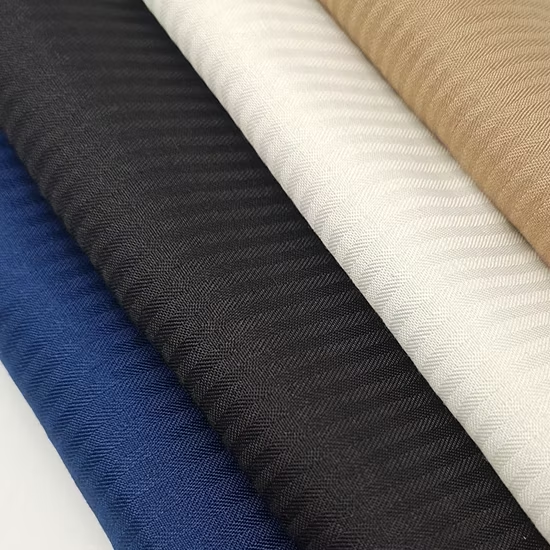
Pocketing fabric is the part of a garment almost nobody sees and almost every brand has a detailed technical specification for. Here’s what pocketing fabric actually is, the full range we manufacture, the global test standards bottomwear brands hold suppliers to, and the certifications that determine whether a mill gets approved as a supplier in the first place.
GOTS CERTIFIED
100+ POCKETING QUALITIES
~800,000M / MONTH CAPACITY
SUPPLYING GLOBAL & DOMESTIC BRANDS
Start here
What pocketing fabric actually is, and why it has its own specification
Pocketing fabric is the inner fabric used to construct pocket bags — the part of a pair of trousers, jeans, or shorts a wearer’s hand actually goes into, sewn behind the visible pocket opening on the outer (shell) fabric. It’s never seen when a garment is worn correctly, which is exactly why it’s tempting to assume it doesn’t matter much. In practice, bottomwear brands write detailed, fibre-specific technical specifications for pocketing precisely because it fails in visible, complaint-generating ways when the wrong fabric is used.
Pocket fabric sits at one of the highest-stress, highest-friction points on a garment — hands go in and out of it repeatedly, coins and keys abrade it from the inside, and on lighter-coloured denim, an incorrectly specified pocketing fabric shows through the shell fabric as a visible shadow (a defect the industry commonly calls “pocket show-through”). Getting pocketing fabric selection right is a genuine technical decision, not an afterthought — which is exactly why global brands maintain their own approved pocketing supplier lists rather than accepting whatever fabric a garment factory happens to source locally.
What we actually manufacture
The pocketing fabric types we produce
100% Polyester Pocketing
The most common base for cost-efficient, high-durability pocketing — resists stretching and abrasion well, doesn’t absorb moisture the way cotton does, and takes disperse dye consistently for colour-matched pocketing where visible edges matter.
Polyester-Cotton Blend (65:35, 80:20, 85:15)
The workhorse of the pocketing world — blend ratio is chosen based on the durability-vs-comfort and cost balance a brand’s technical spec calls for. Our 65:35 twill qualities are built specifically for higher-stress bottomwear applications.
100% Cotton Pocketing
Used where a brand’s sustainability positioning or garment-care requirements call for a natural-fibre pocket bag, or where cotton’s better breathability is a stated requirement.
Cotton-Lycra Stretch Pocketing (97/3)
Built for stretch bottomwear lines where the pocket bag needs to move with a stretch shell fabric rather than restricting it — a mismatch here is a common cause of pocket seam failure in stretch garments.
Top-Dyed & Solid Pocketing
Fil-a-fil, dull chambray, and top-dyed dobby constructions — used where the pocket edge or coin pocket is partially visible in the finished garment design and needs to colour-match the shell fabric closely.
Twill & Drill Weaves
Our 65:35 and 85:15 twill and drill qualities are engineered specifically for the abrasion resistance heavier bottomwear pocketing requires, at GSM ranges from roughly 108 to 216.
Representative constructions
Sample pocketing specifications
| Blend | Construction | Weave | GSM |
|---|---|---|---|
| 80:20 PC Plain | 56×40/30PC×30PC | Plain | 74 |
| 80:20 PC Plain | 78×68/30PC×30PC | Plain | 122 |
| 65:35 PC Twill | 98×54/30PC×30PC | Twill | 115 |
| 65:35 PC Twill | 112×56/20PC×20PC | Twill | 216 |
| 85:15 PC Drill | 90×36/150D×20PC | Drill | 108 |
| 85:15 PC Drill | 128×54/150D×20’s Cotton | Drill | 162 |
| 100% Cotton | 60×56/20’s×20’s | Plain | 142 |
| 100% Cotton | 108×56/20’s×20’s | Drill | 203 |
Full specification sheets, including the remaining 90+ active qualities across denim, non-denim, and formal trouser pocketing, are available to buyers on request.
What brands actually test for
Global standards and test methods for bottomwear pocketing
There isn’t a single universal “pocketing fabric standard” the way there might be for, say, a fire safety rating — instead, most global bottomwear brands maintain their own technical specification document that references a common set of internationally recognised test methods. Understanding these is the difference between a mill that can talk to a brand’s technical team credibly and one that can’t.
ASTM D434 / seam slippage
Resistance to yarn slippage at the seam
Since pocket bags are sewn under real load (a hand pushing into the pocket, keys and coins pulling at the seam), brands test how much the seam opens under a standardised pulling force. A typical acceptance threshold sits in the 15–25 lb resistance range before yarns visibly slip apart at the stitch line — a pocketing fabric that fails this test will show gapping seams within weeks of normal wear.
ASTM D5034 (Grab Test) / tensile strength
Breaking strength under direct tension
Measures the force needed to tear the fabric itself, in both warp and weft direction — relevant because a pocket bag under a heavy load (a full set of keys, a phone) needs sufficient raw tensile strength independent of the seam.
ISO 12945 / ASTM D3511 / pilling resistance
Surface pilling under repeated friction
Pocket fabric rubs constantly against the wearer’s hand and against whatever’s carried in the pocket. The Martindale-based ISO method runs the fabric through thousands of rub cycles and rates the resulting pill formation on a numeric scale — a poor rating means visible fuzzing and surface degradation well before the garment’s expected lifespan.
ISO 105 series / colourfastness
Colour retention against washing, light, and rubbing
Especially relevant for top-dyed or solid pocketing where the pocket edge is partially visible, or for coloured pocket bags used as a design feature. Poor colourfastness here can also cause dye transfer (crocking) onto light-coloured shell fabric — a defect that’s highly visible and hard to reverse.
Bursting strength (Mullen-type test)
Resistance to a pushing/bursting force
Tests the fabric’s resistance to a perpendicular bursting force rather than a linear pull — relevant to how a pocket bag actually fails in real use, since hands and objects push against the fabric from inside the pocket rather than pulling it in a straight line.
Dimensional stability / shrinkage
Shrinkage after wash relative to the shell fabric
Pocketing and shell fabric are cut and sewn together before the garment’s first wash. If the two fabrics shrink at meaningfully different rates, the pocket bag distorts the garment’s shape at the pocket opening — which is why pocketing shrinkage tolerance is usually specified relative to the shell fabric’s shrinkage, not as an independent number.
REACH / restricted substances
Chemical compliance for the EU and beyond
Global brands increasingly require pocketing fabric — even though it’s an inner, non-visible component — to meet the same restricted substance limits (banned azo dyes, formaldehyde limits, heavy metals) as visible shell fabric, since REACH and similar regulations apply to the finished garment as a whole, not just its visible layers.
What actually gets a mill approved
Certifications that matter for global pocketing supply
Test reports prove a specific fabric batch performs correctly. Certifications prove the facility producing it operates to a verifiable standard — and for most global brands, both are required before a mill is added to an approved supplier list.
GRS — Global Recycled Standard
Certifies recycled content claims (recycled polyester) through third-party audit and shipment-level transaction certificates — increasingly a hard requirement for brands with public recycled-content sourcing commitments.
GOTS — Global Organic Textile Standard
Certifies organic fibre content and processing chain-of-custody, relevant for pocketing supplied into organic cotton garment lines.
OEKO-TEX Standard 100
Tests the finished fabric itself for harmful substances against human-ecological limits — widely requested by European buyers specifically for pocketing and other skin/body-adjacent components, even though pocketing is technically an inner layer.
ISO 9001
Quality management system certification — doesn’t certify the fabric itself, but certifies that a mill’s production and quality control processes are documented, consistent, and auditable, which is what most brand technical teams check before a first trial order.
Sedex / SMETA social compliance audit
Covers labour practices, worker safety, and ethical sourcing at the manufacturing facility — increasingly a pre-condition for supplier approval independent of fabric quality, since brands are directly accountable to their own customers for supply chain labour practices.
Higg Index (Facility Environmental Module)
A self-assessed and increasingly third-party-verified environmental performance index used heavily by larger apparel brands to compare suppliers on water, energy, and chemical management — relevant to any mill running its own dyeing and processing operation.
Note for our editorial team: only GRS and GOTS are confirmed certifications currently held. If MM Group holds or is pursuing any of the industry-common certifications listed above (OEKO-TEX, ISO 9001, Sedex/SMETA, Higg), update this section with the actual certificate numbers and validity dates — a named certificate number is a materially stronger buyer-facing claim than a general mention, and global brand technical teams specifically check for this during supplier approval.
How a mill actually gets approved
The brand supplier-approval process for pocketing fabric
- 01Technical specification review. The brand shares its pocketing tech pack — construction, GSM range, required test performance thresholds, and any restricted substance list — and the mill confirms which existing quality meets it, or whether a custom development is needed.
- 02Lab dip and swatch submission. For coloured or top-dyed pocketing, a small sample is dyed and submitted for shade approval before any bulk commitment.
- 03Third-party lab testing. Submitted fabric is tested at an accredited lab against the standards above — seam slippage, tensile strength, pilling, colourfastness, and restricted substances — with results shared directly with the brand’s technical team, not self-reported by the mill.
- 04Social and environmental compliance audit. For most global brands, a Sedex/SMETA-type audit of the facility happens in parallel with fabric testing, since supplier approval typically requires both to pass.
- 05Pre-production sample (PPS) and trial order. A small trial order runs through the brand’s actual garment factory before the mill is added to the approved supplier list for bulk orders.
The practical reality is that this process can take several months for a new mill relationship — which is exactly why brands prefer working with mills that already have current certifications and test data on file, rather than starting the qualification process from zero on every new order.
Already supplying at scale
Our existing pocketing supply relationships
MM Group already supplies fabric — including pocketing constructions from the ranges above — to established global and domestic apparel brands across denim, formal wear, and casual bottomwear segments:
Tom TailorNauticaMyntraIndian Terrain
KillerBlackberrysReliance TrendsGini & Jony
Buyer questions
Frequently asked questions
?What blend ratio is best for pocketing fabric?
It depends on the brand’s durability, cost, and comfort priorities. 65:35 polyester-cotton is a common workhorse balance for durability and cost; 80:20 and 85:15 blends shift further toward polyester’s abrasion resistance and dimensional stability; 100% cotton is chosen where breathability or a natural-fibre sourcing commitment matters more than raw durability.
?Why does pocketing fabric need seam slippage testing if it’s not visible?
Because seam failure at the pocket is one of the most common garment-return reasons in bottomwear — an invisible component that fails still generates a visible complaint and a returned garment, which is exactly why brands test it as rigorously as visible fabric.
?Does pocketing fabric need to match the shell fabric’s shrinkage rate exactly?
Not exactly, but closely — brands typically specify a maximum shrinkage differential between shell and pocketing fabric rather than an identical figure, since even a small mismatch distorts the pocket opening after the garment’s first wash.
?Is GRS certification required for all pocketing fabric, or only recycled content?
GRS certification is only relevant where the pocketing fabric contains recycled fibre content the brand wants to claim on the finished garment. Conventional (non-recycled) pocketing doesn’t require it, though many brands are shifting increasing volumes of their pocketing spec toward certified recycled content as part of broader sustainability commitments.
?How long does new pocketing fabric development typically take?
For a construction close to an existing quality, a few weeks including lab dip and testing. A genuinely new construction or blend ratio, combined with full brand supplier approval from scratch, can reasonably take several months given the testing and audit steps involved.
?Can pocketing fabric be supplied with functional finishes like anti-bacterial treatment?
Yes — functional finishing (anti-microbial, anti-fungal, and similar treatments) can be applied to pocketing fabric the same way it’s applied to shell fabric, though it’s less commonly specified for pocketing than for outerwear unless the brand has a specific hygiene-related requirement for the garment category.
Request Pocketing Fabric Specifications
Share your construction, blend ratio, GSM, and required test standards — our export team will confirm availability, lead time, and certification documentation.
Leave a Reply