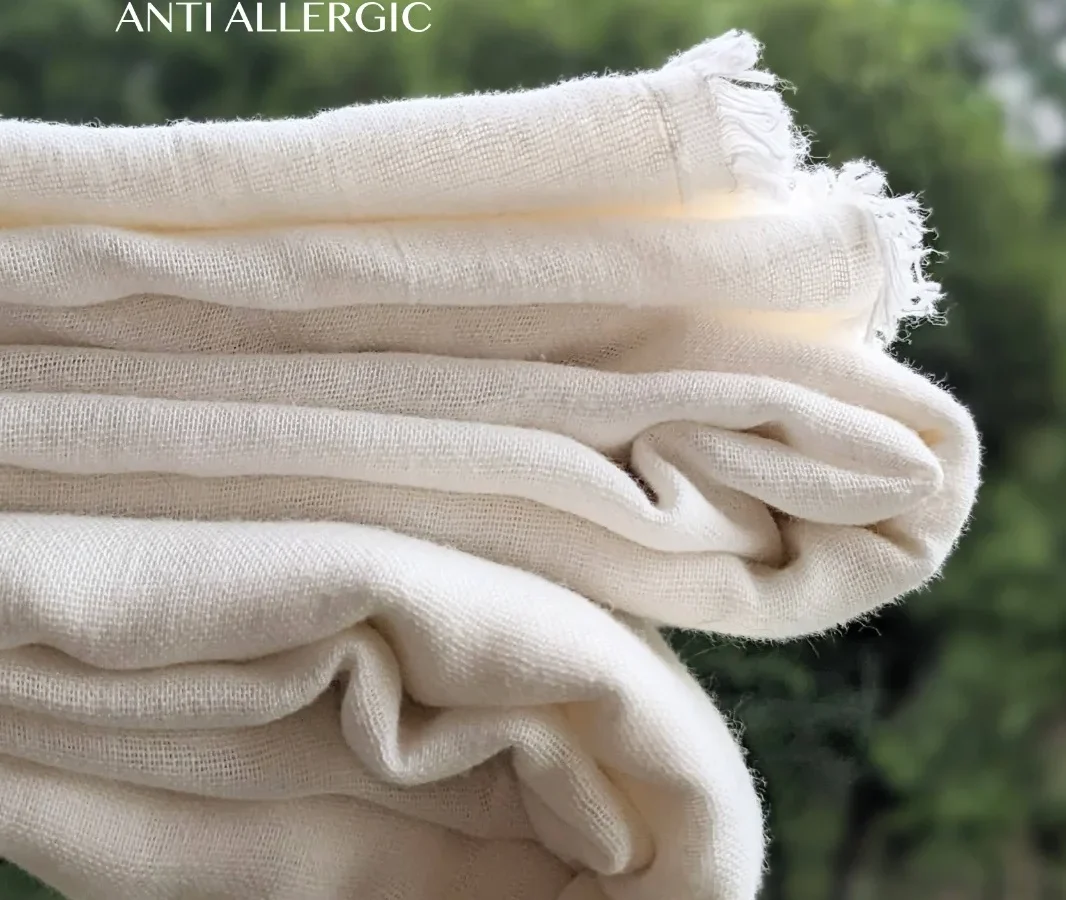
MM Group manufactures 100% organic cotton fabric on an order basis under GOTS certification. Here’s what organic cotton is actually used for, why global brands are steadily increasing demand for it, what the real production growth data shows, and exactly how a GOTS-certified organic cotton order moves through our facility from certified yarn to finished, transaction-certified fabric.
GRS CERTIFIED
MADE TO ORDER
FULL BATCH TRACEABILITY
Market size figures for organic cotton vary enormously across research providers — published 2026 estimates for the same global market range from under $2 billion to over $50 billion depending on methodology and scope. Where precise dollar figures are unreliable, this article relies on production volume and hectare data from Textile Exchange, the industry’s primary standards and reporting body, rather than disputed market-value projections.
Start here
What makes cotton “organic,” and why it’s a supply chain claim, not just a farming one
Organic cotton is grown without synthetic pesticides, herbicides, or synthetic fertilisers, from non-GMO seed, using farming practices intended to maintain soil health and reduce water and chemical impact relative to conventional cotton cultivation. That’s the agricultural definition — but for a brand sourcing organic cotton fabric, the more important part is what happens after the cotton leaves the farm.
Organic cotton fabric
Certified fibre, tracked through spinning, weaving, and processing under a chain-of-custody standard (GOTS), with restricted processing chemicals and a shipment-level transaction certificate proving the claim all the way to the finished fabric.
Conventional cotton fabric
No chain-of-custody requirement between farm and fabric — a brand generally cannot verify the specific farming practices behind a given roll of conventional cotton fabric.
This distinction matters because “organic cotton” without a certificate behind it is simply an unverifiable claim. A brand that wants to state “made with organic cotton” on a hangtag, in almost all serious retail markets today, needs a valid transaction certificate tracing that specific fabric back through a certified supply chain — which is exactly why GOTS certification, not the cotton itself, is what actually enables the commercial claim.
What the real data shows
Organic cotton growth: the numbers that actually hold up
Textile Exchange, the nonprofit standards body behind GOTS and the primary industry source for fibre production data, reported organic cotton fibre production grew 37% in the 2020/21 season to reach over 342,000 tonnes, grown across more than 621,000 hectares of certified organic cotton farmland globally.
India, Turkey, China, and Kyrgyzstan together account for roughly 97% of global organic cotton output, with India alone responsible for the largest single share. This is directly relevant to sourcing strategy: a mill operating in India isn’t importing organic cotton from a distant, hard-to-verify supply chain — it’s positioned inside the country producing the largest share of the world’s certified organic cotton fibre, which shortens and simplifies the chain-of-custody a buyer ultimately has to verify.
Why growth is structurally different this time
Earlier waves of organic cotton demand were driven mainly by a narrow set of values-led brands (Patagonia being the most cited example) and a relatively small, dedicated consumer base. The current growth cycle has a different, more durable set of drivers behind it: regulatory pressure (the EU’s sustainability disclosure and due-diligence rules increasingly require brands to substantiate environmental claims with actual chain-of-custody evidence, not marketing language), and mainstream retailers — not just sustainability-focused niche brands — building organic cotton into core, ongoing product lines rather than limited capsule collections. That shift, from “occasional sustainable capsule” to “standard procurement requirement,” is the more meaningful growth signal than any single disputed market-size dollar figure.
Why brands are actually asking for it
What’s driving global brand demand for organic cotton
Regulatory pressure
Sustainability claims now need to be provable, not just stated
European regulation increasingly requires brands to substantiate environmental and sustainability claims with verifiable supply chain evidence rather than general marketing statements — pushing “organic” from a voluntary differentiator toward something closer to a documented procurement requirement for brands selling into these markets.
Procurement-level sustainability targets
Brands have made public, dated commitments they now have to hit
A large share of global apparel brands have published sustainability roadmaps with specific target years (commonly 2025 or 2030) committing to a percentage of “preferred” or certified fibre in their supply chain — organic cotton is one of the standard fibre categories counted toward these commitments, which converts what used to be a marketing choice into an internal procurement scorecard metric.
Consumer demand, still real but no longer the only driver
Sustainability-aware buying has moved from a niche to a mainstream expectation
Consumer willingness to seek out certified sustainable textiles has broadened well beyond the early adopter segment, particularly among younger buyers, giving brands a genuine commercial incentive alongside the regulatory and procurement-target pressure above.
Category expansion beyond apparel
Home textiles and baby/personal care products are growing organic cotton categories
Beyond core apparel, organic cotton demand is expanding into bedding, towels, and baby products — categories where the absence of pesticide residue and processing chemicals is a directly marketable, easily understood consumer benefit rather than an abstract environmental claim.
What it’s actually used for
Organic cotton fabric applications
Shirting & casualwear
Woven organic cotton shirting fabric for brands with certified apparel lines — a direct extension of our conventional cotton shirting range under the same construction options.
Bottomwear & trousers
Twill and drill weight organic cotton fabric for trouser and casual bottomwear applications, following the same construction logic as our conventional cotton bottomweight range.
Pocketing
Organic cotton pocketing for garments where the brand’s certification scope covers the entire garment, including non-visible components — increasingly required as GOTS certification scope has tightened around whole-garment compliance.
Home textiles
Bedding, towelling-adjacent, and household fabric applications, a fast-growing category as organic positioning expands beyond apparel into home goods.
Baby & sensitive-skin apparel
A category where the absence of pesticide residue and restricted processing chemicals is a directly marketable product benefit, driving above-average category growth.
Recycled + organic blends
Fabric combining GOTS-certified organic cotton with GRS-certified recycled polyester or cotton content, for brands running combined sustainability claims across both standards.
How we actually make it
The GOTS-certified organic cotton production process, order to shipment
Organic cotton fabric isn’t produced by running the same machines with different cotton — the entire batch has to be handled, tracked, and documented separately from conventional production to preserve the certification chain. Here’s how an order actually moves through our facility.
- 01Certified yarn sourcing. Organic cotton yarn is procured specifically against a confirmed order, sourced from suppliers holding valid GOTS transaction certificates of their own — the certification chain has to be unbroken from farm-certified fibre through spinning before it ever reaches our weaving floor.
- 02Segregated production scheduling. Organic cotton warp and weft is run as a dedicated, separately scheduled production lot — not interleaved with conventional cotton runs on the same equipment without a documented, GOTS-compliant cleaning and changeover process between lots, to prevent fibre cross-contamination.
- 03Weaving. The certified yarn is woven to the ordered construction on our air-jet loom lines, with batch identity maintained and recorded throughout — every roll produced is traceable back to the specific certified yarn lot it was woven from.
- 04GOTS-compliant wet processing. Desizing, scouring, bleaching, and dyeing — where required — use only GOTS-approved input chemicals, which excludes a substantial list of conventional textile chemicals (including certain conventional dyes, finishing agents, and processing aids) that are permitted in standard fabric production but prohibited under organic certification.
- 05Finishing. Any functional or aesthetic finishing applied has to similarly draw only from the GOTS-approved chemical input list, which can mean certain conventional finishes (some flame retardant and easy-care chemistries in particular) aren’t available in combination with organic certification — a genuine technical constraint worth discussing upfront if a buyer wants both organic certification and a specific functional finish.
- 06Quality control and batch documentation. Finished fabric goes through the same quality inspection as conventional fabric, with the added requirement of maintaining unbroken batch and lot documentation connecting the finished roll back to the original certified yarn purchase.
- 07Transaction certificate issuance. The shipment is issued its own GOTS transaction certificate — the document that actually lets the buyer make an organic cotton claim on their finished product, distinct from and in addition to our facility-level GOTS scope certificate.
Why we produce organic cotton to order rather than holding stock
Segregated scheduling, dedicated cleaning cycles between conventional and organic runs, and certified yarn procurement all carry real cost and lead-time implications that don’t make sense to absorb speculatively without a confirmed order. Producing to order also means the certified yarn purchase itself is sized to the actual order quantity, avoiding the carrying cost and certification-tracking complexity of holding organic cotton fabric stock against uncertain future demand — the practical result is a made-to-order model rather than an off-the-shelf one.
What’s actually verified
Our certification credentials
Our GOTS scope certificate covers dyed fabrics, greige fabrics, and greige yarns — meaning organic cotton fabric can be supplied undyed (greige/RFD) or through our own in-house dyeing process, both within certified scope. Facility-level certification alone doesn’t prove any specific shipment is organic — that requires the shipment-level transaction certificate described in the process above, which we issue against every certified order.
Where this is heading
Our view on organic cotton demand going forward
Two structural trends point toward sustained, rather than cyclical, growth in organic cotton demand over the next several years. First, regulatory tightening in major export destination markets is moving sustainability substantiation from optional to functionally mandatory for brands operating there — a trend that doesn’t reverse easily once compliance infrastructure is built. Second, India’s position as the largest global producer of organic cotton fibre means Indian mills with existing GOTS certification and organic processing experience — rather than mills that would need to build this capability from scratch — are structurally better positioned as brands look to shorten and simplify supply chains they now have to document more rigorously than before.
Practically, this means our expectation is steady growth in organic cotton order volume and diversification across categories — from apparel-led demand toward genuine growth in home textiles and baby/sensitive-skin categories — rather than a short-lived trend tied to a single sustainability news cycle.
Buyer questions
Frequently asked questions
?What’s the actual difference between organic cotton and GOTS-certified cotton fabric?
Organic cotton describes the farming method for the raw fibre. GOTS certification covers the entire chain of custody afterward — spinning, weaving, and processing — under restricted chemical and traceability requirements. A brand making an “organic cotton” claim on a finished fabric almost always needs the GOTS (or equivalent) chain-of-custody certification, not just organically-grown fibre with no tracked processing chain.
?Why is organic cotton fabric made to order rather than stocked?
Because certified yarn procurement, segregated production scheduling, and dedicated equipment cleaning between organic and conventional runs all carry cost and lead-time implications that only make sense against a confirmed order — holding speculative organic cotton stock would mean carrying that cost without a guaranteed buyer.
?Can organic cotton fabric be combined with functional finishes like flame retardant or wrinkle-free treatment?
Some finishes, yes — but GOTS restricts input chemicals to an approved list, which excludes some conventional finishing chemistries. If a buyer needs both organic certification and a specific functional finish, this needs to be discussed upfront to confirm a GOTS-compliant finishing option exists for that specific requirement.
?Why does India produce so much of the world’s organic cotton?
India accounts for roughly 38% of global organic cotton production, the largest single share, driven by a combination of climate suitability, an established base of smallholder farmers able to transition to organic methods, and years of accumulated certification infrastructure supporting the transition and ongoing compliance process.
?Does a GOTS facility certificate mean every fabric a mill produces is organic?
No — a facility (scope) certificate confirms the mill is audited and equipped to produce certified fabric under GOTS rules. It doesn’t mean every product is organic; each specific organic shipment still requires its own transaction certificate proving that particular batch’s certified chain of custody.
?What’s a realistic lead time for a new organic cotton fabric order?
Longer than conventional fabric, mainly due to certified yarn procurement lead time and segregated production scheduling. Buyers should factor in additional lead time versus a conventional order of the same construction and volume, and discuss specific timelines against their required delivery date upfront.
Request Organic Cotton Fabric Quotation
Share your construction, GSM, order quantity, and required delivery timeline — our export team will confirm certified yarn availability, lead time, and transaction certificate documentation.
Leave a Reply