Introduction
The textile manufacturing industry has always been one of the world’s most important industrial sectors. From the clothes we wear every day to the fabrics used in automobiles, healthcare, sports, hospitality, and home furnishings, textiles touch nearly every aspect of modern life.
However, the industry entering 2026 looks very different from the one that existed just a decade ago.
Manufacturers are facing rising labor costs, increasing competition, sustainability regulations, shifting consumer expectations, and global supply chain disruptions. At the same time, technological advancements such as automation, artificial intelligence (AI), smart machinery, digital manufacturing, and integrated sourcing platforms are creating new opportunities for growth.
The companies that adapt to these changes are likely to emerge as industry leaders, while those relying solely on traditional methods may struggle to remain competitive.
In this article, we explore the most important textile manufacturing trends shaping the industry in 2026 and beyond.
The Current State of the Textile Manufacturing Industry
The global textile and apparel market continues to grow steadily despite economic uncertainties.
According to various industry reports, the global textile market is expected to surpass trillions of dollars in value during the coming decade. Countries such as India, China, Bangladesh, Vietnam, Turkey, and Indonesia continue to dominate textile production due to their strong manufacturing infrastructure and skilled workforce.
India, in particular, has emerged as a major textile manufacturing hub. The country benefits from:
- A large cotton-producing base
- Growing technical textile production
- Government incentives
- Expanding export opportunities
- Increasing investment in manufacturing technology
Yet growth comes with challenges.
Manufacturers must manage:
- Rising raw material costs
- Skilled labor shortages
- Increasing buyer expectations
- Sustainability requirements
- Faster delivery timelines
These factors are pushing textile companies toward modernization.
Why 2026 Is a Turning Point for Textile Manufacturing
Several major forces are driving transformation across the textile industry.
Rising Production Costs
Labor expenses continue increasing across major manufacturing regions.
For years, many textile businesses relied on low-cost labor to remain competitive. Today, rising wages are forcing manufacturers to improve productivity through automation and technology.
Demand for Faster Deliveries
Modern consumers expect products faster than ever.
E-commerce has changed purchasing behavior dramatically. Brands can no longer wait months to replenish inventory.
Manufacturers must shorten lead times without sacrificing quality.
Sustainability Pressures
Consumers increasingly care about where and how products are made.
Major fashion brands now require suppliers to meet environmental standards related to:
- Water usage
- Energy consumption
- Waste reduction
- Carbon emissions
- Ethical manufacturing
This shift is influencing production methods throughout the textile value chain.
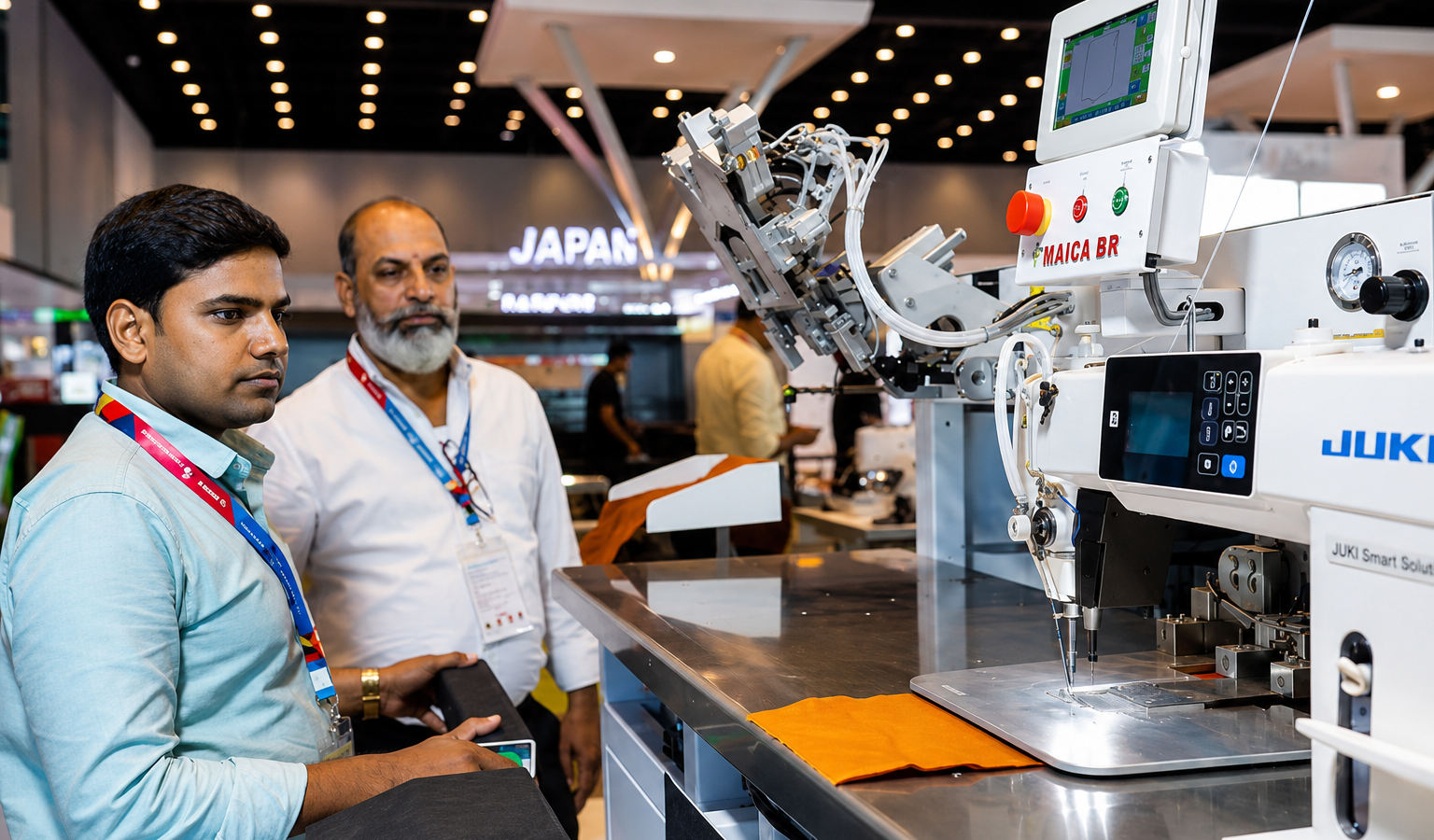
Trend 1: Automation Is Becoming the New Standard
Automation is no longer optional.
It has become one of the strongest competitive advantages in textile manufacturing.
Factories are investing heavily in technologies that reduce manual intervention while improving efficiency and consistency.
Areas Seeing Rapid Automation
Automated Fabric Spreading
Modern spreading machines can:
- Control fabric tension
- Improve alignment
- Reduce wastage
- Increase production speed
Automatic Cutting Systems
Computerized cutting machines offer:
- Higher precision
- Better marker efficiency
- Reduced fabric consumption
- Faster order processing
Automated Embroidery
Advanced embroidery systems can complete intricate designs with remarkable speed and consistency.
Robotic Material Handling
Many factories are implementing:
- Conveyor systems
- Automated guided vehicles
- Smart warehousing solutions
These technologies reduce production bottlenecks and labor dependency.
Real-World Impact
A medium-sized apparel factory implementing automated cutting often reports fabric savings between 2% and 5%.
Considering that fabric represents the largest manufacturing cost, even small improvements can significantly improve profitability.
Trend 2: Smart Factories and Industry 4.0
Industry 4.0 is transforming textile manufacturing.
Instead of isolated machines working independently, modern factories are becoming connected ecosystems where equipment communicates through digital networks.
What Is a Smart Textile Factory?
A smart factory uses technologies such as:
- Internet of Things (IoT)
- Artificial Intelligence
- Cloud Computing
- Data Analytics
- Machine Learning
- Real-Time Monitoring Systems
These technologies allow manufacturers to monitor production continuously.
Benefits of Smart Manufacturing
Real-Time Production Tracking
Managers can instantly view:
- Machine performance
- Production output
- Efficiency levels
- Downtime causes
Predictive Maintenance
Instead of waiting for equipment failure, smart systems identify maintenance requirements before breakdowns occur.
This minimizes costly production interruptions.
Improved Quality Control
Connected systems can detect process deviations immediately, reducing defect rates.
Why It Matters
Factories that operate using real-time data make faster decisions and respond more effectively to changing production demands.
Trend 3: Artificial Intelligence Is Reshaping Production Planning
Artificial intelligence is becoming a powerful tool across textile manufacturing operations.
Previously, production planning relied heavily on manual spreadsheets and human judgment.
Today, AI can process thousands of data points simultaneously.
Applications of AI in Textile Manufacturing
Demand Forecasting
AI analyzes:
- Historical sales
- Market trends
- Seasonal demand
- Consumer behavior
This improves inventory planning.
Production Scheduling
AI systems help optimize:
- Machine allocation
- Workforce planning
- Order sequencing
- Production capacity
Quality Prediction
Machine learning algorithms can identify patterns that lead to defects.
Manufacturers can solve problems before they impact production.
Example
A textile mill using AI-powered forecasting can reduce excess inventory while maintaining better stock availability.
This improves both cash flow and customer satisfaction.
Trend 4: Digital Textile Printing Continues to Expand
Digital printing is one of the fastest-growing technologies in the fabric manufacturing sector.
Traditional printing methods often require:
- Screens
- Lengthy setup
- High minimum quantities
Digital printing eliminates many of these limitations.
Advantages of Digital Printing
Faster Design Changes
Manufacturers can switch designs quickly without extensive setup time.
Lower Water Consumption
Digital printing generally uses significantly less water compared to conventional methods.
Reduced Inventory Risk
Brands can produce smaller quantities based on demand.
Greater Customization
Customers increasingly want personalized products.
Digital printing supports this trend effectively.
Future Outlook
As printing technology improves, digital printing will continue replacing traditional methods in many product categories.
Trend 5: Sustainability Is Becoming a Business Requirement
Sustainability is no longer just a marketing strategy.
It has become a core business requirement.
Major global brands are demanding more sustainable manufacturing practices throughout their supply chains.
Key Sustainability Trends
Water Conservation
Textile processing consumes substantial amounts of water.
Manufacturers are investing in:
- Water recycling systems
- Low-liquor dyeing technologies
- Efficient washing processes
Renewable Energy
Many factories are installing:
- Solar power systems
- Energy-efficient machinery
- Smart energy management systems
Circular Manufacturing
The industry is moving toward:
- Fabric recycling
- Fiber recovery
- Waste reduction
- Closed-loop production systems
Why Sustainability Matters
Beyond environmental benefits, sustainable manufacturing often lowers operating costs through improved resource efficiency.
Trend 6: Integrated Sourcing Platforms Are Simplifying Vendor Discovery
One of the biggest challenges in textile manufacturing is managing supplier relationships.
A single garment may involve:
- Fabric suppliers
- Trim manufacturers
- Printing companies
- Embroidery vendors
- Packaging suppliers
Managing these relationships can be complex.
The Problem with Fragmented Supply Chains
Manufacturers often struggle with:
- Supplier discovery
- Quality consistency
- Delivery coordination
- Communication gaps
Integrated Sourcing Solutions
Modern sourcing ecosystems help manufacturers connect with:
- Machinery suppliers
- Fabric producers
- Technology providers
- Service companies
Through centralized platforms, businesses can evaluate multiple solutions more efficiently.
This trend is expected to accelerate significantly throughout 2026.
Trend 7: Technical Textiles Continue to Grow
Technical textiles represent one of the most promising segments within the textile manufacturing industry.
Unlike conventional textiles, technical textiles are designed for functionality rather than appearance.
Major Applications
Medical Textiles
Used in:
- Surgical gowns
- Masks
- Implants
- Wound care products
Automotive Textiles
Found in:
- Seat covers
- Airbags
- Interior components
Construction Textiles
Used for:
- Geotextiles
- Reinforcement materials
- Insulation products
Protective Clothing
Demand continues rising for:
- Fire-resistant fabrics
- Industrial uniforms
- Safety apparel
Growth Potential
Government initiatives and industrial development are driving strong investment in technical textile manufacturing worldwide.
Trend 8: Data-Driven Decision Making Is Becoming Essential
The most successful textile manufacturers are increasingly becoming data-driven organizations.
Instead of relying solely on experience, decisions are supported by measurable performance indicators.
Important Metrics Being Tracked
- Overall Equipment Effectiveness (OEE)
- Production Efficiency
- Fabric Utilization
- Rejection Rates
- Energy Consumption
- Lead Times
- Labor Productivity
When analyzed correctly, these metrics help manufacturers identify improvement opportunities that might otherwise go unnoticed.
The result is better operational efficiency and stronger profitability.
Trend 9: Global Supply Chains Are Being Rebuilt
The textile manufacturing industry has experienced significant supply chain disruptions over the last few years. Events such as the COVID-19 pandemic, geopolitical tensions, shipping delays, and raw material shortages exposed vulnerabilities in global sourcing networks.
As a result, manufacturers and brands are rethinking how they source materials and manage production.
Nearshoring and Regional Manufacturing
One emerging trend is nearshoring, where brands move production closer to their target markets.
Benefits include:
- Faster delivery times
- Lower logistics risks
- Better inventory management
- Improved responsiveness to demand changes
While Asia remains the world’s largest textile manufacturing hub, many brands are diversifying sourcing locations to reduce dependency on a single region.
Supply Chain Visibility
Modern textile companies are investing in digital tools that provide real-time visibility into:
- Raw material availability
- Production status
- Shipment tracking
- Inventory levels
This transparency helps businesses respond more quickly to disruptions and customer demands.
Trend 10: ERP Systems Are Becoming the Backbone of Textile Manufacturing
As textile operations become more complex, manufacturers need centralized systems to manage information across departments.
This is where Enterprise Resource Planning (ERP) software plays a critical role.
Why ERP Matters
Many textile businesses still operate using disconnected spreadsheets and manual processes.
This creates challenges such as:
- Data duplication
- Inventory inaccuracies
- Delayed reporting
- Poor coordination
An industry-specific textile ERP system integrates:
- Sales orders
- Inventory
- Purchasing
- Production planning
- Quality control
- Costing
- Dispatch management
Benefits of ERP Integration
Improved Inventory Management
Manufacturers gain real-time visibility into stock levels, reducing shortages and excess inventory.
Better Production Planning
ERP systems help align production schedules with customer demand.
Cost Control
Accurate costing allows businesses to understand profitability at every stage of production.
Enhanced Customer Service
Faster access to information improves communication with customers and suppliers.
As digital transformation accelerates, ERP adoption will become increasingly important for textile manufacturers of all sizes.
Trend 11: Robotics Is Entering Textile Manufacturing
For many years, robotics adoption in textile manufacturing lagged behind industries such as automotive and electronics.
The primary challenge has been fabric itself.
Unlike metal or plastic components, fabric is flexible, stretchable, and difficult for machines to handle consistently.
However, recent advancements in robotics are changing this reality.
Areas Where Robotics Is Growing
Material Handling
Robotic systems can transport fabric rolls and finished products throughout factories.
Fabric Inspection
Vision-based robots can identify defects with high accuracy.
Packaging Operations
Automated packaging systems improve consistency and speed.
Sewing Assistance
While fully robotic sewing remains limited, specialized robotic systems are increasingly supporting repetitive sewing operations.
As artificial intelligence and machine vision technologies improve, robotic applications will continue expanding.
Trend 12: Workforce Transformation and Upskilling
One of the biggest misconceptions about automation is that it simply eliminates jobs.
The reality is more complex.
Automation changes the nature of work rather than removing the need for workers entirely.
New Skills Are Becoming Essential
Future textile factories will require employees who understand:
- Automation systems
- Machine operation
- Data analysis
- ERP software
- Maintenance technologies
- Digital production planning
Workers who develop these skills will have greater career opportunities.
Industry-Wide Skill Development
Many educational institutions and training centers are introducing programs focused on:
- Smart manufacturing
- Textile technology
- Industrial automation
- Digital production systems
Companies investing in workforce training will be better positioned to succeed in an increasingly technology-driven environment.
Trend 13: E-Commerce Is Influencing Textile Production
The rapid growth of online shopping is changing how textiles are manufactured.
Traditional manufacturing focused on large production runs and seasonal collections.
Today, consumers expect:
- Faster delivery
- More customization
- Greater product variety
This requires manufacturers to become more agile.
Smaller Production Runs
Brands increasingly prefer flexible manufacturing that can respond quickly to market trends.
Faster Product Development
Digital design tools and virtual sampling are helping reduce development cycles.
Greater Customization
Consumers want personalized products, which encourages manufacturers to adopt flexible production technologies.
The influence of e-commerce will continue shaping textile manufacturing strategies throughout 2026 and beyond.
Trend 14: Smart Warehousing and Logistics
Warehouse operations are becoming smarter through technology adoption.
Modern warehouses use automation to improve efficiency and accuracy.
Technologies Driving Change
RFID Tracking
Radio Frequency Identification enables real-time tracking of materials and products.
Automated Storage Systems
Smart storage solutions improve space utilization and retrieval speed.
Warehouse Management Software
These systems optimize inventory movement and order fulfillment.
Benefits
- Reduced inventory errors
- Faster order processing
- Better stock visibility
- Improved customer satisfaction
As textile supply chains become more complex, smart warehousing will play a crucial role in maintaining competitiveness.
Major Challenges Facing the Textile Manufacturing Industry
While opportunities are abundant, the industry must also address several challenges.
Rising Raw Material Costs
Cotton, polyester, chemicals, dyes, and energy costs continue fluctuating.
Manufacturers must carefully manage margins while remaining competitive.
Environmental Regulations
Governments worldwide are introducing stricter environmental standards.
Compliance requires investment in cleaner technologies and sustainable practices.
Technology Adoption Barriers
Many small and medium-sized manufacturers struggle with:
- High investment costs
- Limited technical expertise
- Resistance to change
Overcoming these barriers will be essential for long-term success.
Global Competition
Manufacturers face competition from both established and emerging textile-producing regions.
Differentiation through technology, quality, and service is becoming increasingly important.
Expert Insights: What Industry Leaders Are Saying
Industry experts agree that the future of textile manufacturing will depend on a combination of technology, sustainability, and collaboration.
According to manufacturing consultants and industry analysts, companies that successfully integrate automation with skilled workforce development will gain a significant competitive advantage.
Experts also emphasize that digital transformation is no longer optional.
The most successful manufacturers are those that:
- Invest in technology
- Build resilient supply chains
- Embrace sustainability
- Focus on continuous improvement
Rather than treating innovation as a one-time project, leading companies view it as an ongoing journey.
What the Textile Manufacturing Industry Could Look Like by 2030
Looking beyond 2026, several long-term trends are likely to shape the industry’s future.
Fully Connected Smart Factories
Factories will become increasingly connected through IoT devices and cloud-based platforms.
Greater AI Adoption
Artificial intelligence will play a larger role in forecasting, quality control, maintenance, and production optimization.
Increased Automation
More production processes will become automated, particularly in material handling and repetitive manufacturing tasks.
Circular Manufacturing Models
Recycling and resource recovery will become integral components of textile production.
Personalized Production
Advancements in digital manufacturing will support greater product customization.
The industry of 2030 will likely be far more technology-driven, data-centric, and sustainable than today’s manufacturing environment.
Frequently Asked Questions (FAQs)
What is the biggest trend in textile manufacturing for 2026?
Automation and digital transformation are among the most significant trends shaping the textile industry in 2026.
How is AI used in textile manufacturing?
AI is used for demand forecasting, production planning, predictive maintenance, quality control, and process optimization.
Why is sustainability important in textile manufacturing?
Sustainability helps reduce environmental impact, improve resource efficiency, meet regulatory requirements, and satisfy customer expectations.
What role does ERP play in textile manufacturing?
ERP systems integrate business processes, improve inventory control, enhance production planning, and provide real-time operational visibility.
Will automation replace textile workers?
Automation will change job roles rather than eliminate the workforce entirely. New opportunities will emerge in machine operation, maintenance, software management, and data analysis.
Conclusion
The textile manufacturing industry is entering one of the most transformative periods in its history.
Driven by automation, artificial intelligence, digital manufacturing, sustainability initiatives, and integrated supply chains, the sector is evolving rapidly. Manufacturers that embrace these trends will be better equipped to improve efficiency, reduce costs, enhance product quality, and respond to changing customer expectations.
Technology alone, however, is not enough. Success will depend on how effectively businesses combine innovation with workforce development, strategic sourcing, and sustainable manufacturing practices.
As the industry moves through 2026 and beyond, one thing is clear: the future belongs to textile manufacturers that are agile, data-driven, and willing to adapt to an increasingly connected global marketplace.
The next chapter of textile manufacturing is already being written, and the companies investing in modernization today will be the ones leading the industry tomorrow.
Leave a Reply