Introduction
If you’ve ever worked with textile exports, denim manufacturing, garment sourcing, fabric development, or international buyers, you’ve probably encountered a common challenge: converting GSM to Oz.
In India, textile manufacturers typically use GSM (Grams per Square Meter) to measure fabric weight. However, buyers from the United States, Canada, and several international markets often specify fabric weight in ounces per square yard (oz/yd²).
This difference in measurement systems can create confusion, especially when discussing denim, canvas, workwear fabrics, cotton twills, and industrial textiles.
That’s where a GSM to Oz Conversion Calculator becomes invaluable.
Instead of manually calculating conversions every time, a calculator provides instant and accurate results, helping textile professionals communicate effectively with global buyers and suppliers.
In this guide, you’ll learn what GSM and Oz mean, how to convert between them, why the conversion matters, common textile applications, practical examples, and how to use a GSM to Oz calculator accurately.
What Is GSM in Textiles?
GSM stands for Grams per Square Meter.
It measures the weight of fabric over one square meter of area.
Simply put:
If one square meter of fabric weighs 200 grams, the fabric is said to be 200 GSM.
Example
- 120 GSM = Lightweight fabric
- 180 GSM = Medium-weight fabric
- 300 GSM = Heavyweight fabric
Textile manufacturers use GSM because it provides a standardized way to compare fabric weights.
What Is Oz in Textiles?
Oz refers to Ounces per Square Yard (oz/yd²).
This measurement system is widely used in:
- United States
- Canada
- Denim industry
- Industrial textile sector
Instead of measuring grams per square meter, it measures ounces over one square yard.
For international textile trade, understanding both GSM and Oz is essential.
Why Is GSM to Oz Conversion Important?
Imagine a denim buyer from the USA requesting:
12 oz denim fabric
Meanwhile, your production team only works with GSM specifications.
Without proper conversion, misunderstandings can occur.
This may lead to:
- Wrong production
- Shipment rejection
- Buyer complaints
- Financial losses
Accurate conversion ensures both parties are discussing the same fabric specification.
GSM to Oz Conversion Formula
The standard conversion formula is:
Oz/yd^2=GSMtimes0.0295
Reverse Formula
To convert ounces into GSM:
GSM=Oz/yd^2times33.906
These formulas are used by textile manufacturers, exporters, sourcing agents, and garment buyers worldwide.
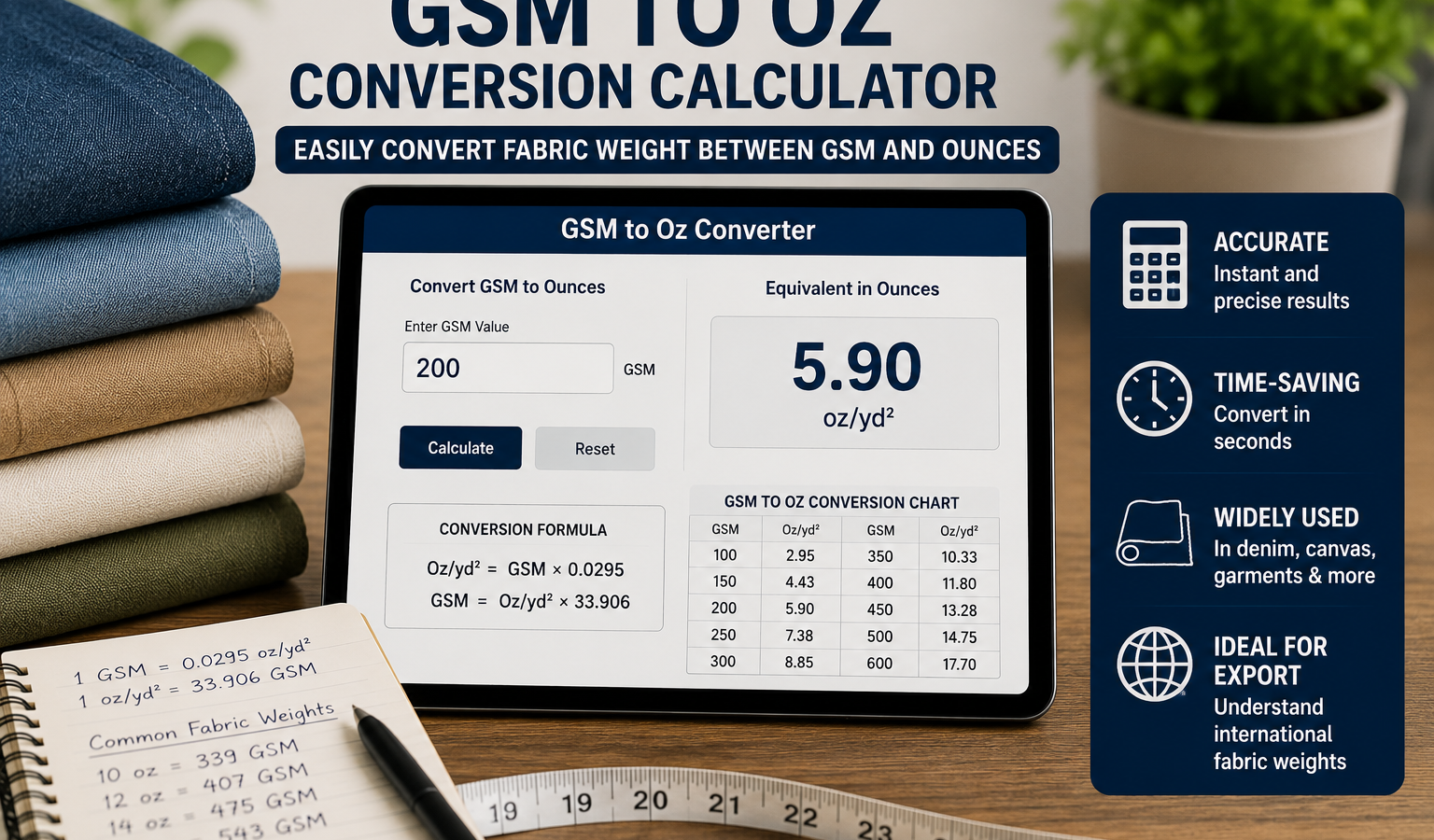
GSM to Oz Conversion Calculator
A GSM to Oz calculator simplifies fabric weight conversion instantly.
How to Use It
Step 1:
Enter GSM value.
Step 2:
Click calculate.
Step 3:
Get equivalent Oz value.
Example
Input:
200 GSM
Calculation:
200 × 0.0295
Output:
5.90 oz
Simple, accurate, and fast.
GSM to Oz Conversion Chart
Below is a quick reference chart used by many textile professionals.
| GSM | Oz |
|---|---|
| 100 GSM | 2.95 oz |
| 120 GSM | 3.54 oz |
| 150 GSM | 4.43 oz |
| 180 GSM | 5.31 oz |
| 200 GSM | 5.90 oz |
| 220 GSM | 6.49 oz |
| 250 GSM | 7.38 oz |
| 280 GSM | 8.26 oz |
| 300 GSM | 8.85 oz |
| 350 GSM | 10.33 oz |
| 400 GSM | 11.80 oz |
| 450 GSM | 13.28 oz |
| 500 GSM | 14.75 oz |
Many denim manufacturers keep this chart handy during buyer discussions.
Real-Life Example: Denim Fabric Conversion
A US buyer requests:
14 oz Denim
You need to determine the equivalent GSM.
Calculation:
14 × 33.906
Result:
474.68 GSM
Practical production target:
475 GSM
This conversion ensures the fabric meets buyer expectations.
Real-Life Example: Cotton Canvas Export
An Indian manufacturer produces:
350 GSM cotton canvas.
The buyer asks:
“What is the fabric weight in ounces?”
Calculation:
350 × 0.0295
Result:
10.33 oz
The manufacturer can confidently quote the product as:
10.3 oz Cotton Canvas Fabric
Common GSM Ranges and Their Oz Equivalents
Lightweight Fabrics
Typically:
80–150 GSM
Equivalent:
2.4–4.4 oz
Examples:
- Linings
- Summer shirts
- Scarves
- Fashion garments
Medium Weight Fabrics
Typically:
150–250 GSM
Equivalent:
4.4–7.4 oz
Examples:
- Polo shirts
- Uniforms
- Casual wear
Heavyweight Fabrics
Typically:
250–450 GSM
Equivalent:
7.4–13.3 oz
Examples:
- Denim
- Workwear
- Canvas
- Jackets
Industrial Fabrics
Typically:
450 GSM and above
Equivalent:
13 oz and above
Examples:
- Protective textiles
- Industrial covers
- Technical fabrics
Industries That Use GSM to Oz Conversion
Denim Manufacturing
Probably the most common application.
Denim buyers frequently use:
- 10 oz
- 12 oz
- 14 oz
- 16 oz
rather than GSM.
Garment Industry
International brands often specify fabric weights in ounces.
Textile Exports
Exporters regularly convert GSM into ounces while preparing quotations.
Technical Textiles
Industrial buyers may use either system depending on geography.
GSM vs Oz: Which Measurement Is Better?
Neither system is inherently superior.
They simply serve different markets.
GSM Advantages
✔ Widely used globally
✔ Easy to understand
✔ Common in textile mills
✔ Standardized metric system
Oz Advantages
✔ Popular in North America
✔ Common in denim trade
✔ Frequently used by fashion brands
For international textile businesses, understanding both systems is essential.
Common Mistakes During Conversion
Using Incorrect Conversion Factors
Many websites use rounded values.
Always use:
1 GSM = 0.0295 oz
for reliable results.
Confusing Fabric Weight and Thickness
Heavier fabric does not always mean thicker fabric.
Factors such as:
- Fiber type
- Yarn count
- Construction
also affect appearance and feel.
Ignoring Buyer Specifications
Always confirm whether the buyer refers to:
- oz/yd²
- oz/linear yard
These are not identical measurements.
Expert Tips for Textile Manufacturers
Keep Both Values on Product Specifications
Example:
65/35 Poly Cotton Twill
240 GSM
7.08 oz
This helps international buyers understand your product immediately.
Use Conversion During Product Development
When developing new fabrics for export markets, convert specifications before production.
This reduces sampling errors.
Train Sales Teams
Sales executives should understand:
- GSM
- Oz
- Fabric construction
- End-use applications
This improves customer confidence and closes deals faster.
Frequently Asked Questions
What is GSM in textiles?
GSM stands for Grams per Square Meter and measures fabric weight.
What does Oz mean in textiles?
Oz refers to Ounces per Square Yard, another fabric weight measurement system.
How do I convert GSM to Oz?
Multiply GSM by 0.0295.
How do I convert Oz to GSM?
Multiply Oz by 33.906.
What is 200 GSM in Oz?
200 GSM equals approximately 5.90 oz.
What is 12 oz denim in GSM?
12 oz denim equals approximately 407 GSM.
Why do US buyers use Oz instead of GSM?
The US textile industry traditionally uses ounces per square yard for fabric weight measurement.
Conclusion
A GSM to Oz Conversion Calculator is a simple but powerful tool for textile manufacturers, exporters, sourcing professionals, and garment buyers. As textile trade becomes increasingly global, understanding both measurement systems is no longer optional.
Whether you’re exporting denim to the USA, developing workwear fabrics for Europe, or sourcing cotton canvas for international customers, accurate GSM-to-Oz conversion ensures clear communication and better product consistency.
By understanding the conversion formula, using reliable calculators, and keeping both GSM and Oz values in your specifications, you can avoid misunderstandings, improve buyer confidence, and operate more effectively in global textile markets.
Leave a Reply