Introduction
The Indian textile industry has evolved dramatically over the last decade. Gone are the days when textile businesses could manage production, inventory, costing, and customer orders using spreadsheets and manual registers.
Today, textile manufacturers face increasing competition, fluctuating raw material prices, shorter delivery timelines, rising labor costs, and demanding global buyers. In such an environment, relying on manual processes can result in costly mistakes.
This is where Textile ERP Software becomes a game changer.
Whether you run a spinning mill, weaving unit, processing house, garment factory, home textile business, or fabric trading company, an ERP system helps integrate operations into a single platform.
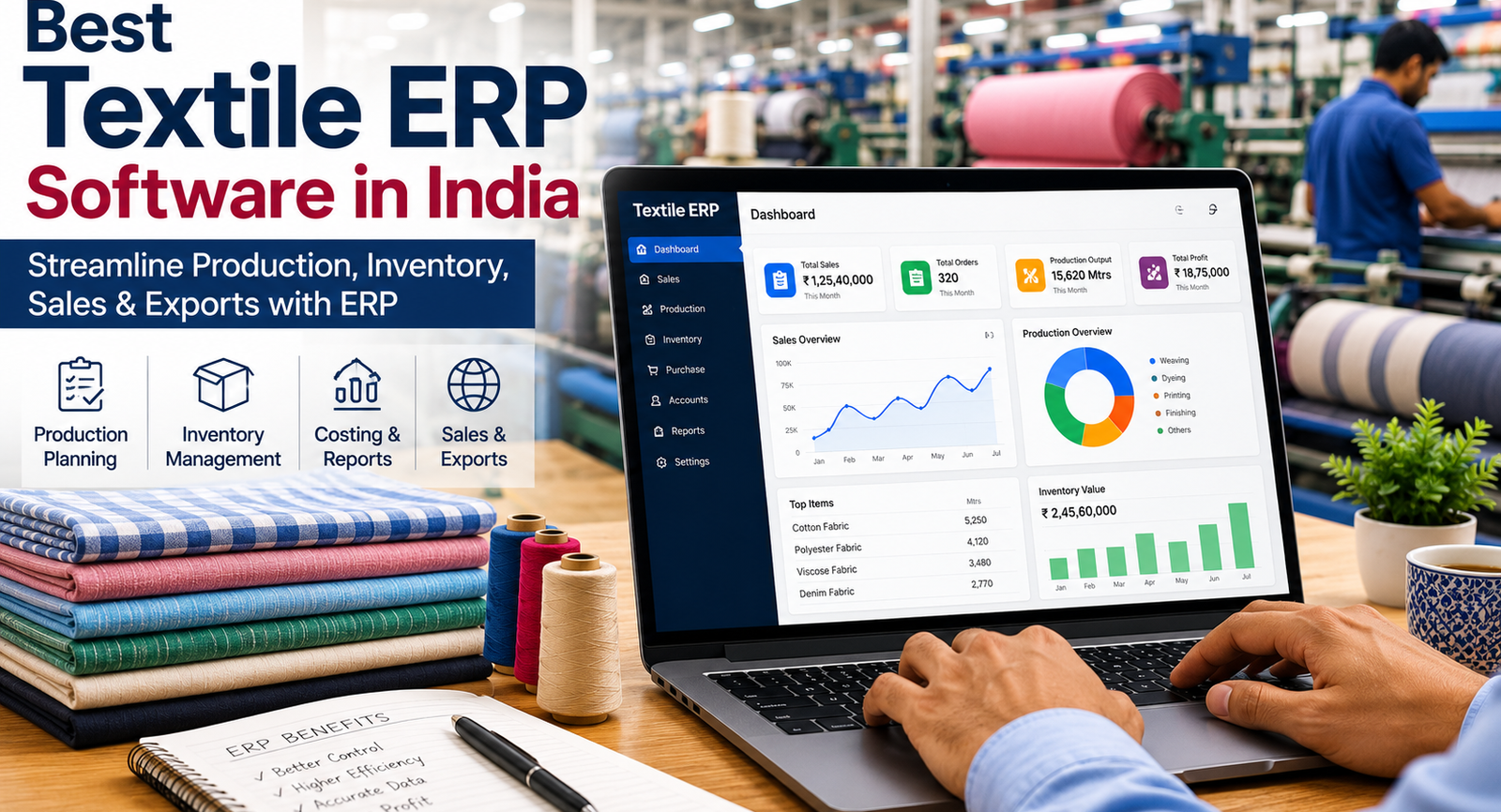
From yarn procurement and fabric production to inventory management, costing, sales, finance, and export documentation, a textile ERP can streamline every aspect of business management.
In this guide, we’ll explore the best textile ERP software in India, key features to look for, benefits, implementation strategies, costs, and expert recommendations to help you choose the right solution.
What Is Textile ERP Software?
ERP stands for Enterprise Resource Planning.
A Textile ERP is a specialized software solution designed specifically for textile and apparel businesses.
Unlike generic ERP systems, textile ERP software understands industry-specific requirements such as:
- Yarn management
- Fabric production
- Dyeing processes
- Weaving operations
- Garment manufacturing
- Batch tracking
- Fabric roll management
- Export documentation
- GSM calculations
- Production planning
The goal is simple:
Provide complete visibility and control over business operations.
Why Textile Businesses Need ERP Software
Many textile businesses start with spreadsheets.
Initially, it works.
However, as the business grows, problems begin to appear.
Common Challenges Without ERP
- Inventory mismatches
- Delayed deliveries
- Production inefficiencies
- Costing inaccuracies
- Duplicate data entry
- Poor customer tracking
- Slow decision making
These issues can directly impact profitability.
ERP software eliminates many of these bottlenecks by creating a centralized information system.
Key Benefits of Textile ERP Software
Improved Inventory Management
Inventory is one of the largest assets in a textile business.
ERP software helps track:
- Yarn stock
- Grey fabric inventory
- Dyed fabric inventory
- Accessories
- Finished goods
Real-time visibility reduces stock shortages and excess inventory.
Better Production Planning
Textile production involves multiple stages.
ERP software helps manage:
- Production schedules
- Machine allocation
- Capacity planning
- Job tracking
This improves efficiency and delivery performance.
Accurate Costing
Costing mistakes can destroy profit margins.
ERP systems provide detailed visibility into:
- Raw material costs
- Processing costs
- Labor costs
- Overheads
This enables more accurate pricing decisions.
Enhanced Customer Service
ERP software stores customer information in a centralized database.
Benefits include:
- Faster order tracking
- Improved communication
- Better service quality
Satisfied customers often become repeat buyers.
Faster Business Decisions
Real-time dashboards allow management to monitor:
- Sales
- Production
- Inventory
- Financial performance
Decision making becomes faster and more data-driven.
Features Every Textile ERP Should Have
Before selecting software, evaluate its features carefully.
Yarn Management Module
Useful for:
- Yarn purchase tracking
- Lot management
- Consumption monitoring
Especially important for spinning and weaving units.
Weaving Management
Tracks:
- Loom production
- Efficiency
- Machine performance
- Fabric output
Essential for weaving businesses.
Dyeing & Processing Module
Manages:
- Batch processing
- Chemical consumption
- Shade tracking
- Production scheduling
Critical for processing houses.
Fabric Inventory Management
Tracks:
- Fabric rolls
- GSM
- Width
- Shade
- Lot numbers
Reduces inventory errors significantly.
Garment Manufacturing Module
Supports:
- Cutting
- Stitching
- Finishing
- Packing
Ideal for apparel manufacturers.
Purchase Management
Handles:
- Supplier records
- Purchase orders
- Material receipts
Improves procurement efficiency.
Sales & Order Management
Tracks:
- Customer orders
- Delivery schedules
- Dispatches
- Invoicing
Provides end-to-end sales visibility.
Finance & Accounting
Most modern ERP systems integrate:
- Accounting
- GST compliance
- Banking
- Financial reports
Eliminating duplicate entries.
Export Documentation Module
Very useful for textile exporters.
Supports:
- Commercial invoices
- Packing lists
- Shipping documents
- Export compliance
Best Textile ERP Software in India
Let’s examine some of the leading ERP solutions used by textile companies.
1. Oracle NetSuite ERP
Best For:
Large textile manufacturers and exporters.
Strengths:
- Cloud-based
- Highly scalable
- Strong reporting
- Global operations support
Limitations:
- Higher implementation cost
2. SAP Business One
Popular among:
Mid-sized and large textile businesses.
Advantages:
- Strong analytics
- Enterprise-grade functionality
- Inventory management
Challenges:
- Complex implementation
3. Microsoft Dynamics 365
Suitable For:
Growing textile businesses requiring advanced automation.
Benefits:
- Cloud architecture
- Powerful reporting
- Integration with Microsoft ecosystem
4. Focus ERP
Widely adopted by textile businesses in India.
Strengths:
- Industry-specific customization
- Affordable pricing
- Local support
Popular among:
Fabric manufacturers and garment exporters.
5. ERPNext
An open-source ERP solution gaining popularity.
Advantages:
- Cost-effective
- Flexible
- Cloud deployment available
Ideal for:
Small and medium textile businesses.
6. Textile-Specific ERP Solutions
Several Indian ERP providers offer dedicated textile ERP platforms designed specifically for:
- Spinning mills
- Weaving units
- Processing houses
- Garment manufacturers
These solutions often include textile-focused workflows that generic ERP systems lack.
How Textile ERP Helps Different Segments
Spinning Mills
ERP manages:
- Cotton procurement
- Yarn production
- Waste monitoring
- Sales tracking
Weaving Units
Tracks:
- Loom efficiency
- Production planning
- Fabric inventory
Processing Houses
Manages:
- Dyeing schedules
- Chemical consumption
- Quality control
Garment Factories
Supports:
- Production planning
- Order management
- Inventory control
Home Textile Manufacturers
Handles:
- Bedsheet production
- Towel manufacturing
- Export documentation
- Customer orders
Real-Life Example
Consider a medium-sized fabric manufacturer.
Before ERP implementation:
- Inventory discrepancies every month
- Delayed customer deliveries
- Frequent stock shortages
After implementing a textile ERP:
- Inventory accuracy improved significantly
- Production planning became more predictable
- Customer satisfaction increased
Most importantly:
Management gained visibility into real-time business performance.
This is one of the biggest reasons ERP adoption continues to grow across the textile industry.
Cloud ERP vs On-Premise ERP
Choosing the right deployment model is important.
Cloud ERP
Advantages:
- Lower upfront investment
- Remote access
- Automatic updates
Disadvantages:
- Recurring subscription fees
On-Premise ERP
Advantages:
- Full control
- Internal hosting
Disadvantages:
- Higher infrastructure costs
- Maintenance responsibility
Most modern textile businesses are moving toward cloud-based ERP solutions due to flexibility and scalability.
How to Successfully Implement Textile ERP Software
Buying ERP software is only the first step.
The real challenge is implementation.
Many textile companies invest in ERP systems but fail to achieve expected results because of poor planning.
Step 1: Define Business Goals
Before selecting software, identify what problems you want to solve.
Examples:
- Inventory control
- Production planning
- Costing accuracy
- Export documentation
- Financial reporting
Clear objectives improve implementation success.
Step 2: Map Existing Processes
Document current workflows.
Examples:
- Purchase process
- Production process
- Sales process
- Dispatch process
Understanding existing operations helps customize ERP effectively.
Step 3: Data Migration
Import existing:
- Customer data
- Supplier records
- Inventory information
- Product masters
Poor data quality is one of the most common ERP implementation problems.
Step 4: Employee Training
Even the best ERP system fails if employees don’t know how to use it.
Invest in:
- User training
- Department-specific training
- Process documentation
Training reduces resistance and increases adoption.
Step 5: Go Live
After testing:
- Launch system
- Monitor performance
- Resolve issues quickly
Successful ERP projects often use phased implementation rather than switching everything at once.
Textile ERP Software Pricing in India
ERP pricing varies significantly.
Small Businesses
Approximate Cost:
₹50,000 to ₹5 lakh
Suitable for:
- Small garment factories
- Fabric traders
- Home textile businesses
Medium Businesses
Approximate Cost:
₹5 lakh to ₹25 lakh
Suitable for:
- Weaving units
- Processing houses
- Exporters
Large Enterprises
Approximate Cost:
₹25 lakh to several crores
Suitable for:
- Integrated textile mills
- Multi-location manufacturers
- Large exporters
Cloud Subscription Models
Many vendors now offer monthly subscriptions.
Typical range:
₹1,000 to ₹20,000+ per user per month
depending on functionality.
Calculating ERP Return on Investment (ROI)
Many business owners ask:
“Is ERP worth the investment?”
Let’s consider a simple example.
Before ERP
Annual losses due to:
- Inventory inaccuracies: ₹10 lakh
- Production delays: ₹8 lakh
- Manual errors: ₹5 lakh
Total Loss:
₹23 lakh
ERP Investment
Software + implementation:
₹12 lakh
After ERP
If ERP reduces losses by 50%:
Savings:
₹11.5 lakh annually
In many cases, ERP pays for itself within one to three years.
Signs Your Textile Business Needs ERP Immediately
Many businesses continue using spreadsheets longer than they should.
You likely need ERP if:
Inventory Records Are Inaccurate
Stock shown in records differs from physical stock.
Production Delays Are Increasing
Orders are consistently delivered late.
Multiple Departments Use Separate Systems
Sales, production, and accounts work independently.
Management Lacks Real-Time Information
Important decisions rely on outdated reports.
Customer Complaints Are Rising
Issues related to:
- Delivery
- Quality
- Communication
often indicate process inefficiencies.
Common ERP Implementation Mistakes
Understanding these mistakes can save significant time and money.
Mistake 1: Choosing Software Based Only on Price
The cheapest ERP is not always the best choice.
Focus on:
- Industry fit
- Scalability
- Support quality
Mistake 2: Ignoring Textile-Specific Requirements
Generic ERP systems may not understand:
- Yarn lots
- Fabric rolls
- Dye lots
- GSM tracking
Always verify industry-specific capabilities.
Mistake 3: Lack of Employee Involvement
Employees should participate in:
- Requirement gathering
- Testing
- Training
Ignoring users often leads to adoption issues.
Mistake 4: Poor Data Quality
Incorrect master data causes:
- Inventory errors
- Reporting problems
- Financial discrepancies
Clean data before implementation.
Mistake 5: Unrealistic Expectations
ERP improves processes but does not magically fix poor management practices.
Process improvement and ERP should work together.
Textile ERP Selection Checklist
Before purchasing ERP software, ask these questions.
Industry Fit
Does it support:
- Spinning
- Weaving
- Processing
- Garments
- Home textiles
Scalability
Can it support future growth?
Customization
Can workflows be adapted to your business?
Reporting
Does it provide:
- Production reports
- Inventory reports
- Financial reports
Mobile Access
Can management access information remotely?
Support
Does the vendor provide:
- Training
- Technical support
- Implementation assistance
Integration
Can it integrate with:
- Accounting software
- E-commerce platforms
- Shipping systems
Artificial Intelligence in Textile ERP
Modern ERP platforms increasingly use AI-powered tools.
Demand Forecasting
Predict future customer demand.
Inventory Optimization
Reduce excess inventory.
Production Scheduling
Improve machine utilization.
Quality Analysis
Identify recurring production defects.
Predictive Maintenance
Prevent machine breakdowns before they occur.
AI-enabled ERP systems are becoming increasingly important for competitive textile businesses.
Future of Textile ERP Software
The future of textile ERP is driven by:
Cloud Computing
Improved flexibility and accessibility.
IoT Integration
Machines automatically sending production data to ERP systems.
Mobile Applications
Real-time monitoring from smartphones.
Advanced Analytics
Better business intelligence and forecasting.
Sustainability Tracking
Monitoring:
- Energy consumption
- Water usage
- Carbon footprint
increasingly important for global buyers.
Success Story: Growing Textile Exporter
A textile exporter managing:
- Fabric inventory
- Export orders
- Production planning
across multiple locations faced frequent operational challenges.
Problems included:
- Duplicate inventory
- Delayed shipments
- Manual reporting
After implementing a textile ERP system:
- Inventory visibility improved
- Export documentation became faster
- Production planning became more accurate
- Customer satisfaction increased
Most importantly, management gained confidence in business data.
This is one of the strongest arguments for ERP adoption.
Frequently Asked Questions (FAQ)
What is Textile ERP Software?
Textile ERP software is a specialized business management system designed for textile manufacturers, exporters, garment factories, spinning mills, weaving units, and processing houses.
Which is the best ERP software for textile industry in India?
The best ERP depends on business size, budget, and requirements. Popular options include SAP Business One, Oracle NetSuite, Microsoft Dynamics 365, Focus ERP, ERPNext, and textile-specific ERP solutions.
How much does textile ERP software cost?
Costs range from ₹50,000 for small businesses to several crores for large enterprises.
Is ERP useful for small textile businesses?
Yes.
Even small businesses benefit from:
- Inventory control
- Costing accuracy
- Order management
How long does ERP implementation take?
Typical implementation timelines range from:
- 1–3 months for small businesses
- 6–12 months for large enterprises
depending on complexity.
Does ERP improve profitability?
ERP improves visibility, efficiency, and decision-making, which often leads to increased profitability.
Can ERP manage textile exports?
Yes.
Many ERP systems support:
- Export orders
- Documentation
- Shipping
- International customer management
Key Takeaways
✔ Textile ERP software helps manage production, inventory, costing, sales, and finance from a single platform.
✔ Industry-specific ERP systems provide better results than generic software.
✔ ERP improves efficiency, visibility, and decision-making.
✔ Cloud ERP adoption is increasing rapidly across the textile sector.
✔ Successful implementation requires planning, training, and process improvement.
✔ ERP investment often delivers measurable ROI through reduced inefficiencies.
✔ AI-powered ERP systems represent the future of textile business management.
Conclusion
In today’s competitive textile industry, operational efficiency is no longer optional. Businesses that continue relying on spreadsheets and disconnected systems often struggle with inventory errors, production delays, and poor visibility.
Textile ERP software provides a centralized platform that connects every aspect of operations, from yarn procurement and fabric production to sales, exports, finance, and customer management.
Whether you operate a spinning mill, weaving unit, processing house, garment factory, or home textile business, implementing the right ERP system can transform how your business operates.
The best ERP is not necessarily the most expensive one. It is the solution that aligns with your business size, industry requirements, growth plans, and operational challenges.
As technology continues evolving through cloud computing, artificial intelligence, and IoT integration, ERP systems will become even more essential for textile companies seeking long-term growth and global competitiveness.
Leave a Reply